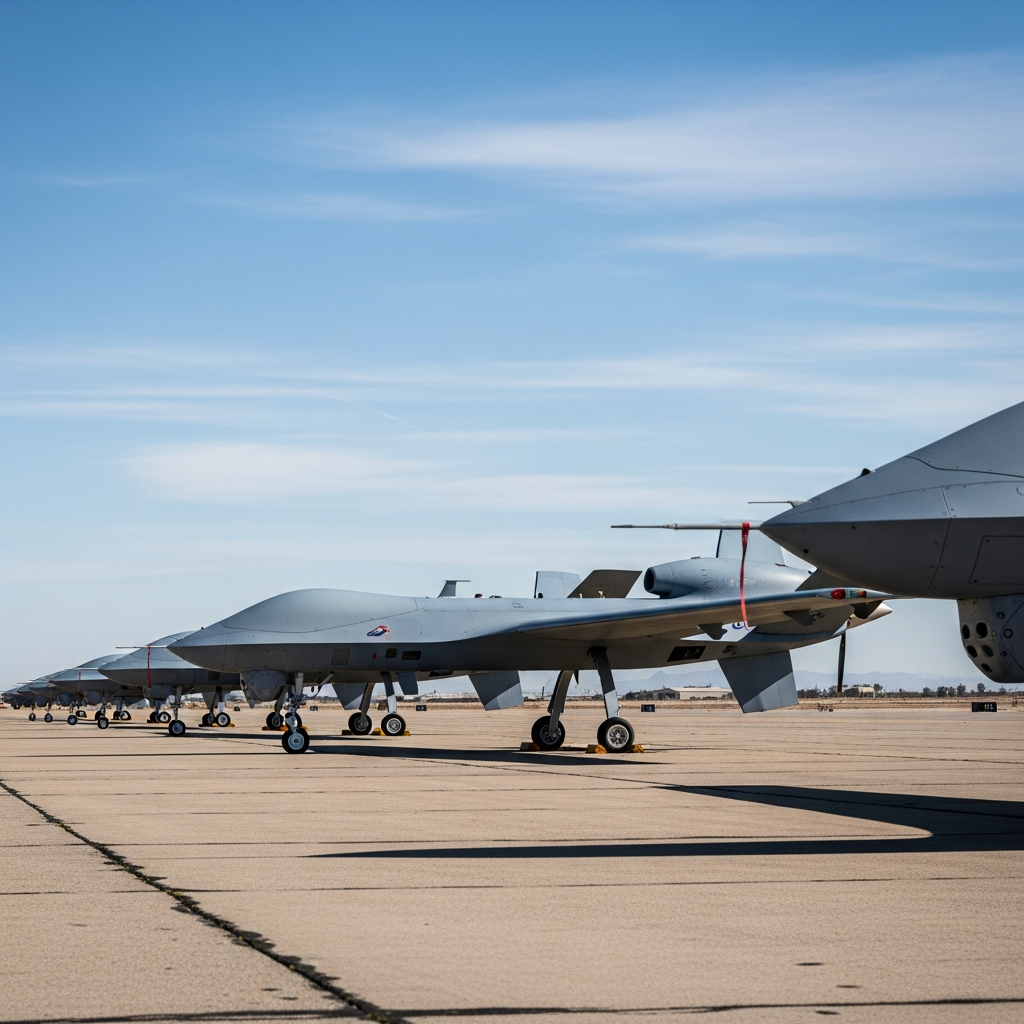
U.S. Central Command has stood up its first operational one-way attack drone squadron — and the weapon it flies is reverse-engineered from Iran’s own Shahed-136 kamikaze aircraft. CENTCOM confirmed the drones saw combat on February 28, 2026, during the opening salvos of Operation Epic Fury, the joint U.S.-Israeli campaign against Iran.
The unit is designated Task Force Scorpion Strike (TFSS). It operates under Special Operations Command Central and was formally announced on December 3, 2025. Its drones — designated LUCAS, or Low-Cost Uncrewed Combat Attack System — are built by Arizona-based SpektreWorks, a firm founded in 2018 that originally developed its FLM-136 as a Shahed-replica threat emulator for counter-drone training. That platform evolved directly into the weapon now being fired at the country that inspired it.
“We captured it, pulled the guts out, sent it back to America, put a little ‘Made in America’ on it, brought it back here and we’re shooting it at the Iranians.”
— Admiral Brad Cooper, CENTCOM Commander
The Aircraft
LUCAS shares the Shahed-136’s core aerodynamic DNA — delta wing planform, rear-mounted pusher propeller, canted vertical winglets. It’s slightly smaller, though. The LUCAS measures roughly 10 feet in length with an 8-foot wingspan, compared to the original’s 11-foot length and 8.2-foot wingspan. It carries up to 18 kilograms of explosives, has an autonomous range of roughly 500 miles (800 km), and costs somewhere between $10,000 and $55,000 per unit — with the average pegged around $35,000. That figure compares favorably, to put it mildly, with the $2.5 million Tomahawk it complements in the strike package.
Launch options include catapult, rocket-assisted takeoff, and vehicle-mounted systems. On December 16, 2025, USS Santa Barbara (LCS-32) conducted the first ship-launched LUCAS test in the Arabian Gulf, confirming a maritime strike dimension. The platform is also believed to leverage SpaceX Starshield — the military variant of Starlink — for beyond-line-of-sight connectivity, letting operators re-task drones mid-flight and coordinate salvos dynamically. Swarming capability is built in, enabling coordinated multi-drone attacks designed to saturate enemy air defenses and corridor through them ahead of more expensive munitions.
SpektreWorks received a $30 million APFIT contract in FY2025 to accelerate production. Manufacturing is deliberately spread across up to 20 vendors simultaneously — airframes and warheads produced in parallel — in what Pentagon testers have explicitly called a “Liberty Ship” production model.
Combat Record So Far
Since February 28, CENTCOM confirmed LUCAS has struck IRGC command centers, disabled Iranian air defense nodes, and hit missile launch sites alongside Tomahawks, HIMARS, and manned aircraft. On March 5, 2026, Admiral Cooper described the weapon as “indispensable” while declining to specify current target sets. That same month, Admiral Cooper reported Iranian drone attack rates had fallen 82 percent since Operation Epic Fury began — a metric TFSS operators will take some credit for.
“CENTCOM’s Task Force Scorpion Strike — for the first time in history — is using one-way attack drones in combat during Operation Epic Fury. These low-cost drones, modeled after Iran’s Shaheed drones, are now delivering American-made retribution.”
— U.S. Central Command
The historical irony runs deep. Iran spent decades producing unlicensed reverse-engineered American weapons — its Toophan ATGM is a direct clone of the BGM-71 TOW. The U.S. likely acquired its first intact Shahed specimens through Ukraine, where Russia had deployed thousands of Iranian-supplied units. The cost math that once favored Tehran — $35,000 drones forcing $4 million PAC-3 intercepts, a 114-to-1 exchange ratio — has now been picked up and turned around.
What Comes Next
The U.S. Marine Corps is separately evaluating LUCAS at the U.S. Army’s Yuma Proving Ground. Former Deputy Assistant Secretary of Defense for Force Development and Emerging Capabilities Michael Horowitz has already framed extended-range LUCAS variants as a potential tool to “flood the space with munitions” and complicate Chinese air defense math in a Pacific scenario. CENTCOM spokesman Capt. Tim Hawkins confirmed the squadron “continues to evolve” — language that suggests capability upgrades are already in the pipeline. We’ll continue to track TFSS operations and any formal Marine Corps procurement decision as they develop.



Stay in the loop
Get the latest aircraft insider updates delivered to your inbox.