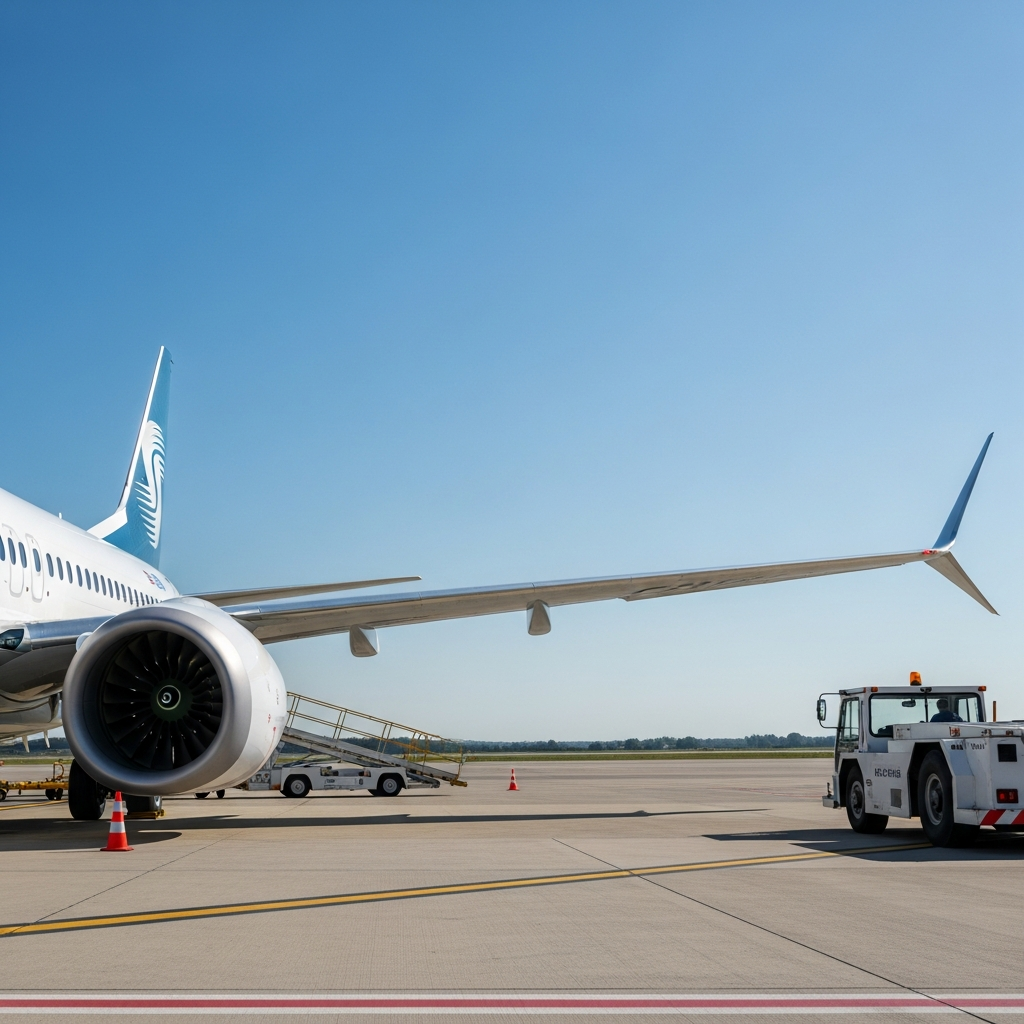
Boeing CEO Kelly Ortberg confirmed on the company’s Q1 2026 earnings call on April 22 that the manufacturer plans to push 737 MAX production from 42 to 47 aircraft per month this summer — a milestone that depends on a fourth final assembly line now operating in Everett, Washington, the first time a MAX has ever been built outside Renton’s traditional facility.
Ortberg told analysts and investors that “all systems are go for this next rate increase,” pointing to a synchronized supply chain and a nearly 20% reduction in final assembly rework hours compared with Q1 2025. He also confirmed Boeing expects FAA type certification of both the long-delayed 737 MAX 7 and 737 MAX 10 variants before the end of 2026, with first deliveries for each planned in 2027.
The Production Ramp — What It Takes to Get to 47
Getting from 38 to 47 aircraft per month has been methodical — and FAA-controlled every step of the way. The agency imposed a hard production cap of 38 per month shortly after Alaska Airlines Flight 1282 suffered a mid-cabin door plug blowout on January 5, 2024, a manufacturing defect that triggered one of the most intensive regulatory crackdowns in the 737 program’s history. The FAA approved a step up to 42 per month in October 2025. Then, as of March 2026, it formally replaced that numerical cap with a performance-based oversight model tied to six agreed KPIs covering escapes, rework, travelled work, shortages, and ticketing performance.
Any increase beyond 47 aircraft per month still requires explicit FAA approval — a condition Ortberg embraced rather than resisted. Boeing’s roadmap targets 52 per month via activation of the Everett North Line, with 53 aircraft monthly described as the next sequential milestone beyond that. That’s the rate analysts consider the threshold for making a meaningful dent in Boeing’s backlog of more than 4,800 737 orders.
“We’re hearing very good things about the quality of our airplanes,” Ortberg said in an appearance on CNBC’s Squawk on the Street following the earnings release. “We’re delivering high-quality commercial and defense products and services, while increasing production to uphold our customer commitments and get back to the iconic global aerospace company that leads our industry.”
Management also addressed a wiring nonconformance that pushed approximately 25 first-quarter 737 deliveries into Q2. Ortberg said all affected aircraft have been reworked, most already delivered, and the issue will not alter full-year delivery targets or the summer rate increase plan.
MAX 7 and MAX 10 — Final Certification Push
The 737 MAX 7 and MAX 10 have been trapped in certification limbo for years, held up by two distinct technical problems. The first: a CFM LEAP-1B engine anti-ice system that can overheat the carbon-composite inlet under certain conditions, risking structural damage or debris release. The second: a congressionally mandated crew alerting system update required in the wake of the 2018–2019 fatal crashes. Boeing disclosed in early 2024 that it needed a full year to redesign the anti-ice system — a delay that cascaded into 2025 and beyond.
The MAX 10 entered Phase 2 of its Type Inspection Authorization flight testing in late December 2025, with Phase 2 flights beginning in early January 2026. Ryanair CEO Michael O’Leary has said that Boeing projected MAX 7 certification in Q2 2026 and MAX 10 in Q3. Southwest Airlines CEO Bob Jordan has separately indicated he expects MAX 7 certification by August 2026, with Southwest as launch operator. The FAA’s own administrator, Bryan Bedford, told Bloomberg on April 22: “We haven’t seen anything today that would indicate that Boeing would not be able to meet certification before the end of the year.”
“They’re pretty confident that they’ll certify the MAX 7 in Q2 and the MAX 10 in Q3 — about six months in advance of our first 15 MAX 10 deliveries in the spring of 2027,” O’Leary said.
The commercial stakes are hard to overstate. Boeing holds approximately 300 firm orders for the MAX 7 and approximately 1,400 for the MAX 10 — including 277 from United Airlines, 150 from Ryanair, and 105 from Alaska Airlines. The MAX 10 remains Boeing’s primary answer to the Airbus A321neo in the high-capacity narrowbody segment, despite carrying a 14-seat disadvantage at maximum density.
Financial Picture and What Comes Next
Boeing Commercial Airplanes delivered 143 aircraft in Q1 2026 — beating Airbus’s 114 for the quarter. It was Boeing’s first quarterly delivery win over its European rival since approximately Q1 2019. Segment revenue rose 13% year-over-year to $9.2 billion. CFO Jay Malave projected positive free cash flow of $1 billion to $3 billion for the full year, weighted toward the second half.
The summer production numbers will be telling. If Boeing successfully sustains 47 aircraft per month through Q3, the case for FAA approval of a step to 52 — and the activation of the Everett North Line at meaningful rate — becomes substantially stronger. Certification timelines for the MAX 7 and MAX 10 are the other critical variable; any further slippage would ripple directly into 2027 delivery commitments to Southwest, Ryanair, and Alaska.
Stay in the loop
Get the latest aircraft insider updates delivered to your inbox.