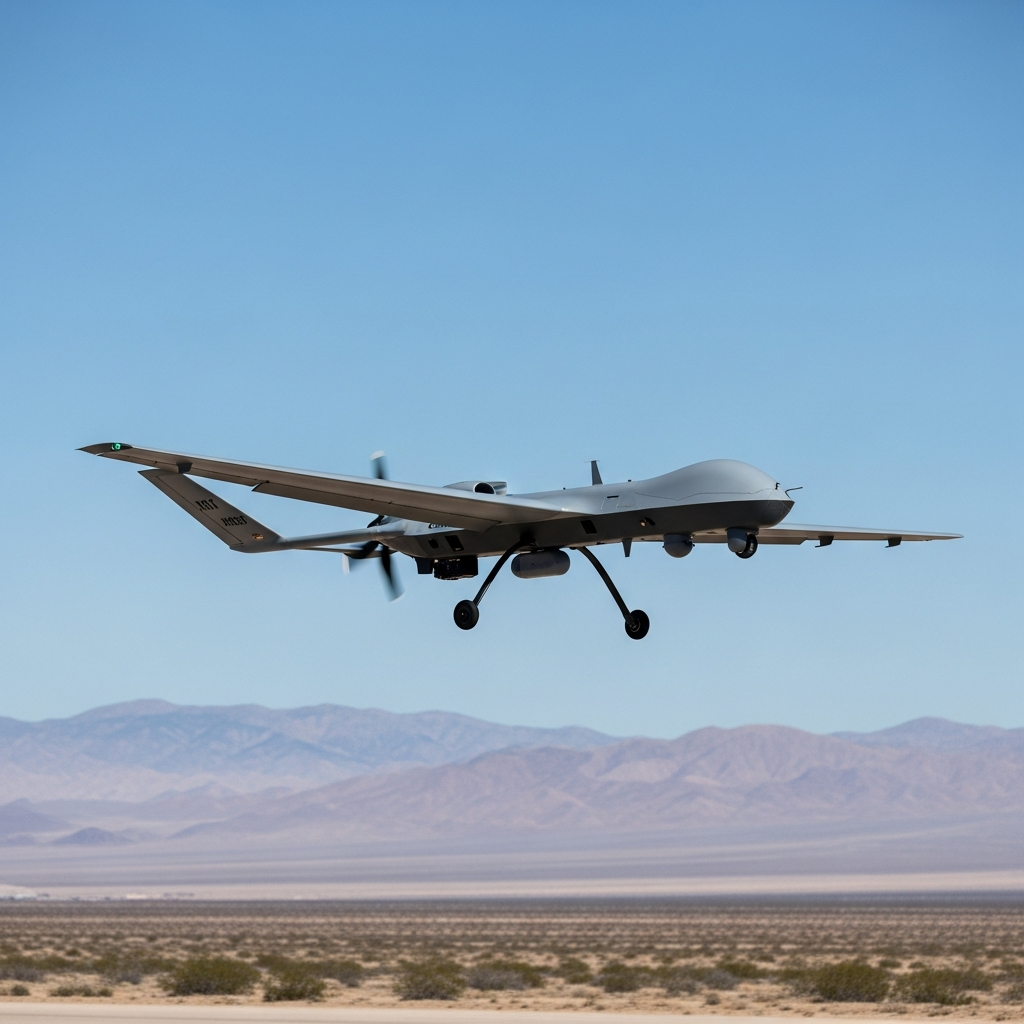
DARPA’s XRQ-73 SHEPARD hybrid-electric unmanned aircraft made its first flight on April 14, 2026, at Edwards Air Force Base, California. The agency said nothing about it for three weeks — only publicly confirming the event on May 6. That deliberate silence is telling. SHEPARD is being developed under a level of secrecy that suggests its operational implications go well beyond a routine technology demonstration.
Built by Northrop Grumman Aeronautics Systems — with Scaled Composites handling prototyping and flight test support — the XRQ-73 is a tailless, blended-wing-body platform weighing approximately 567 kg (1,250 lbs). That puts it squarely in the U.S. military’s Group 3 UAS category, covering aircraft operating between 3,500 and 18,000 feet at speeds between 100 and 250 knots. The airframe’s swept wings, large vertical winglets, and two primary dorsal air intakes flanking a smaller auxiliary dorsal intake give it a family resemblance to Northrop’s B-2, B-21, and X-47B, and to Lockheed Martin’s RQ-170 Sentinel.
A Series Hybrid Architecture — Not Just a Quieter Motor
The propulsion concept is the heart of the program. SHEPARD uses a series hybrid-electric architecture: an onboard gas turbine generator burns conventional fuel to produce electricity, which drives electric motors powering the aircraft’s propulsors while simultaneously charging onboard batteries. The turbine runs at its optimal RPM for efficiency regardless of flight demand. The electric motors, meanwhile, deliver instant and precise power response. That arrangement sidesteps the core limitation of pure-electric aviation — battery energy density — by using the turbine as a range extender.
The acoustic payoff is real. Electric propulsors are inherently quieter than conventional jet or piston powerplants, and the hybrid setup also reduces infrared signature by allowing lower, more consistent exhaust temperatures. Acoustic stealth tends to get overlooked next to radar cross-section management in these discussions — but ground-based sensors and human observers can cue on engine noise long before an aircraft is visually acquired. SHEPARD addresses that gap directly.
“This milestone is not just about a single flight. The architecture proven by the XRQ-73 paves the way for new types of mission systems and delivered effects. We look forward to advancing this technology through the flight test program and delivering new capabilities for our warfighters.” — Lt. Col. Clark McGehee, SHEPARD Program Manager, DARPA
Lineage — From Great Horned Owl to SHEPARD
The XRQ-73 didn’t emerge from nothing. It descends directly from the XRQ-72, developed under the Air Force Research Laboratory’s Great Horned Owl program in partnership with IARPA. That earlier effort focused on slashing acoustic signatures without sacrificing endurance or payload — objectives SHEPARD inherits at larger scale. The XRQ-73 is heavier and more capable than its predecessor, with internal engines replacing the XRQ-72A’s externally mounted fans. A large ventral fairing almost certainly houses a sensor or payload suite intended for covert ISR missions.
First-flight imagery shows the aircraft parked on Rogers Dry Lake — the same hardpan expanse that once caught returning Space Shuttles and X-15 flights — rather than on a conventional runway. Black wool tuft strips are visible on the wings in released photos, used to visualize airflow during early test work. Those will come off as the campaign matures.
What Comes Next
Lt. Col. McGehee described a “short flight test campaign” to The War Zone, with objectives centered on propulsion performance, handling qualities, efficiency validation, and autonomous operations. DARPA has been clear that the goal is technology maturation, not direct procurement of the XRQ-73 airframe itself — the agency wants to de-risk hybrid-electric propulsion so it can migrate into future platforms across multiple mission sets.
One open question: a cursory review of DARPA’s proposed FY2027 budget does not appear to show a request for new funding for SHEPARD. That raises the possibility the program has been reorganized, rebranded, or has otherwise evolved in scale or scope — which is not uncommon for DARPA projects. General Atomics’ competing GHOST hybrid drone program adds competitive pressure for rapid development.
The flight test campaign at Edwards is ongoing. Given the agency’s three-week silence on the first flight, real-time updates seem unlikely — but the program bears watching as results emerge.
Sources
- DARPA Official Press Release — darpa.mil
- Northrop Grumman Corporate Statement — northropgrumman.com
- The War Zone — twz.com
- FlightGlobal — flightglobal.com
- DefenseScoop — defensescoop.com
- The Aviationist — theaviationist.com
- Army Recognition — Aerospace News
- Interesting Engineering — interestingengineering.com


Stay in the loop
Get the latest aircraft insider updates delivered to your inbox.