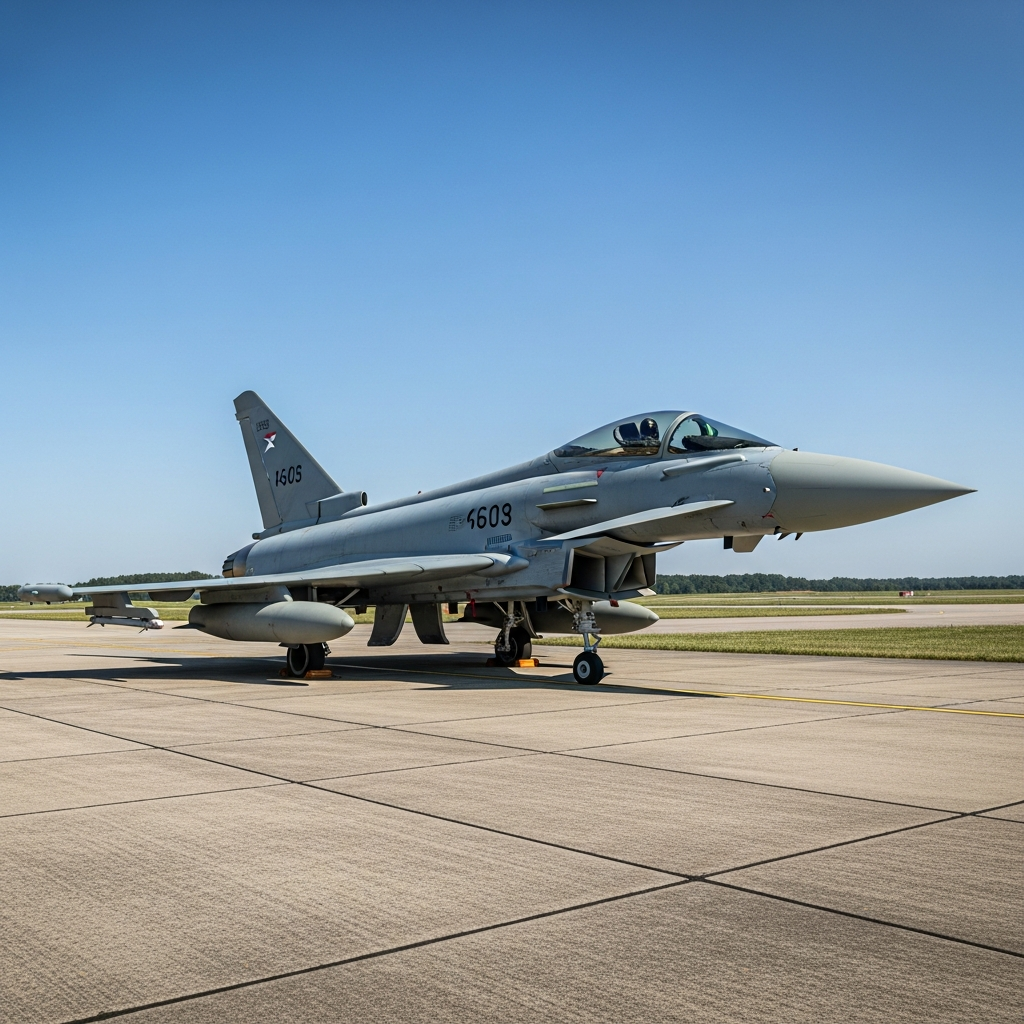
Austrian Air Force Eurofighter Typhoons scrambled on two consecutive days — May 10 and 11, 2026 — to intercept U.S. Air Force PC-12-type aircraft, almost certainly U-28A Dracos operated by Air Force Special Operations Command. The trigger: administrative confusion over overflight clearances that pushed Austria to its highest-level air defense response.
Austrian Ministry of Defence spokesperson Michael Bauer confirmed Monday’s incident publicly via X on May 11, posting in German: “Priority A activation and deployment of two Eurofighters due to overflight of two PC-12s of the US Air Force at 12:31 for identification purposes.” Priority A is the ceiling — the highest urgency classification in Austrian air defense protocols, the same threshold that puts armed fighters airborne within minutes.
What Happened — Day by Day
The first incident unfolded on Sunday, May 10. A valid overflight permit had been filed for two PC-12-type aircraft routing from RAF Mildenhall, UK to Bucharest. At approximately 14:10, though, two different USAF aircraft approached Austrian airspace unannounced — no clearance, no warning. Eurofighters scrambled, made visual contact over the Totes Gebirge mountain range in Upper Austria — over 60 kilometers from the German border — and the American aircraft turned back toward Munich.
Monday, May 11. Same scenario. At 12:31 p.m., Austrian fighters were again ordered airborne under Priority A. The U.S. aircraft, once intercepted, again altered course toward Munich. Bauer noted it was initially unclear whether Monday’s aircraft held the necessary clearances.
By May 13, the picture had clarified. U.S. European Command told Defense News:
“This flight took place after an administrative error in the overflight clearance paperwork was corrected. The United States continues to work closely with Austrian authorities on any questions regarding overflights and fully complies with Austrian laws and procedures.”
Bauer confirmed that, contrary to initial German-language media reports, no unauthorized airspace violation appears to have occurred. The matter, he said, would “be resolved through diplomatic channels.”
The Aircraft Involved
The U-28A Draco is a Pilatus PC-12 airframe militarized for AFSOC — operated by the 34th, 318th, and 319th Special Operations Squadrons as well as the 919th Special Operations Wing, Air Force Reserve Command, based primarily at Cannon AFB, New Mexico and Hurlburt Field, Florida. Single-engine turboprop. It carries a sensor turret with electro-optical, infrared, and SIGINT systems, and recent upgrades under the classified EQ+ configuration add a new sensor turret with a high-definition, multi-spectral imaging full-motion video camera with better standoff range. Service ceiling of 30,000 feet, range of 1,500 nautical miles — well-suited for long transits across Europe. The GAO estimated close to 40 U-28As remained in service as of late 2023; AFSOC plans to retire the fleet by 2029 in favor of the OA-1K Skyraider II.
On the Austrian side: Eurofighter Typhoon EF2000s — a fleet of 15 aircraft delivered beginning in 2007 and dedicated exclusively to the air policing mission. Austria’s Typhoons carry no air-to-ground capability whatsoever. Two aircraft plus one reserve are maintained at continuous readiness, armed with the Mauser 27mm cannon and Diehl BGT IRIS-T short-range missiles.
Diplomatic and Strategic Context
The timing is pointed. Austria had already barred U.S. military overflights connected to Operation Epic Fury — the ongoing U.S. air campaign against Iran — making it one of five European nations to do so. Austrian Vice Chancellor Andreas Babler stated publicly that Austrians want “nothing to do with Trump’s politics of chaos and his war.” The incidents also coincided with Trojan Footprint 2026, a major SOF exercise running May 11 to 22 across multiple European countries — which may help explain the spike in AFSOC aircraft movements through the Alpine corridor, though no direct causal link has been confirmed.
This isn’t the first time the U.S. has bumped against Austrian airspace sensitivities. In 2002, Austrian Air Force Drakens intercepted a KC-10A Extender flying two F-117A Nighthawks in close formation beneath it — an incident that ended in a formal diplomatic protest lodged at the U.S. Embassy in Vienna.
Austria’s geography makes the Alpine corridor a natural routing between Germany and Italy or the broader Middle East theater. Nine authorized USAF overflights of Switzerland were reported in the same three-day window, suggesting elevated U.S. military transit activity across the region was hardly limited to Austrian airspace.
Whether EUCOM or AFSOC provide further clarification on the specific missions involved — or whether Austria’s foreign ministry issues a formal statement beyond Bauer’s social media posts — remains to be seen.
Stay in the loop
Get the latest aircraft insider updates delivered to your inbox.