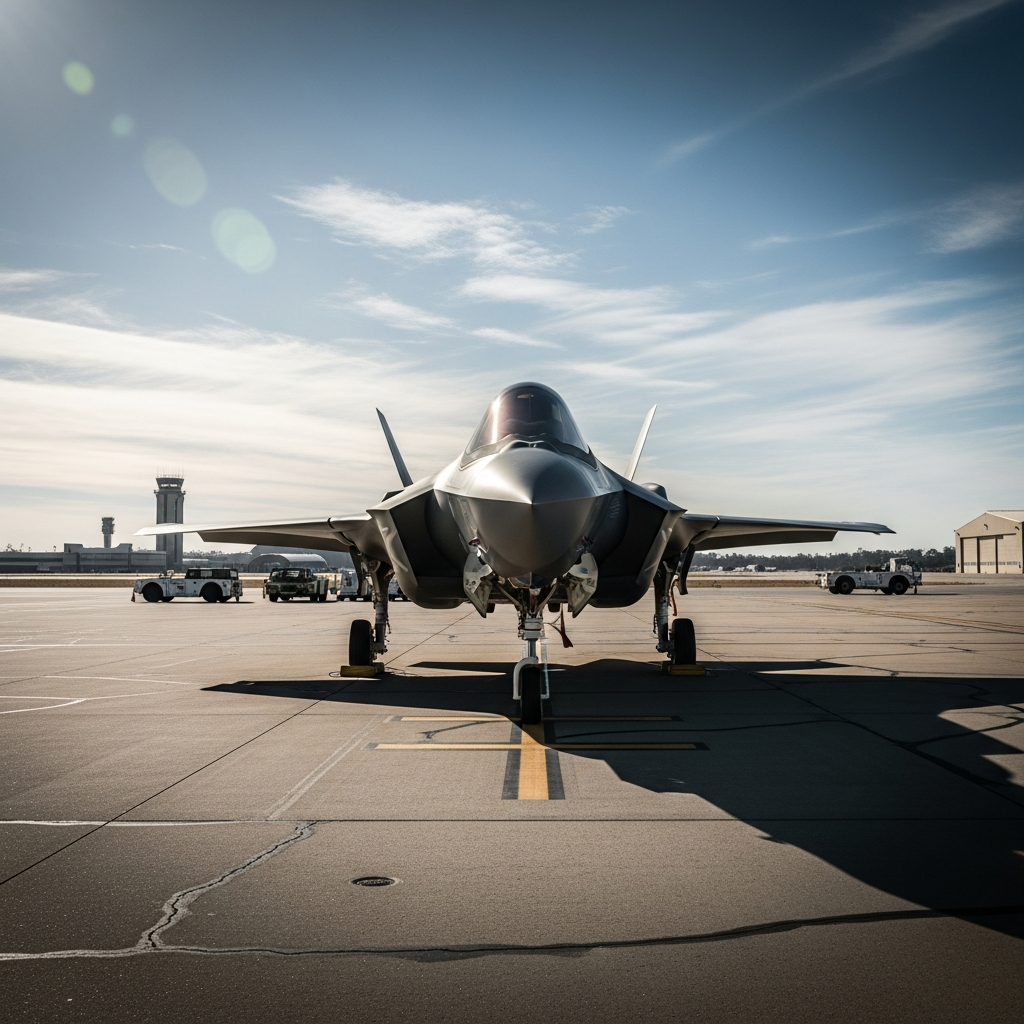
In late May, an F-35 Lightning II and a General Atomics MQ-20 Avenger unmanned jet demonstrated coordinated combat operations in a test—a significant milestone for the Pentagon’s strategy to dominate contested airspace through manned-unmanned teaming.
GA-ASI announced the demonstration on May 27, 2026. An F-35A pilot, working from the ground with a cockpit tablet interface, sent tactical autonomy commands to the MQ-20 via beyond-line-of-sight satellite datalink. The unmanned jet executed the assigned maneuvers, adjusted waypoints, and fired back critical track data—location, altitude, velocity—through a tactical proliferated low Earth orbit data link. This was a controlled test of the integration concept underlying the Air Force’s Collaborative Combat Aircraft (CCA) strategy.
The test validated the hardware, software, networks, and command protocols underlying the Air Force’s Collaborative Combat Aircraft (CCA) concept: pairing crewed fifth-generation fighters with large numbers of highly autonomous unmanned wingmen.
How It Worked — And Why It Matters
The F-35 pilot, positioned on the ground, issued commands through a Bashi Pilot Vehicle Interface. Those orders traveled via satellite to the MQ-20, where General Atomics’ TacACE (Tactical Autonomy Ecosystem) software executed the maneuvers autonomously. The MQ-20 itself—powered by a single Pratt & Whitney PW545B turbofan—operates at speeds exceeding 400 knots and altitudes above 50,000 feet, with more than 20 hours of endurance.
What makes this different: the F-35 pilot wasn’t remote-piloting an unmanned aircraft like a traditional ISR drone. Instead, high-level tactical directives flowed to the MQ-20’s autonomy stack, which interpreted and executed them independently. Scale that up. One crewed fighter can command multiple unmanned wingmen simultaneously, each responding to strategic intent rather than demanding continuous manual control.
“This significant warfighter integration milestone is the beginning of operational readiness for the Collaborative Combat Aircraft,” said Michael Atwood, Vice President of Advanced Programs at GA-ASI. “Events like these drive home GA-ASI’s continued commitment to adoption of next-generation data links, mission autonomy, and unmanned air combat operations.”
The MQ-20 as CCA Surrogate
The MQ-20 Avenger—formerly Predator C—has been the primary test bed for CCA integration over the past five years. It carries an S-shaped exhaust for reduced infrared signature and a 20-meter swept wing, holding up to 3,000 pounds of payload internally and 6,500 pounds total. Sensors include the Lynx synthetic aperture radar and an ALERT targeting pod derived directly from the F-35’s electro-optical system.
The F-35 demonstration carries significant weight as a validation milestone. The Lightning II is the backbone of allied air forces worldwide, making F-35-to-CCA integration a genuine multinational capability pathway.
What’s Next
Congress moved fast. On May 26—a single day before GA-ASI’s announcement—lawmakers included expanded CCA funding in the latest National Defense Authorization Act draft. The Air Force targets the late 2020s for fielding the first operational CCA units, with initial operational capability by 2030. Two platforms are in competition: GA-ASI’s YFQ-42A (Dark Merlin) and Anduril’s YFQ-44A, both undergoing weapons integration and operational testing at Nellis AFB.
Future air dominance belongs to distributed human-machine teams, not isolated crewed fighters. For the Air Force’s $8.9 billion CCA investment through fiscal 2029, that integration pathway now has proof.
Sources
- Combat Aircraft Magazine
- General Atomics Aeronautical Systems Press Release, May 27, 2026
- Air & Space Forces Magazine
- The Aviationist
- Army Recognition
- Aviation A2Z
Stay in the loop
Get the latest aircraft insider updates delivered to your inbox.