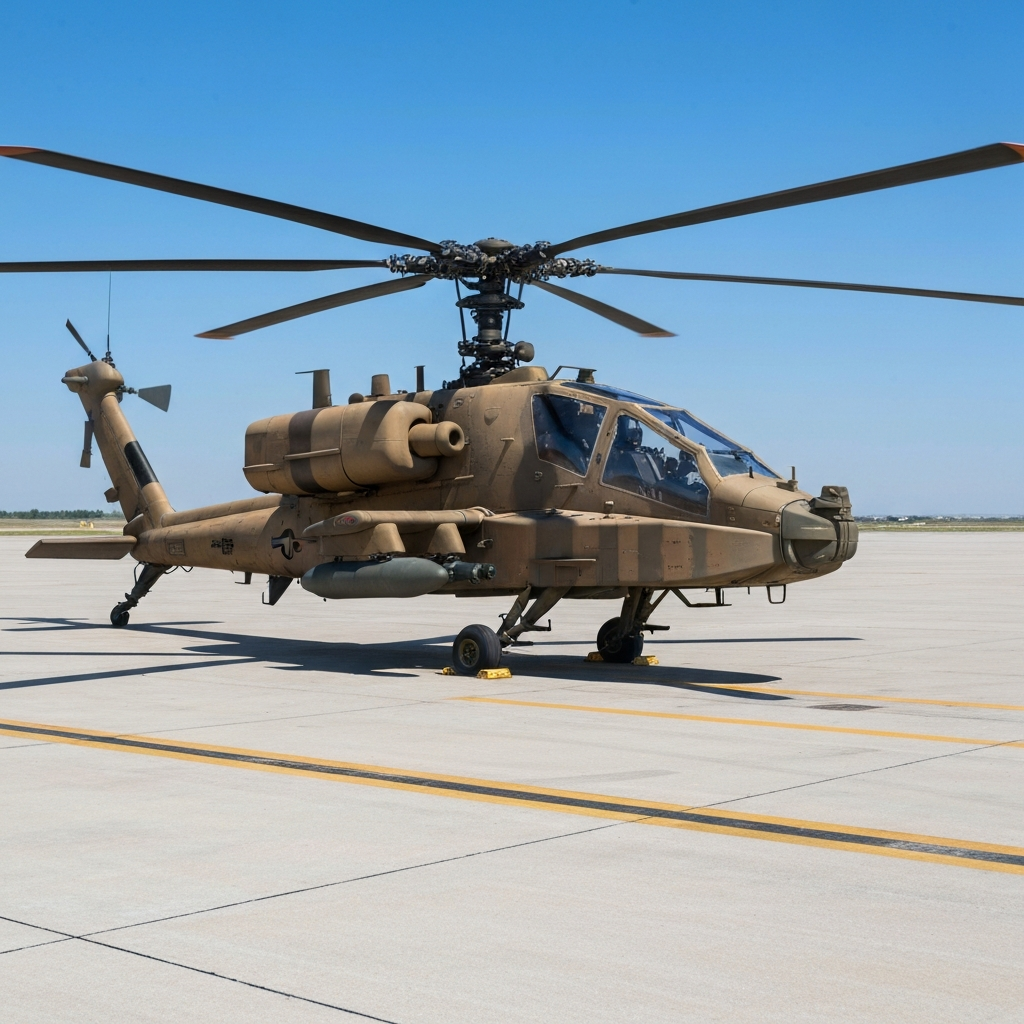
An Iranian Shahed drone brought down an AH-64E Apache helicopter assigned to the 82nd Airborne Division near the Strait of Hormuz on Monday night. The U.S. military responded with immediate “self-defense strikes” against Iranian air defense, radar, and command sites Tuesday evening — marking the first loss of a crewed American aircraft to direct Iranian fire in the current conflict.
The Apache went down at approximately 10:00 p.m. GMT (6:00 p.m. ET) on June 8, 2026, off the coast of Oman. Both pilots ended up in the water, but here’s where the operation became historic: a U.S. Navy unmanned surface vessel pulled them out within roughly two hours. It was the first time the American military had ever conducted a combat rescue using maritime drones. Both aviators are in stable condition.
President Trump announced the incident via Truth Social on Tuesday morning. “I have just been informed by our Great Military that last night the Iranians shot down one of our highly sophisticated Apache Helicopters while patrolling over the Strait of Hormuz,” he wrote. During the retaliatory strikes, he told ABC News’ Jonathan Karl: “They shot down a helicopter, and we are responding as we speak.”
The Rescue Operation — First of Its Kind
The recovery operation itself represented a turning point in combat rescue doctrine. A 24-foot Corsair unmanned surface vessel, built by Saronic Technologies and operated by Task Force 59 (the U.S. Navy’s dedicated unmanned systems task force), found the pilots and ferried them to a recovery point where a helicopter hoisted them aboard. Throughout the operation, Air Force and Navy fighters — including MQ-9 Reapers — provided overhead cover.
CENTCOM spokesman Captain Tim Hawkins confirmed what made this significant: it was the first combat rescue the U.S. military had ever pulled off using maritime drones. Task Force 59, based in Bahrain since its establishment in September 2021, exists specifically to weave unmanned systems and artificial intelligence into fleet operations across the Fifth Fleet’s territory.
The Retaliatory Strike Response
At 5 p.m. ET on Tuesday, June 9, CENTCOM announced the counterattack. “The mission is a proportional response to unjustified Iranian aggression,” the command said on social media. U.S. Air Force and Navy fighter jets went after Iranian air defense systems, ground control stations, and surveillance radar concentrated near the Strait of Hormuz and on Qeshm Island. Iranian state media reported explosions across Sirik, Jask, Bandar Abbas, and Qeshm. The strikes lasted roughly four hours, wrapping up shortly after 9 p.m. ET.
Iranian Retaliation Escalates Tensions
Iran’s Islamic Revolutionary Guard Corps fired back early Wednesday morning. The IRGC claimed it targeted U.S. naval facilities in Bahrain with drones and the Muwaffaq Salti Air Base in Jordan with long-range solid-fuel missiles. Sirens went off in Kuwait — suggesting possible strikes aimed at Ali Al Salem Air Base. U.S. officials said nearly all incoming missiles and drones got intercepted, with no American casualties or significant damage reported.
Operational Significance
This marks the first Apache lost to enemy fire since the Iraq War. It’s also the first manned U.S. aircraft downed by Iran in this conflict. Iran had shot down unmanned American aircraft before — more than 30 MQ-9 Reapers and at least one MQ-1 Predator. An F-15E Strike Eagle was lost on April 3, 2026, though under noncombat circumstances.
The Shahed-136 one-way attack drone — essentially a slow-moving cruise missile — illustrates a changing threat landscape. Apache crews operating in the Persian Gulf now confront man-portable air defense systems, FPV drones, and loitering munitions carried on Iranian naval assets.
Aviation observers will be watching closely to see if this escalation triggers more Iranian retaliation or additional U.S. strikes, and whether diplomacy can survive the current kinetic operations.
Sources
- The Aviationist
- Aviation Week & Space Technology
- U.S. Central Command Official Statements
- CBS News Military Correspondent David Martin
- The Washington Post
- CNN Pentagon Correspondent Barbara Starr
- Stars & Stripes
- Axios


Stay in the loop
Get the latest aircraft insider updates delivered to your inbox.