Verified update — July 30, 2026: This was an early status report. CENTCOM later confirmed that both crew members were safely recovered in separate missions completed April 4. Read the official-source F-15E shootdown and rescue account for the confirmed timeline and the details that remain unverified.
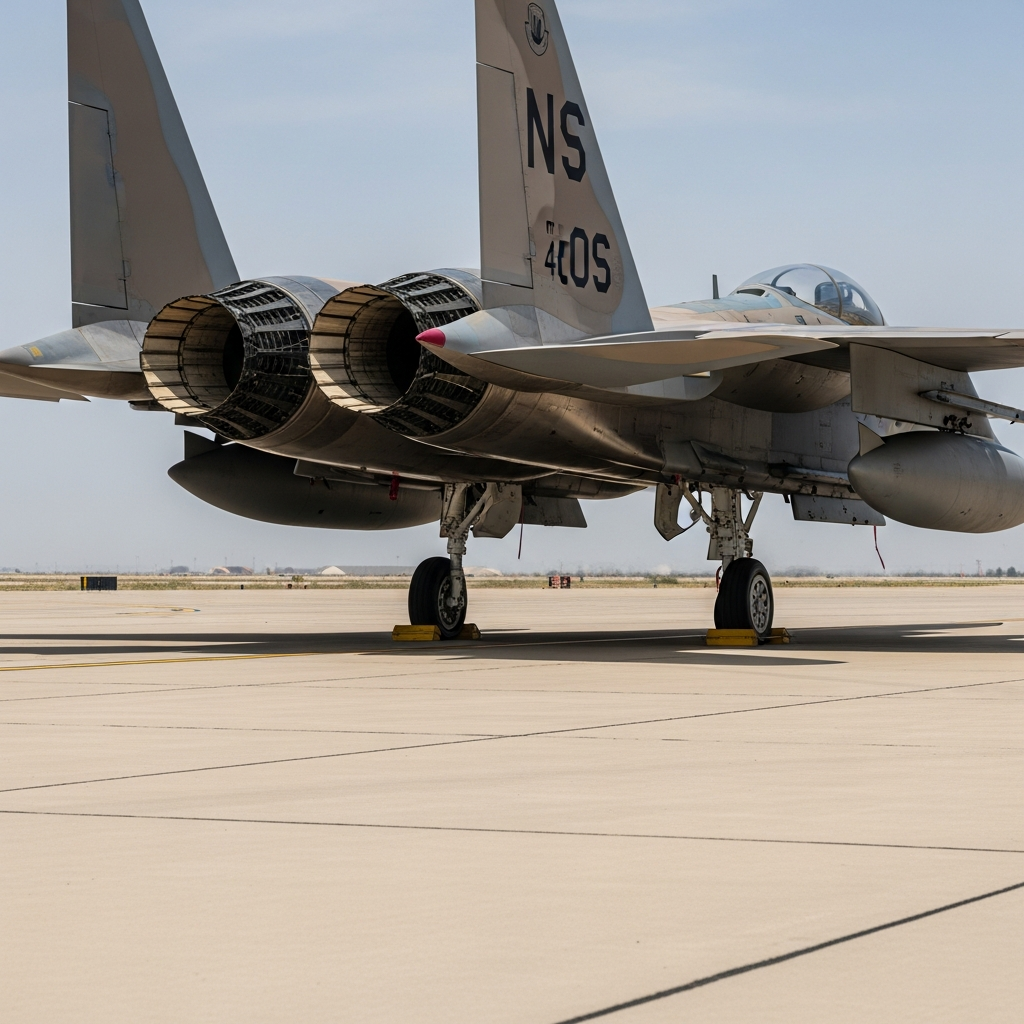
An F-15E Strike Eagle from RAF Lakenheath was shot down over southern Iran on Friday morning. It was the first confirmed American combat loss deep inside Iranian territory—and the most significant air engagement of the ongoing conflict.
The twin-engine fighter-bomber, call sign “Dude 44,” belonged to the 494th Fighter Squadron of the 48th Fighter Wing based in Suffolk, England. A shoulder-fired missile struck the aircraft during operations over Iran. Both crew members—a pilot and weapons systems officer—ejected safely and evaded initial capture in the mountainous Zagros region.
U.S. special forces recovered the pilot within seven hours of the shootdown. The second airman remained at large for approximately 36 hours. He used survival training to evade Iranian Revolutionary Guard Corps (IRGC) forces while scaling cliff faces and treating his own combat wounds. Late Saturday evening, he was successfully rescued—bringing both crew members home safely.
A Breach in Air Dominance Claims
The shootdown contradicted repeated assertions from Defense Secretary Pete Hegseth and President Trump about American air superiority over Iran. On March 24, Trump declared that Iran had “no anti-aircraft equipment” and that “we are unstoppable as a military force.” Yet the F-15E—one of the most capable strike fighters in the U.S. inventory—had been brought down. It exposed a persistent threat: asymmetric air defense systems, particularly man-portable air defense systems (MANPADS), remained viable despite extensive U.S. efforts to neutralize Iran’s conventional air defense networks.
The incident occurred during Operation Epic Fury, which began February 28 with coordinated U.S. and Israeli strikes across Iranian military targets. A Congressional Research Service report documented the toll: 42 U.S. aircraft losses or significant damage, with drones accounting for a portion of those losses.
The Rescue Operation — Scale and Complexity
The combat search and rescue mission that followed was massive. Trump later revealed that 155 U.S. aircraft were mobilized for the recovery effort—four bombers, 64 fighters, 48 refueling tankers, and 13 dedicated rescue aircraft. The operation unfolded at night. U.S. forces utilized an airfield in the region, with critical intelligence support from Israeli forces.
The rescue came at substantial cost. An A-10 Thunderbolt dispatched to provide air support was struck by Iranian fire but made it to Kuwaiti airspace before the pilot ejected. Two MC-130J transport aircraft became stuck during the extraction and were intentionally destroyed by U.S. forces to prevent capture. Two UH-60 Black Hawk helicopters were damaged by Iranian fire—crew injuries reported—and four special operations helicopters from the 160th Special Operations Aviation Regiment were destroyed during the operation.
The CIA launched a concurrent deception campaign, spreading false reports that U.S. forces had already located and were moving the second airman to ground. This kept Iranian forces misdirected during the critical recovery window.
What Happens Next
The loss of an F-15E raises serious questions about operational planning in an environment where shoulder-fired systems remain viable despite claims of air defense suppression. The original F-15E has been out of production for years. Replacement aircraft—the newer F-15EX model—cost approximately $125 million each. Operation Epic Fury has reached $29 billion in total cost, with aircraft replacement costs alone estimated between $2.6 billion and $7 billion.
Developments in the conflict and any adjustments to U.S. air operations tactics in response to this significant engagement remain to be seen.
Stay in the loop
Get the latest aircraft insider updates delivered to your inbox.