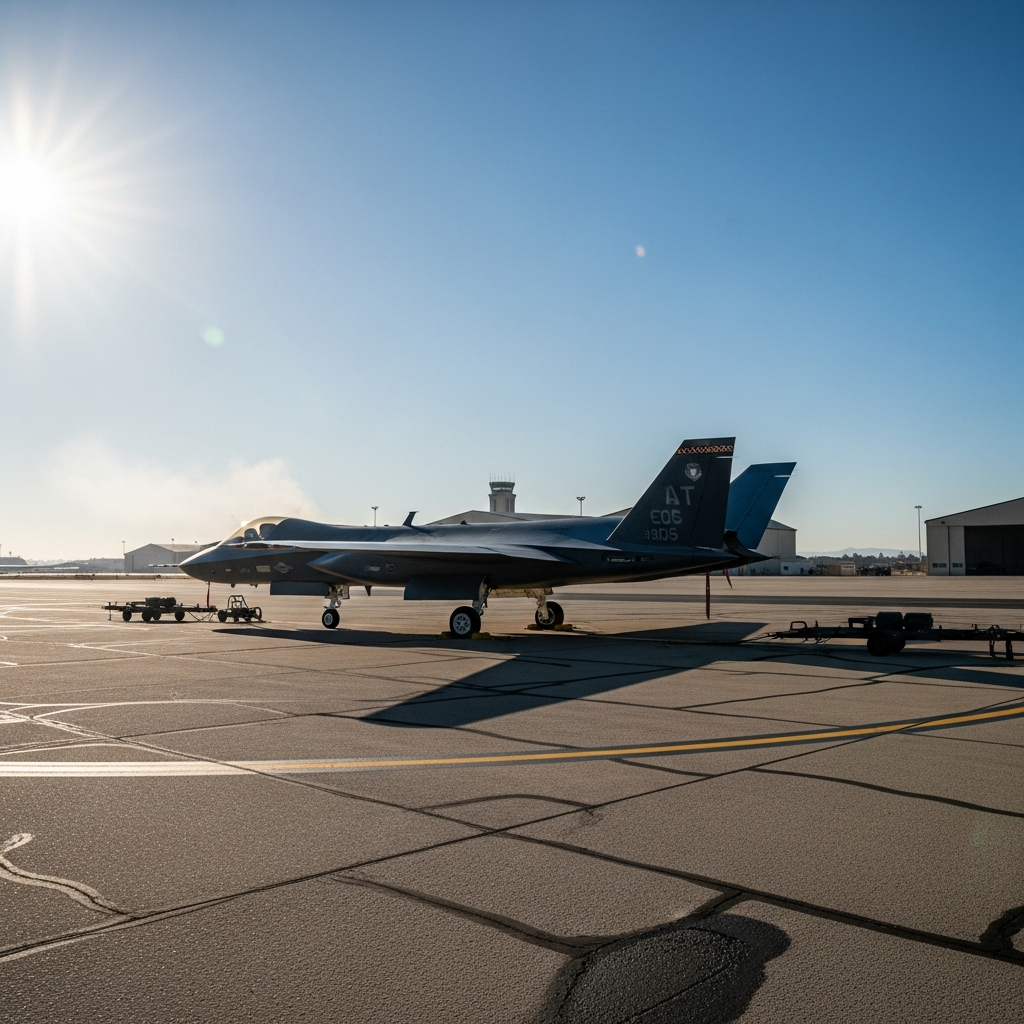
Boeing Defence Australia’s MQ-28 Ghost Bat has made its combat debut during Exercise Valiant Shield 2026. It marked the first operational deployment of a Collaborative Combat Aircraft in a live multinational military exercise. The uncrewed fighter conducted its first offensive and defensive counter-air missions alongside U.S. and allied forces beginning June 24, 2026, from Naval Base Rota in the Commonwealth of the Northern Mariana Islands.
This milestone represents a watershed moment for human-machine teaming tactics in the Indo-Pacific. Exercise Valiant Shield 2026—directed by U.S. Indo-Pacific Command and running from June 22 through July 1—has evolved into a multinational joint field training exercise. The United States, Australia, Japan, Canada, and other allies all participated. The Ghost Bat’s integration into this high-end coalition environment demonstrates maturation of next-generation air warfare concepts that will define Pacific deterrence strategy for the next two decades.
First Autonomous Air-to-Air Engagement Sets the Stage
The Ghost Bat’s readiness for Valiant Shield 2026 was validated through a series of historic milestones in the months leading up to the exercise. In December 2025, the MQ-28 conducted its first autonomous air-to-air engagement, firing an AIM-120 Advanced Medium-Range Air-to-Air Missile at a fighter-class target drone. It did so in cooperation with an E-7A Wedgetail Airborne Early Warning and Control aircraft and an F/A-18F Super Hornet. The three aircraft launched from separate locations, rendezvoused in flight, and the E-7A operator took custodianship of the MQ-28 to execute the engagement while the Super Hornet provided sensor coverage and shared targeting data across all platforms. It was reportedly the first time any uncrewed aircraft had fired an AMRAAM.
By June 1, 2026—just weeks before Valiant Shield kicked off—Boeing completed Radar Cross Section (RCS) testing that validated the MQ-28’s low-observable characteristics. The company provided customers with objective, repeatable data about survivability and detection risks.
Technical Specifications and Mission Profile
The production representative test aircraft measures 11.7 meters in length with a 7.3-meter wingspan and weighs approximately 3,175 kilograms. A Williams International FJ44 turbofan engine powers the Ghost Bat, which reaches speeds up to Mach 0.9 and operates at altitudes exceeding 40,000 feet with a range exceeding 2,000 nautical miles. Imagery from June 21, 2026, shows the aircraft equipped with an Infra-Red Search and Track (IRST) sensor mounted above the nose—a multirole payload capability that allows the 1.5 cubic meter nose section to be swapped in hours for different mission packages including ISR, aerial radar surveillance, electronic warfare sensors, and combat munitions.
During Valiant Shield, the MQ-28 performed manned-unmanned teaming (MUM-T) missions where human operators maintained oversight for all critical decisions. A launch and recovery operator manages takeoff, then hands control to a crewed platform—an E-7A, F-35A, or F/A-18F—whose crew tasks the Ghost Bat for specific missions. The teaming need not occur in close formation; aircraft can coordinate effectively across dozens of kilometers depending on mission requirements.
What Comes Next
“The future of airpower is a partnership between our greatest assets: our skilled warfighters and the technology that empowers them,” said U.S. Air Force Maj. Daniel Pesich, Officer in Charge of the Experimental Operations Unit CCA Detachment. “By advancing human-machine teaming, we are increasing our power projection while building a more resilient, capable, and lethal joint force.”
The Royal Australian Air Force intends to bring the MQ-28 into operational service by 2028, positioning it to become the world’s first operational Collaborative Combat Aircraft. Over 150 test flights have been completed and Block 2 developmental assets are entering the pipeline. The Ghost Bat has transitioned from concept demonstrator to front-line asset. The Valiant Shield deployment signals that advanced uncrewed combat integration is no longer theoretical—it’s operational doctrine.
Stay in the loop
Get the latest aircraft insider updates delivered to your inbox.