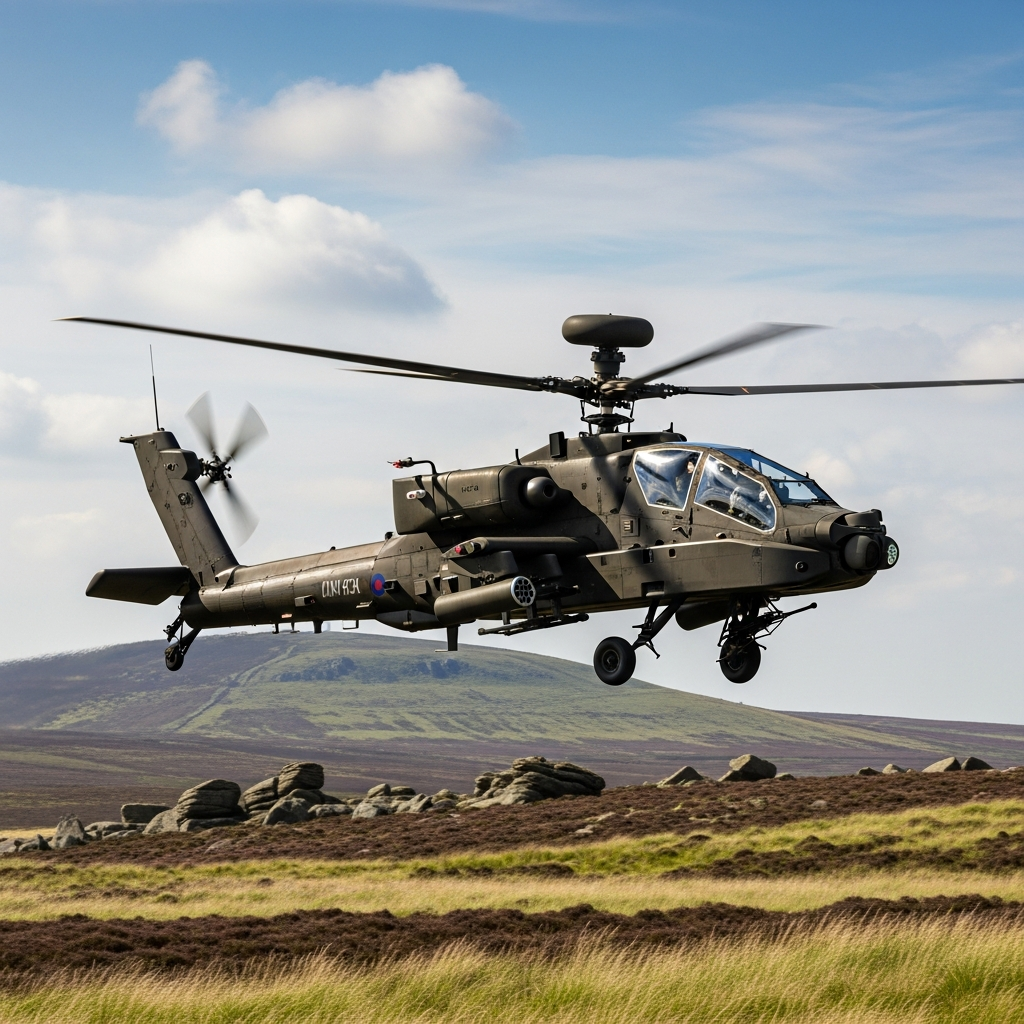
Britain’s Ministry of Defence has confirmed Project NYX—an armed drone teaming initiative that pairs autonomous aircraft with AH-64E Apache attack helicopters. It marks one of the British Army’s most ambitious crewed-uncrewed collaboration programs to date.
The programme’s initial industry engagement event occurred in August 2024, with a formal tender notice issued on 4 November 2025. Seven companies were invited to present designs on 24 January 2026, which were down-selected to four teams in March 2026. Four industry teams were formally selected on 15 May 2026 to develop rival autonomous platforms: Anduril UK, BAE Systems, Tekever, and Thales UK. All are tasked with creating systems capable of operating alongside Apache crews in contested environments. Down-selection to two vendors is planned for autumn 2026, with operational capability targeted for 2030.
The Apache Partnership
The AH-64E “Guardian” Version 6 serves as the crewed anchor. The British Army operates approximately 50 of these helicopters across two main bases: 3 Regiment Army Air Corps at Wattisham Flying Station in Suffolk and the Army Aviation Centre at Middle Wallop in Hampshire. The ‘E’ variant brings significant upgrades, including enhanced engines (T700-GE-701D), a 30mm M230 chain gun, 70mm Hydra rockets, Hellfire missiles, and a Longbow radar capable of detecting 1,000 targets simultaneously while classifying 256 and prioritising 16 in seconds.
The AH-64E already carries a Manned Unmanned Teaming (MUM-T) mast for controlling uncrewed systems—infrastructure the Army will leverage directly for Project NYX operations. Link 16 tactical datalinks and Mode 5 Identification Friend or Foe systems provide the digital backbone for seamless human-machine coordination.
The Autonomous Wingman Concept
Project NYX drones will operate on a “command rather than control” principle. Apache crews will issue voice commands rather than manually flying each asset via traditional ground control stations. The MoD emphasises that lethal engagement decisions remain under human authority, preserving critical oversight while exploiting machine-speed sensing and coordination.
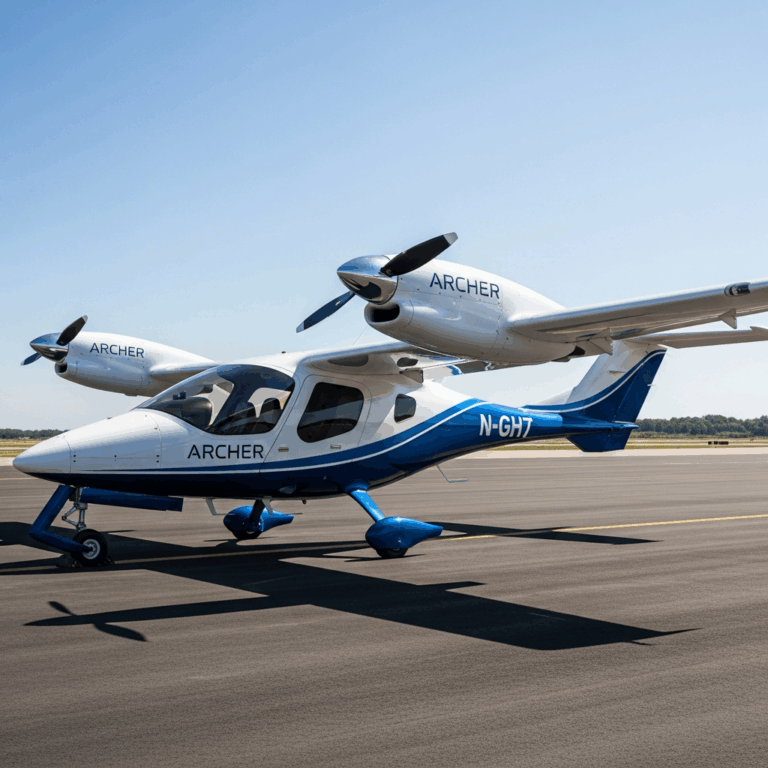
The programme aims to field up to 24 armed autonomous drones by 2030. Their specific characteristics—airframe type, endurance, weapon payload, and launch methodology—remain undisclosed. Contractor statements, however, reveal emerging designs. BAE Systems is partnering with UK supplier Certo Aerospace on the CAPSTONE platform. Anduril UK has completed full-scale surrogate flight tests and plans hybrid-electric propulsion via Archer Aviation. Tekever, supplier of the RAF’s StormShroud surveillance drones deployed in Ukraine, plans a “rotary platform” with advanced autonomy. Thales is collaborating with Schiebel, designer of the Peregrine UAS for the Royal Navy.
“Through the Strategic Defence Review, the UK is pivoting to a new way of war; by harnessing new technology our Armed Forces will increasingly utilise uncrewed and autonomous capabilities to generate mass and lethality. Project NYX is delivery of that work in action,” the MoD stated.
Broader Context and Investment
Project NYX sits within a larger £5 billion autonomous systems investment through 2030, announced in the Defence Investment Plan on 29–30 June 2026. The MoD is simultaneously advancing Project CORVUS—up to 24 long-range surveillance drones replacing Watchkeeper by 2029—while phasing out Wildcat Battlefield Reconnaissance helicopters from 2027. The Apache fleet itself receives £1.1 billion in planned funding through FY29/30.
Similar manned-unmanned teaming programs exist across NATO and U.S. services, but the British approach uniquely emphasises battlefield autonomy for land warfare aviation. QinetiQ’s earlier trials paired crewed jets with Banshee drones using NATO Link 16 messaging, proving the datalink feasibility the Army will now operationalise at scale.
What To Watch
The March 2026 down-select proved competitive. Autumn 2026 will narrow the field to two final contenders moving into prototype development. Demonstration flights integrating with 3 Regiment Army Air Corps (653, 662, and 663 Squadrons) and 4 Regiment Army Air Corps (656 and 664 Squadrons) will follow. Success here could reshape rotary-wing doctrine across NATO allies, particularly regarding crew workload, sensor-to-shooter timelines, and autonomous rules of engagement in peer-conflict scenarios.

Stay in the loop
Get the latest aircraft insider updates delivered to your inbox.