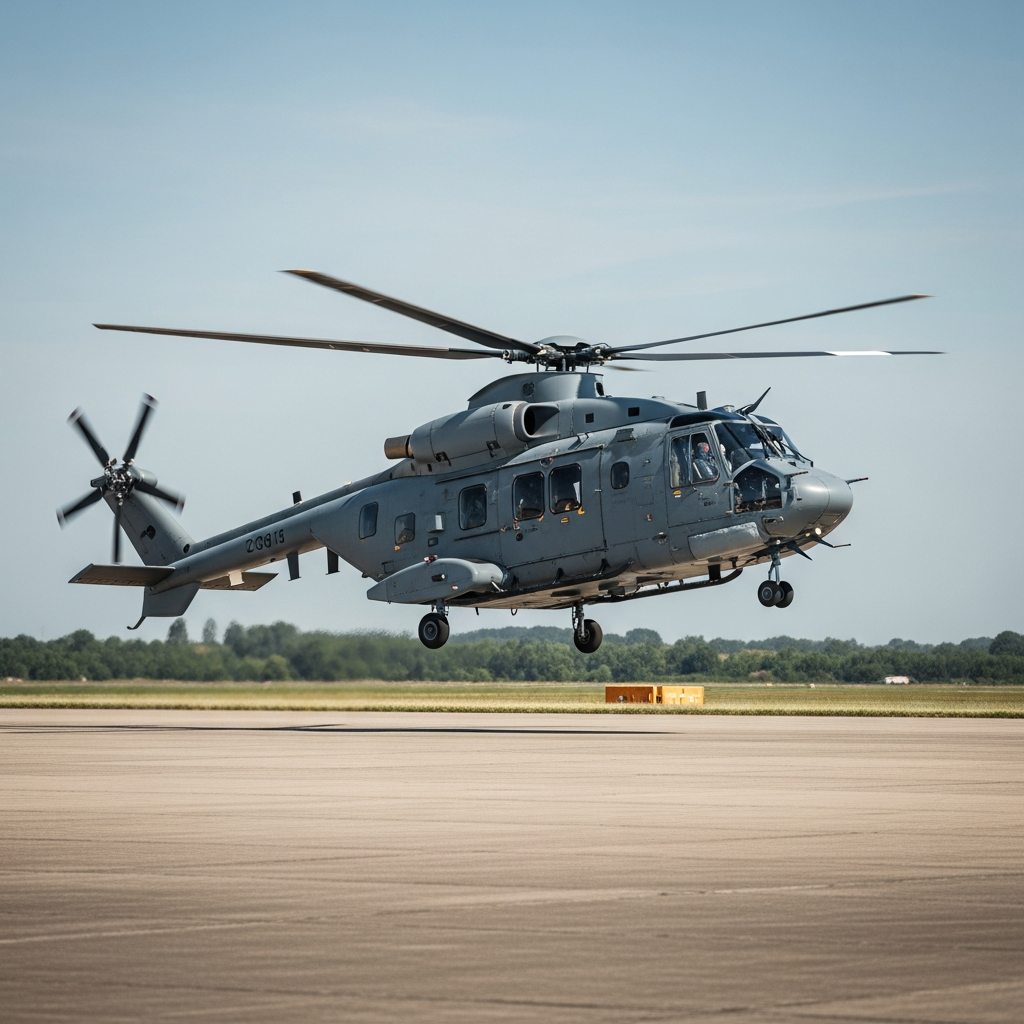
Sikorsky just hit a major milestone in autonomous rotorcraft development. On July 22 at the Farnborough International Airshow, the defense contractor completed initial ground and flight tests of its Nomad 100 uncrewed aerial system — a demonstration that marks its formal entry into the fast-growing unmanned aircraft market and validates a novel design architecture that could reshape tactical aviation.
The Nomad 100 is roughly 330 pounds. It’s a Group 3 drone developed under DARPA’s Early VTOL Aircraft Demonstration (EVADE) program and represents Sikorsky’s most advanced autonomous rotorcraft to date. Unlike conventional helicopters or fixed-wing drones, the Nomad 100 employs a rotor-blown wing design — a hybrid architecture that channels airflow from twin rotors across the wings to generate lift even at low speeds. The result: vertical takeoff and landing capability paired with the cruise speed and range of a fixed-wing aircraft.
“Nomad 100’s ongoing flight testing reflects our commitment to advancing autonomous technology while delivering safe and reliable mission capabilities that equip customers to fill critical operational gaps,” said Rich Benton, VP and General Manager of Sikorsky. “Nomad will serve as part of a crewed-uncrewed team complementing missions anywhere from austere forward operating bases to ship decks and unimproved landing zones.”
Why This Matters — No Runway Required
The Nomad 100’s design solves a real problem. Fixed-wing unmanned aircraft, which dominate current military inventories, require prepared or flat terrain to operate — a vulnerability in contested environments where runways and landing zones can be targeted or destroyed. The Nomad 100’s ability to hover like a helicopter while maintaining fixed-wing speed and endurance directly addresses this operational gap. It enables logistics resupply, reconnaissance, and light attack support from locations no conventional aircraft could reach.
A hybrid electric propulsion system incorporating a diesel engine powers the aircraft, meeting EVADE’s demanding performance envelope: 12 hours of endurance at 100 nautical miles with a 60-pound payload while remaining easy to launch, recover, and operate without special infrastructure. DARPA selected five American companies for the EVADE competition — Sikorsky, AeroVironment, Griffon Aerospace, Karem Aircraft, and Method Aeronautics — but tapped Sikorsky’s proprietary MATRIX autonomous technology as the autonomy backbone for all five platforms.
MATRIX — The Autonomy Engine
MATRIX represents 1,000-plus flight hours logged, 500-plus successful tests, and integration across 20-plus different aircraft platforms. The system enables operators to assign missions remotely and let the aircraft execute autonomously — a capability Sikorsky has already proven on the S-70UAS U-Hawk, a fully autonomous variant of the Black Hawk helicopter unveiled in October 2025.
Scalable From Group 3 to Group 5
Sikorsky positioned the Nomad family as scalable across military size categories. It ranges from Group 3 aircraft (56 pounds to 1,320 pounds) up through Group 4 and Group 5 aircraft (1,320 pounds and above). This architecture allows the company to pitch the same underlying technology to multiple customers — from Army reconnaissance units seeking small tactical drones to logistics operators requiring larger cargo-capable platforms.
The Nomad 100 now advances into an intensive flight test campaign at a government facility designed to replicate the full spectrum of operational missions the aircraft will ultimately perform. The unmanned helicopter market is projected to grow from $5.78 billion in 2025 to $11.94 billion by 2030. Sikorsky’s proven autonomy track record positions it favorably against competitors including Airbus Helicopters, Boeing, and emerging pure-play autonomy firms like Shield AI and Skydio.
What to Watch
Keep eyes on the next phase of Nomad 100 testing and any follow-on contracts from U.S. Central Command or Pacific Fleet. Sikorsky also announced a new collaboration with Safran Helicopter Engines at Farnborough, suggesting propulsion upgrades may be in the pipeline. This is just the beginning.
Stay in the loop
Get the latest aircraft insider updates delivered to your inbox.