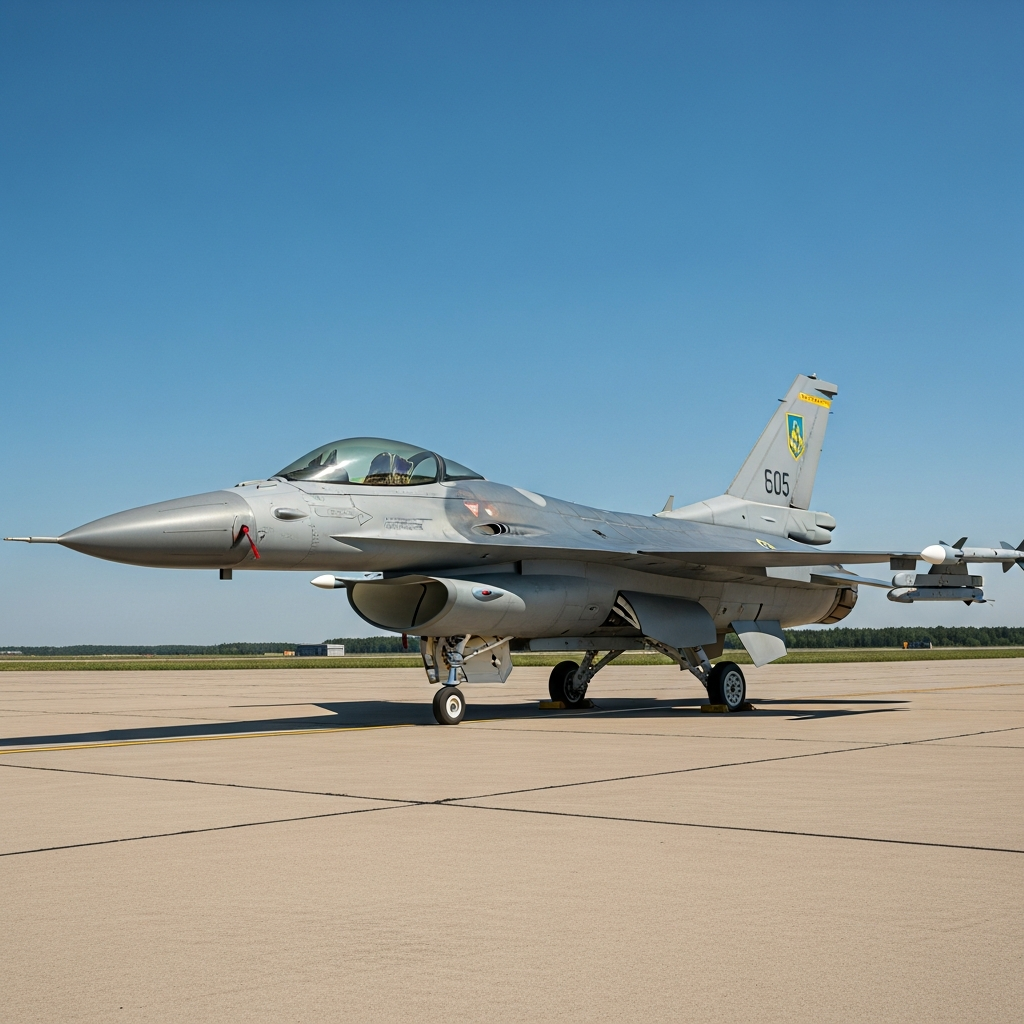
A Ukrainian F-16 Fighting Falcon has scored its first confirmed air-to-air kill, shooting down a Russian Sukhoi Su-35S advanced fighter jet during combat operations this month, according to U.S. military leadership.
General Dan Caine, Chairman of the Joint Chiefs of Staff, revealed the engagement while testifying before the Senate Appropriations Committee on July 21, 2026. “I’ll note that recently we had the first air-to-air kill where a Ukrainian F-16 shot down a Russian fighter,” Caine told senators. He said the engagement showed that Ukraine’s Western-supplied fighter fleet was growing more capable by the day.
For Ukraine’s fledgling F-16 program, this kill marks a major milestone. Kyiv got its first F-16s in summer 2024 after months of back-and-forth among NATO allies over whether sending advanced fighters would push the conflict further. The Ukrainian Air Force announced the Su-35 shootdown on July 8 via Telegram: “Today, another Russian air terrorist was eliminated.” But until Caine’s testimony, nobody had confirmed what weapon brought it down, though the likely match is the Su-35S Ukraine reported destroying that day.
Technical Context — A Matchup of Generations
Both aircraft are fourth-generation fighters. They’re capable machines, though not as stealthy as fifth-generation designs. Russia’s Su-35S is a twin-engine air superiority fighter that has served as one of Moscow’s primary interceptors throughout the war. A Russian Su-35S photographed over the Black Sea in April 2026 carried R-73/74, R-37M, R-77-1, and Kh-31 anti-radiation missiles—a genuinely dangerous opponent.
The Ukrainian F-16 is something else entirely. It represents a dramatic leap from the Soviet-era MiG-29 and Su-27 platforms Ukraine has flown for decades. Those aircraft—most built between 1982 and 1990, then upgraded through 2015—now integrate modern NATO weapons including the AIM-120D radar-guided air-to-air missile, AIM-9X and IRIS-T short-range missiles, and guided rockets.
How exactly the kill happened remains partly classified. Ukrainian defense site Militarnyi reported that it came from a coordinated operation: a MiG-29 pretended to make a ground-attack run to draw out the Su-35, while two F-16s waited for their chance. One F-16 scored the direct hit—most likely with an AIM-120 AMRAAM in a beyond-visual-range engagement. The Russian pilot ejected and was rescued.
Strategic Implications — Beyond Symbolism
Until now, Ukraine’s F-16s have mostly flown defensive missions. They’ve intercepted drones and cruise missiles. Ukrainian Air Force spokesman Yuriy Ihnat said F-16s have shot down around 2,200 of the roughly 3,000 Russian drones and missiles Ukraine has intercepted in total. This engagement signals the fleet is moving into offensive air-superiority operations as part of Ukraine’s layered defense network.
Caine’s word carries weight here. He’s a former F-16 pilot who flew combat missions in Iraq with special operations forces—so his take on how the aircraft performed against Russian opposition actually means something.
The loss will force Russian planners to rethink their patrol routes and tactics. Ukraine’s General Staff says Russia has lost 436 aircraft and 353 helicopters since the invasion began. Open-source tracking group Oryx has confirmed nine Su-35 losses, though the real number is probably higher.
Ukraine isn’t stopping at the F-16. On June 30, Kyiv signed a deal for 16 Gripen fighter aircraft valued at $2.54 billion, with deliveries between 2029 and 2039. France committed to supplying 16 Rafale jets on July 13, with training beginning this year and first deliveries once pilots complete qualification.
While this engagement proves the F-16 transfer program was worth it strategically, don’t mistake it for a turning point. Russia still has far more combat aircraft and extensive surface-to-air missile coverage. But the fact that Ukrainian pilots can now beat Russia’s air-superiority fighters shows something real has shifted in the aerial balance along the front lines.


Stay in the loop
Get the latest aircraft insider updates delivered to your inbox.