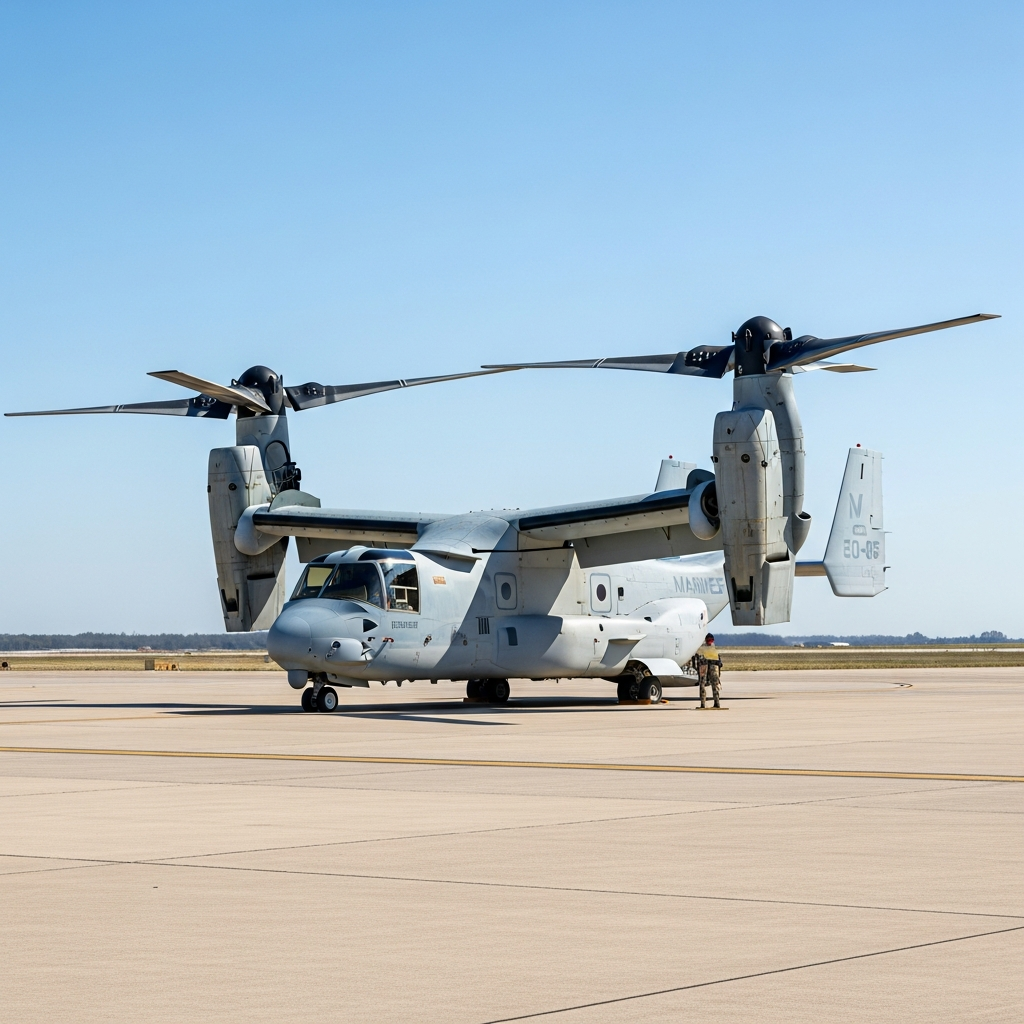
The U.S. Marine Corps closed the books on one of defense aviation’s most consequential programs yesterday. On July 28, 2026, they accepted delivery of the 359th and final MV-22B Osprey—marking the end of a 46-year journey that started with a failed hostage rescue in Iran and fundamentally reshaped how the Marine Corps projects power globally.
That final aircraft delivery shifts focus away from the production line. Now comes sustainment and modernization—a five-pillar effort designed to keep Ospreys flying through the 2050s. The tiltrotor’s proven combat record and unique operational advantages make it irreplaceable for now, even as the Marine Corps begins eyeing next-generation platforms.
From Iran Crisis to Operational Game-Changer
Operation Eagle Claw’s 1980 failure exposed a critical gap. No aircraft existed that could deliver troops across distance while maintaining vertical lift capability. The Department of Defense responded by launching the Joint-service Vertical Take-Off/Landing Experimental (JVX) program in 1981. Bell Helicopter and Boeing Helicopters won a preliminary design contract on April 26, 1983, and the resulting V-22 Osprey was designated on January 15, 1985.
Development proved grueling. First horizontal flight didn’t occur until March 19, 1989; vertical flight followed on September 14, 1989. Sea trials aboard USS Wasp came in December 1990, but then years of political turbulence followed—the program faced near-cancellation in 1992. Initial deliveries began in 1997, yet two fatal accidents in 2000 killed 19 Marines and crew, further testing Congressional patience.
But persistence paid dividends. The MV-22B achieved Initial Operational Capability in June 2007, and its transformation of Marine assault doctrine proved immediate. Squadrons VMM-263, VMM-162, and VMM-266 conducted successful Iraq deployments between October 2007 and April 2009. In May 2009, VMM-263 completed the first shipboard deployment aboard USS Bataan—cementing the platform’s viability.
The Numbers Tell the Story
Since achieving IOC, the Osprey fleet has logged more than 686,500 flight hours across 114 operational deployments spanning Iraq, Afghanistan, Libya, Nepal, the Philippines, Africa, and the Middle East. The aircraft now sources 75 percent of all Marine Corps rotary-wing assault support. Compared to the CH-46 Sea Knight it replaced, the MV-22B delivers twice the speed, six times the range, and three times the payload—a force multiplier that one Marine commander in Iraq famously said turned his battlespace “from the size of Texas to the size of the United States.”
The safety record supports continued operations. Over the past decade, the Osprey has recorded a Class A mishap rate of 3.15 per 100,000 flight hours—below the Marine Corps average of 3.24 and lower than four other Marine Corps aircraft types.
Hard Clutch Engagement and Recovery
The fleet faced significant headwinds in 2022–2023. A hard clutch engagement caused a fatal crash in June 2022 that killed five Marines; investigators identified the input quill assembly as the culprit. In February 2023, the program office halted operations fleet-wide until replacements were installed. No hard clutch engagements have been reported since February 2023, according to Marine Corps spokesman Captain Jacob Sugg.
What Comes Next—Modernization and Replacement
Lt. Gen. William Swan, Deputy Commandant for Aviation, emphasized yesterday that “the MV-22 didn’t simply replace the CH-46. It fundamentally changed the way the MAGTF generates combat power.” He added: “We cannot assume that because the MV-22B transformed Marine aviation once, its evolution is complete.”
The Renewed V-22 Aircraft Modernization Plan (ReVAMP) includes improved propeller gearboxes with triple-melted steel, cockpit technology replacement (VeCToR) beginning development in 2026, and fleet-wide software standardization. The final structural achievement came when the last MV-22 fuselage was accepted by DCMA at Ridley Park, Pennsylvania, on October 8, 2025—ending two decades of continuous production.
The Next Generation Assault Support (NGAS) aircraft remains years away. Until it arrives, the Osprey’s speed, range, and vertical capability ensure the tiltrotor remains central to Marine Corps operations.
Sources
- The Gateway Pundit — Marine Corps Reaches Massive Aviation Milestone with Final MV-22B Osprey Delivery
- U.S. Marine Corps Official Statements and Press Releases
- Naval Air Systems Command (NAVAIR) Technical Documentation
- Defense News, Breaking Defense, Task & Purpose archives

Stay in the loop
Get the latest aircraft insider updates delivered to your inbox.