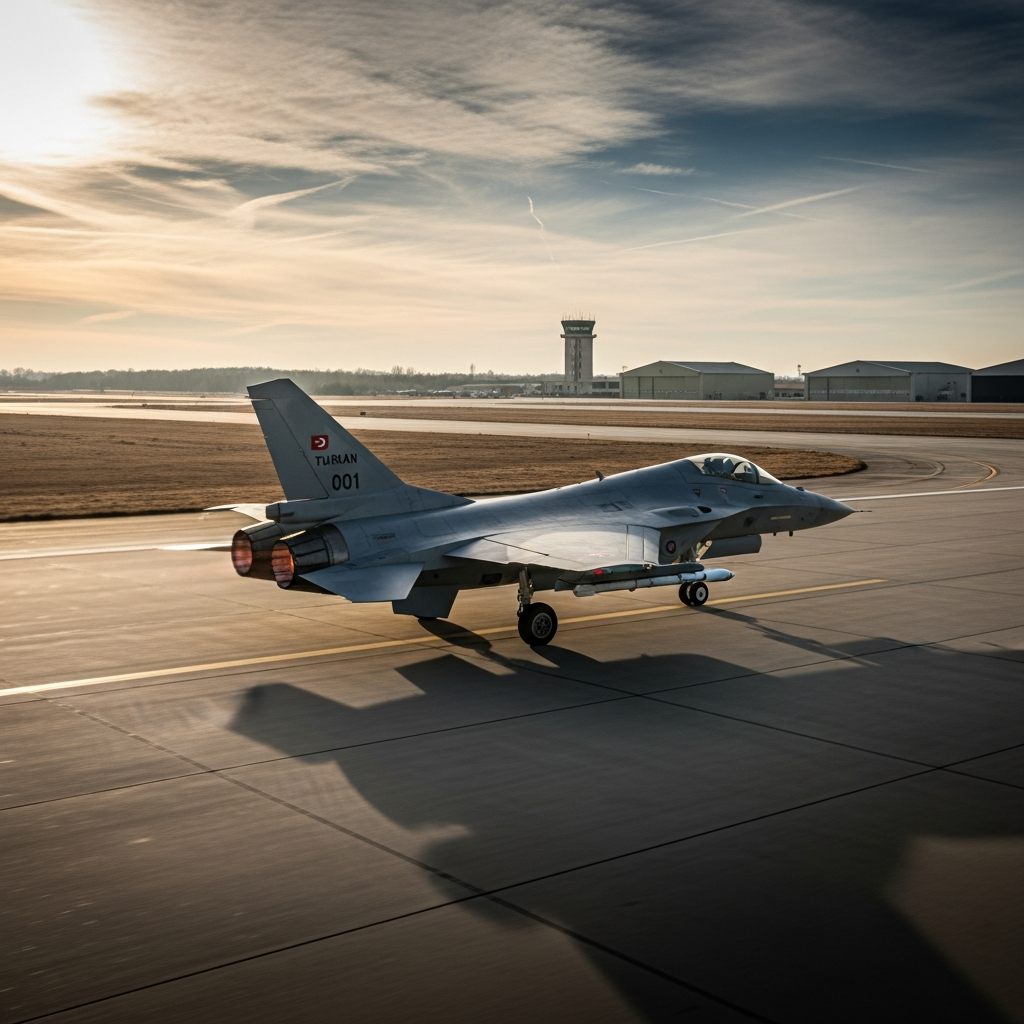
Turkey’s KAAN P1 fifth-generation fighter prototype has begun powered taxi testing at Turkish Aerospace’s Ankara facility, marking a critical milestone as the indigenous fighter program accelerates toward first flight. The company released video footage on July 31, 2026, showing the twin-engine jet rolling under its own power down the runway—the first tangible evidence that the program has cleared its ground-test phase and is moving into active flight preparation.
Turkey was expelled from the U.S. F-35 joint strike fighter program in 2019 after purchasing Russian S-400 air defense systems. That decision galvanized Ankara’s commitment to building its own fifth-generation capability. The KAAN—originally designated TF-X—now stands alongside only a handful of nationally developed fifth-generation fighters: the U.S. F-22 and F-35, Russia’s Su-57, and China’s J-20 and FC-31.
At the Farnborough International Airshow on July 24, Turkish Aerospace CEO Mehmet Demiroglu laid out an aggressive timeline. “We hope to see KAAN in the sky within a few months,” he stated. A second prototype would “fly by the end of the year. Our goal is to have two KAANs flying one after the other, or side by side, at year-end.” That dual-prototype strategy is unusual for development at this stage—but it reflects Turkey’s push to compress testing and hit the 2028 initial operational capability target announced by the Turkish Air Force.
P1 and P2 are production-representative airframes, substantially different from the P0 demonstrator that made KAAN’s maiden flight on February 21, 2024. Reshaped air intakes, refined structural geometry, and more advanced avionics separate the newer prototypes from their predecessor. Unlike P0—which was originally intended for ground testing only—P1 and P2 are expressly designed to carry the full flight-test load across airframe, propulsion, and systems validation.
The aircraft measures 21 meters in length with a 14-meter wingspan. It’s designed for Mach 1.8 performance at 55,000 feet. Current test aircraft are powered by twin General Electric F110-GE-129 engines—the same powerplant family equipping Turkey’s F-16 fleet—each producing roughly 30,000 pounds of thrust with afterburner. Turkish Aerospace holds 10 F110 engines in Ankara for prototype work and is acquiring 80 more for early production aircraft.
But this interim propulsion solution exposes a critical vulnerability. Long-term Turkish independence in the KAAN program depends on the indigenous TF35000 turbofan engine—currently in development by TRMotor and Turkish Engine Industries (TEI). The TF35000, targeting approximately 35,000 pounds of thrust with supercruise capability, entered Critical Design Review in February 2026. Full integration with the KAAN airframe is targeted for 2032, meaning production aircraft delivered before then will rely on American engines. That’s a geopolitical exposure the Trump administration partially eased in June by approving a $700 million F110 engine export sale that cleared Congress on July 9.
Turkey has contracted for a first batch of 20 Block 10 aircraft with Turkish Air Force deliveries targeted between 2028 and 2030. Indonesia has signed a framework agreement for up to $15 billion as the expected first export customer, though Jakarta has signaled preference for an ITAR-free configuration powered by the indigenous engine rather than early F110-equipped variants. Saudi Arabia has also expressed partnership interest.
The powered taxi phase signals that structural integrity, ground handling, and engine response have passed preliminary inspection. The real test—airworthiness, control authority, aerodynamic stability—comes next. Watch for P1’s first flight announcement and, critically, whether P2 achieves flight status before 2026 closes. That dual-aircraft milestone would validate Turkey’s compressed development schedule and confirm whether KAAN can genuinely deliver production capability by 2028.
Stay in the loop
Get the latest aircraft insider updates delivered to your inbox.