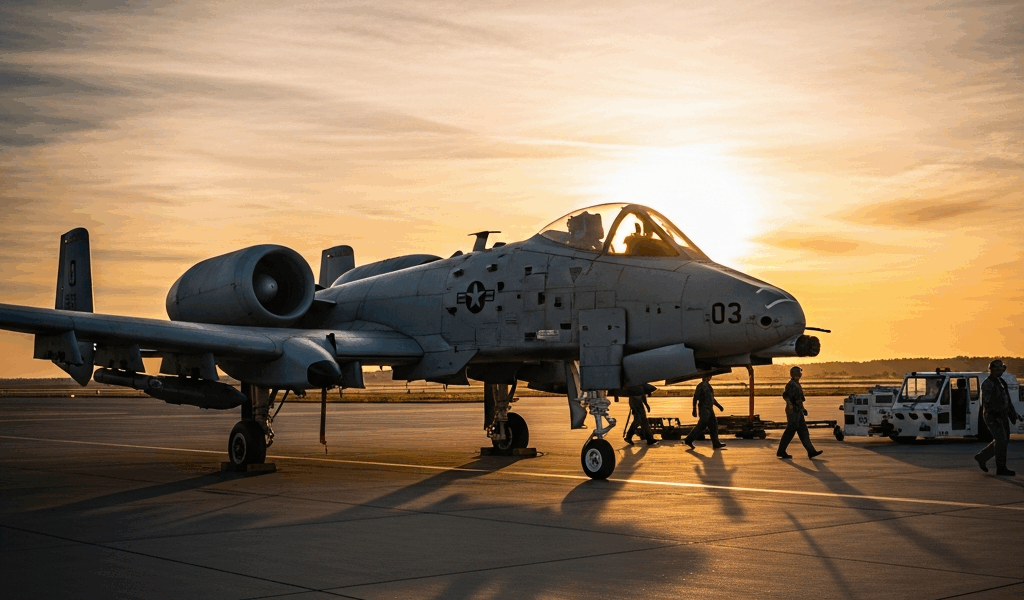
The F-15E Strike Eagle wasn’t the only loss. The Iran rescue operation that began April 3 ultimately cost the United States an A-10C Thunderbolt II, two MC-130J Commando II special operations transports, and at least four helicopters — a single-operation toll of American airpower not seen since the Cold War.
The A-10 Goes Down Near the Strait of Hormuz
While rescue teams moved to recover the downed F-15E crew on April 3, A-10C Thunderbolt IIs were flying “Sandy” missions. It’s a specialized combat search-and-rescue role — puts Warthogs in close, suppressing enemy ground forces threatening both rescuers and downed aircrew. One of those aircraft took significant hits from Iranian air defense fire near the Strait of Hormuz. Iranian state media released video purporting to show a surface-to-air missile striking the aircraft between Qeshm and Hengam islands.
The A-10 didn’t go down over Iran. The pilot pushed the crippled jet to Kuwaiti airspace, ejected safely, and the aircraft crashed in Kuwait. U.S. officials confirmed the pilot was recovered without life-threatening injury. That the pilot made it out at all likely comes down to what the A-10 is built for — a titanium “bathtub” cockpit, redundant flight systems, an airframe engineered to absorb punishment and keep flying. Iran claimed its air defenses downed the Warthog and released footage of the alleged engagement. Experts note that the real threat to low-flying aircraft like the A-10 in this environment is MANPADS and anti-aircraft artillery — threats that are nearly impossible to fully suppress.
Two MC-130Js Stranded and Destroyed in Isfahan Province
The more strategically significant losses came on the ground. To support the extraction of the F-15E’s Weapons System Officer — who had evaded capture in the Zagros Mountains while SEAL Team 6 moved to recover him — U.S. Air Force Special Operations Command established a Forward Arming and Refueling Point on an abandoned agricultural airstrip approximately 14 miles north of Shahreza in Isfahan province. The strip measured roughly 200 feet wide by 3,900 feet long.
It was not a runway. It was a farm.
Two MC-130J Commando II transports landed there on the night of April 4, carrying MH-6M Little Bird helicopters from the 160th Special Operations Aviation Regiment — Night Stalkers — which were offloaded and reassembled on Iranian soil. The Little Birds ferried SEAL Team 6 operators to secure the wounded WSO during a firefight. MQ-9 Reapers provided persistent overwatch and reportedly engaged Iranian forces closing on the officer’s position.
Then the MC-130Js couldn’t leave. Both aircraft sank into soft sand and couldn’t generate the thrust needed for takeoff. President Trump confirmed the failure directly: “It was sandy, wet sand. This was a farm, not a runway.” With extraction impossible and Iranian forces converging, U.S. commanders made the call.
“According to U.S. officials, the aircraft were deliberately destroyed to prevent them from falling into enemy hands.” — Pentagon statement, April 5, 2026
Both MC-130Js — each valued at approximately $114 million and packed with classified Low Probability of Intercept radar, stealth communications suites, and electronic warfare systems — were demolished under the military’s destroy-on-site protocol. Four helicopters, including at least two MH-6/AH-6 Little Birds, were destroyed alongside them. Iranian media published wreckage footage under the headline “Tabas has been repeated” — a direct reference to Operation Eagle Claw’s 1980 Desert One disaster, where sand also played a fatal role.
Three lighter replacement transport aircraft — believed to be C295Ws from a small, rarely publicized USAF special operations fleet — had been pre-positioned as contingency. They successfully extracted all ground personnel.
Helicopters Hit, Crew Members Wounded
Two HH-60W Jolly Green II rescue helicopters, which had completed in-flight refueling over Iran via an HC-130J during the first phase of the mission, also took fire. Small arms originating from Bakhtiari tribesmen struck both aircraft. Crew members aboard were wounded. Both helicopters remained operationally flyable and returned to base.
“The enemy’s flying objects were destroyed and the US once again suffered a humiliating defeat.” — Iranian Revolutionary Guard Corps, April 5, 2026
The Pentagon pushed back, confirming both F-15E crew members were recovered alive. The Department of War called it “the most operationally significant loss of U.S. aircraft on enemy ground since the Cold War.” The total toll: one A-10C, two MC-130Js, four helicopters destroyed, two HH-60Ws damaged, and multiple crew members wounded. We’ll continue tracking aircraft loss assessments and any Iranian claims of additional hardware as they emerge.

Leave a Reply