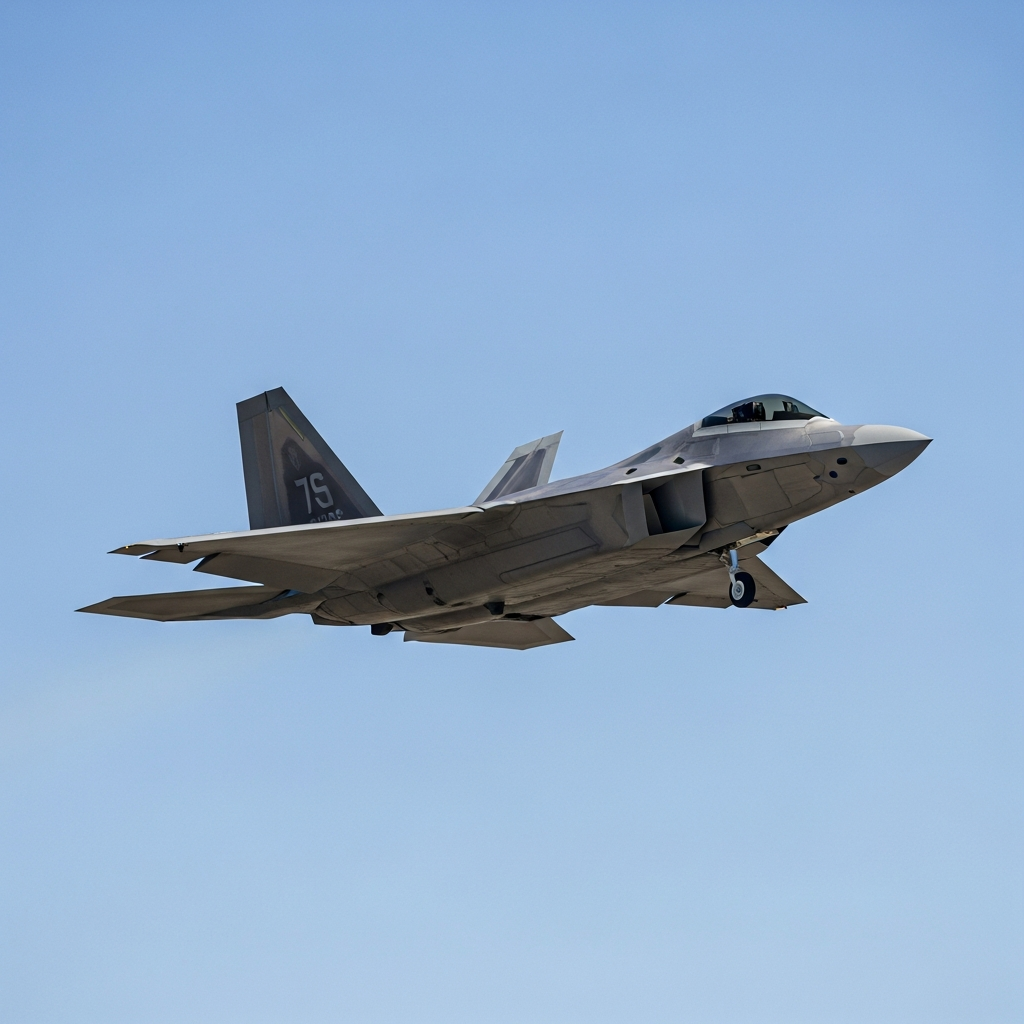
The world got its clearest look yet at America’s most consequential classified air-to-air weapon on May 15, 2026, when The Aviationist published the first confirmed public photographs of the AIM-260 Joint Advanced Tactical Missile — images captured by photographer Jonathan Tweedy at Eglin Air Force Base, Florida.
What the Photos Show
Tweedy was at Eglin on May 13 when he photographed a VX-31 F/A-18F Super Hornet departing with an AIM-260 mounted on the fuselage station outboard of its right engine intake. The jet left at approximately 11:13 AM CST as part of a four-aircraft formation — a VX-9 E/A-18G Growler, an additional VX-31 F/A-18F, and a VX-9 F/A-18F flew alongside it. About an hour later, the VX-31 aircraft returned. Without the missile. That detail strongly suggests either a live-fire or separation test was conducted over Gulf of Mexico test airspace.
The images are striking for what isn’t there. Unlike the AIM-120 AMRAAM the JATM is designed to replace, the AIM-260 carries no mid-body control surfaces or strakes — just four trapezoidal control surfaces at the tail. The nose cone is a distinct light gray set against a predominantly white body. A yellow band near the front marks a live high-explosive warhead. Two black bands toward the rear identify the rocket motor section, which appears noticeably larger than its equivalent on an AMRAAM. Square tracking markers at the aft end are standard flight test instrumentation. The test aircraft also carried a modified FPU-13/A drop tank fitted with an infrared search and track sensor on the centerline, plus flight data pods on the wingtips.
Why There Are No Mid-Body Fins
That missing hardware matters. On the AIM-120, mid-body control surfaces handle aerodynamic stability and turn authority. The AIM-260 almost certainly compensates through thrust vectoring — a necessity if the missile is going to stay agile at long range without that aerodynamic assistance. Analysts have long expected the JATM to use a dual-pulse solid rocket motor, which would sustain kinetic energy across the full flight envelope and dramatically improve terminal-phase maneuverability over the single-pulse motor found in earlier AMRAAM variants.
Range figures are classified. But Aviation Week’s Steve Trimble noted that restricted airspace charts at Eglin show a JATM test range circle roughly double the size of the AMRAAM’s. Defense analysts put the range at least 100 miles, with some reporting a design requirement of at least 120 miles — far enough to outreach the Chinese PL-15, the missile that directly drove the JATM program’s creation in 2017.
Program Background
The AIM-260 is a Lockheed Martin program developed as a Special Access Program, carrying the Pentagon nickname Link Plumeria for Navy funding purposes. The Air Force acknowledged its existence in 2019. Flight testing against QF-16 target drones began as early as 2020, and in November 2021 officials confirmed the missile was engineered to match the AMRAAM’s physical envelope — a hard requirement for internal carriage inside the F-22 Raptor and F-35 Joint Strike Fighter.
The program has missed its original IOC date. As recently as October 2025, a senior Air Force official cited integration issues on fifth-generation fighters — specifically the F-22 and F-35 — though a second official pushed back on that framing and told Air & Space Forces Magazine the program is “progressing well.” The Air Force and Navy together requested $894 million for JATM in FY2026, with plans to scale that figure to $2.9 billion in FY2027 — part of an estimated $15.6 billion multi-year investment.
“JATM milestones and capabilities are classified.” — U.S. Air Force spokesperson, February 2025
What Comes Next
These photographs confirm active weapons testing is well underway on the Navy side. F-22 integration — the platform most critical to the Air Force’s beyond-visual-range strategy — remains among the program’s most significant outstanding public questions, alongside F-35 integration. With $2.9 billion budgeted for FY2027 and combat aircraft like the F/A-18F already conducting live test events, fielding is no longer a distant prospect. Integration milestones and any further sightings will be tracked as the program moves toward operational status.
Sources
- The Aviationist — First published photos of AIM-260 JATM on VX-31 F/A-18F, May 15, 2026
- Aviation Week & Space Technology — Steve Trimble reporting on AIM-260 JATM sighting, May 2026
- Air & Space Forces Magazine — JATM integration status report, October 2025
- The War Zone — AIM-260 JATM program overview and NAVAIR rendering coverage, February 2025



Stay in the loop
Get the latest aircraft insider updates delivered to your inbox.