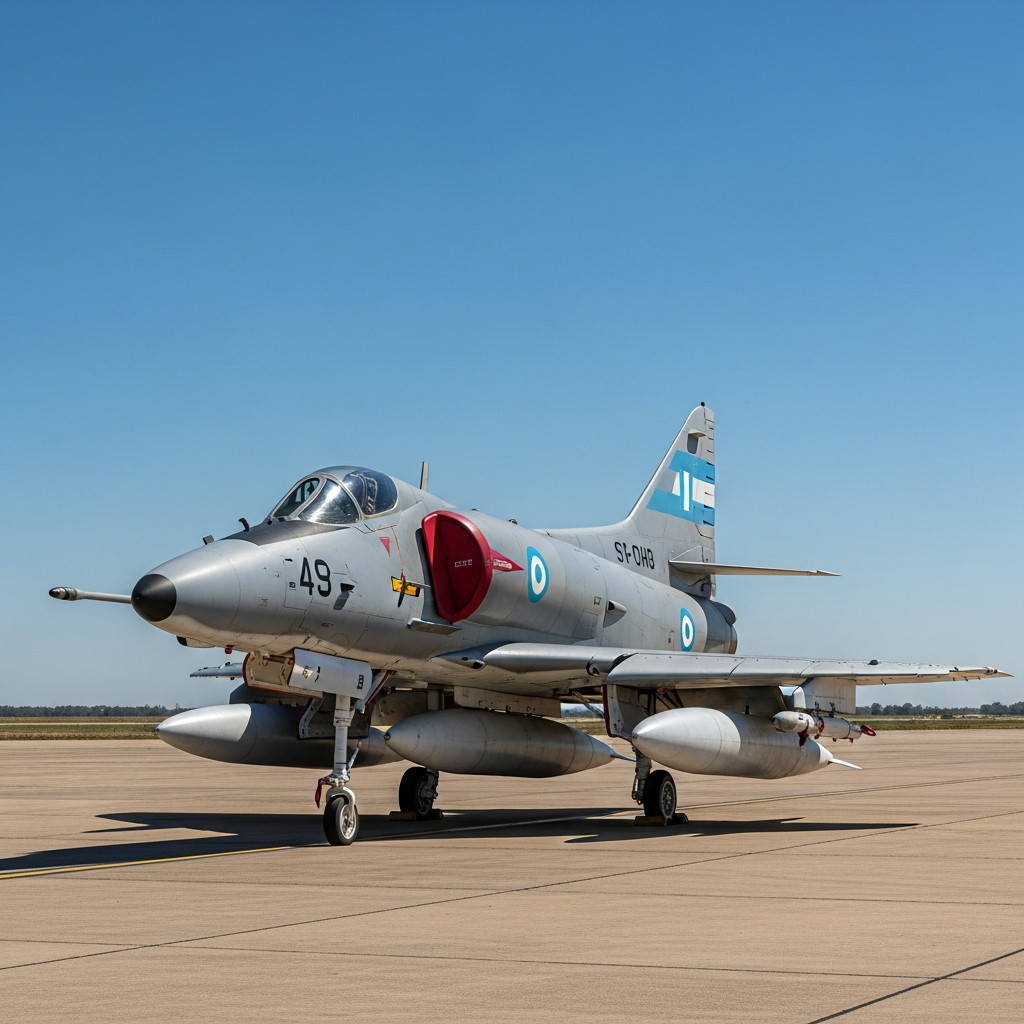
Argentina’s Air Force officially retired its last A-4AR Fightinghawk on May 14, 2026 — ending 60 years of continuous Skyhawk operations and leaving the country temporarily without a supersonic fixed-wing combat aircraft until its incoming F-16 fleet is fully operational.
Brigadier General Gustavo Javier Valverde, Chief of the General Staff of the Argentine Air Force, delivered the retirement announcement personally to personnel of the V Air Brigade (V Brigada Aérea) at Villa Reynolds Air Base in San Luis Province. It was the same base where the Fightinghawks had been stationed since the first aircraft arrived on December 19, 1997, with serials running from C-901. The last airframe delivered — C-936 — came in March 2000.
“The definitive retirement of the A-4AR Fightinghawk Weapons System strictly responds to a comprehensive institutional strategic planning analysis that prioritizes operational efficiency and economic sustainability.” — Argentine Air Force statement, May 14, 2026
Valverde cited unsustainable maintenance and logistics costs, made worse by the demands of standing up the new F-16 program — a transition that requires personnel and infrastructure currently tied to the Fightinghawk fleet. A recovery effort launched to extend A-4AR service life had already consumed more than 7.3 billion pesos before a July 2024 crash halted it entirely. The V Air Brigade had not recorded a single flight in nearly two years.
Sixty Years — From A-4B to Fightinghawk
Argentina was the first export customer for the A-4 Skyhawk, accepting 26 ex-U.S. Navy A-4Bs in 1966 and operating them from both land bases and the carrier ARA Veinticinco de Mayo. Batches of A-4Cs followed in 1976. The A-4AR variant — developed by Lockheed Martin from former U.S. Marine Corps A-4M and OA-4M airframes pulled from AMARC storage — was a quantum leap over those early jets. It came with an AN/APG-66 radar (the same set fitted to early F-16s), HOTAS controls, multifunction displays, a new HUD, an onboard mission-planning computer, and AIM-9M Sidewinder capability. The first airframes were upgraded at Lockheed’s facility in Ontario, California; the rest were done in Córdoba, Argentina.
The Fightinghawk name was a deliberate nod to the F-16 Fighting Falcon, the source of its avionics architecture. Argentina received 32 single-seat A-4ARs and four two-seat OA-4ARs, with serials running C-901 through C-936.
Falklands Legacy — Bombs Over the South Atlantic
No retirement of an Argentine Skyhawk passes without reference to 1982. Flying from mainland bases at the absolute edge of their unrefueled combat radius, FAA A-4 pilots attacked the British task force carrying unguided bombs, no radar, no radar-warning receivers, and no air-to-air missiles. They scored hits on HMS Glasgow, HMS Ardent, HMS Antelope, HMS Coventry, HMS Argonaut, HMS Broadsword, RFA Sir Galahad, RFA Sir Bedivere, and RFA Sir Tristram. Coventry and Ardent were sunk; Sir Galahad was so badly damaged she was later scuttled. The cost was severe — 10 A-4Bs, nine A-4Cs, and three Navy A-4Qs lost in action; 18 pilots killed.
The Fighter Gap — and How It Gets Filled
When Argentina retired its last Mirage III and Mirage 5 aircraft in 2015, the Fightinghawk — a subsonic attack jet by design — was pressed into the air defense role by default. It held that mission for nearly a decade while repeated procurement attempts collapsed one after another: Saab Gripens were blocked by a UK technology veto over Martin-Baker ejection seats and BAE Systems components; KAI FA-50s fell through during COVID-era budget cuts; Kfir and Mirage deals went nowhere.
The breakthrough came when Washington, wary of Chinese jets entering Latin American service, cleared Denmark to sell 24 ex-Royal Danish Air Force F-16A/Bs — aircraft Denmark is retiring as it fields the F-35. Six arrived at Morón Air Base on December 6, 2025, restoring supersonic capability to the FAA after a decades-long procurement drought. The remaining 18 are expected to follow. Argentina’s defense ministry called the deal the country’s most significant military acquisition in 40 years. To support the F-16s, Buenos Aires is also reportedly seeking two KC-135 Stratotankers from U.S. stocks — boom-equipped tankers the probe-and-drogue Fightinghawks never required.
With the retirement now official, the Brazilian Navy remains the last South American military operator of the A-4 Skyhawk family. No ceremony date has been announced for the formal retirement of the Argentine jets, and the disposition of the surviving airframes — along with the remainder of the F-16 delivery schedule — is still to be confirmed.
Stay in the loop
Get the latest aircraft insider updates delivered to your inbox.