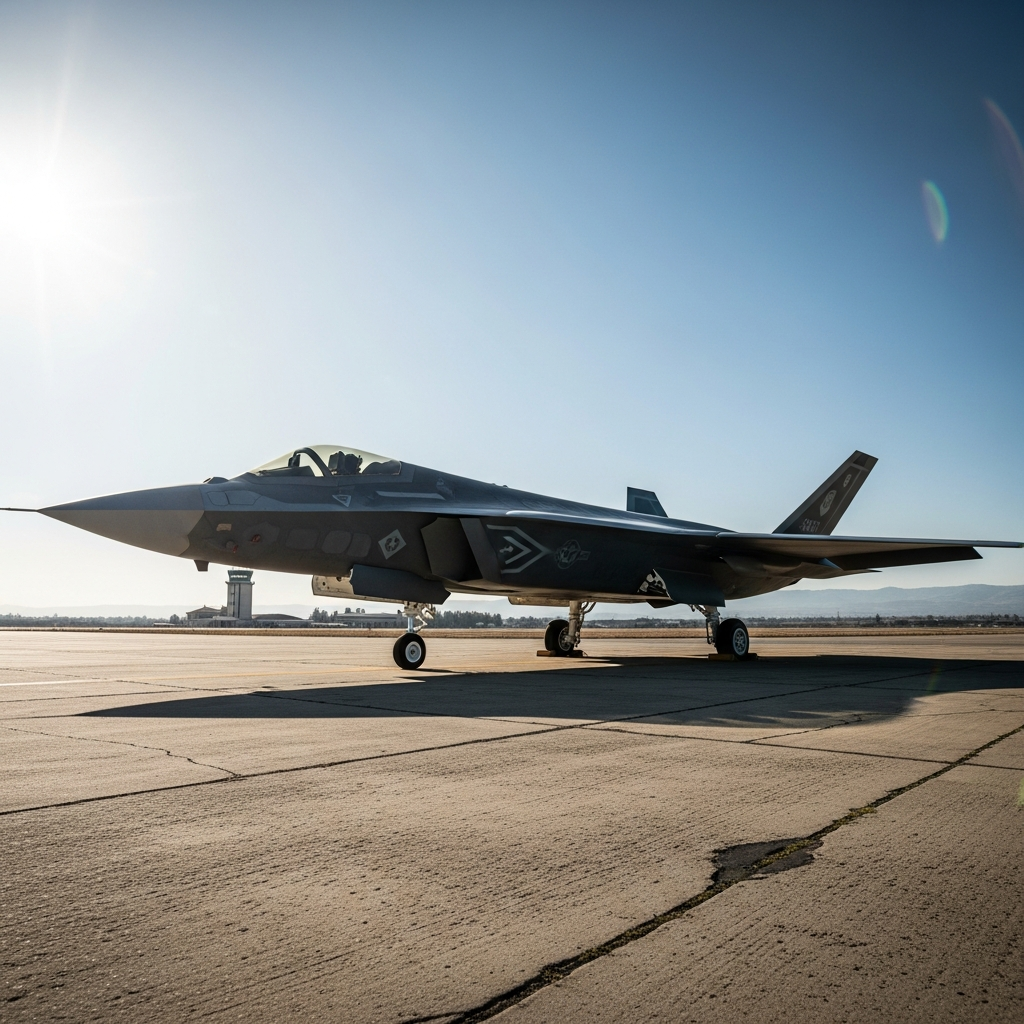
The U.S. Air Force has awarded production contracts for the Collaborative Combat Aircraft (CCA) program to General Atomics and Anduril Industries. The move formally launches the next generation of semi-autonomous combat wingmen designed to fly alongside F-35s and F-22s in contested airspace.
On June 17, 2026, the Air Force announced something less conventional: six-year baseline contracts for mission autonomy software awarded to six vendors — Anduril, General Atomics, Lockheed Martin, Northrop Grumman, RTX Collins Aerospace, and Shield AI. The decision validates an unusual acquisition model that treats mission autonomy as “software sold separately” from the airframe itself.
This marks a fundamental shift. Rather than locking a platform to a single autonomy stack, the CCA program uses an open systems architecture called the Autonomy Government Reference Architecture (A-GRA) to decouple hardware from software. Competing autonomy providers can integrate with the same airframe, enabling faster software updates and continuous capability evolution independent of aircraft production cycles.
Two Air Vehicles, Multiple Autonomy Paths
General Atomics will produce the FQ-42 (designation YFQ-42A during development), internally known as “Dark Merlin.” It’s derived from the company’s XQ-67A Off-Board Sensing Station drone. Anduril will manufacture the FQ-44 (YFQ-44A), known as “Fury.” Both are subsonic, internally-armed uncrewed fighters optimized for air-to-air roles and designed for affordability and mass production at approximately $25 million to $35 million per unit — roughly one-third the cost of an F-35.
The two platforms are currently undergoing developmental testing in California and operational assessments at Nellis Air Force Base in Nevada. General Atomics’ YFQ-42A first flew in August 2025 from Gray Butte, California — just 16 months after contract award. Anduril’s YFQ-44A followed in October 2025. Both have demonstrated semi-autonomous flight including autonomous takeoff, landing, and waypoint navigation alongside crewed fighters.
The program hit a snag in April 2026. A YFQ-42A prototype crashed on April 6, 2026, near Palmdale Regional Airport at a company-owned desert test facility in California due to an autopilot miscalculation of weight and center of gravity. A joint Air Force-GA-ASI safety review led to corrective actions, and the aircraft returned to flight on May 21, 2026. Program officials stated the crash played no role in the source selection decision.
Autonomy as a Competitive Service
The autonomy contracts represent the program’s most innovative element. RTX’s Collins Aerospace Sidekick system is being integrated on General Atomics’ platform, while Shield AI’s Hivemind autonomy is paired with Anduril’s Fury. By summer 2027 — after an initial six-month competitive period — the Air Force will select a primary mission autonomy provider for sustained production.
This structure enables rapid iteration on AI and autonomous behaviors without redesigning airframes or restarting qualification processes. As autonomy technology advances, and it will advance quickly, the Air Force can upgrade or swap autonomy software while keeping production aircraft flowing off the line.
“Mission autonomy is a foundational capability for future airpower,” said Christian Gutierrez, Shield AI’s senior vice president of Hivemind. “The Air Force’s approach enables faster innovation, rapid capability deployment, and greater operational advantage for the warfighter.”
Scale and Timeline
The Air Force projects procuring over 150 CCA by decade’s end. The ultimate goal is fielding approximately 1,000 aircraft across the force. Beale Air Force Base in California has been designated as the preferred home for the first CCA Aircraft Readiness Unit, positioned for rapid deployment.
FY2026 funding totaled $804.4 million when combining mandatory and discretionary allocations. Production is expected to ramp rapidly, with Anduril already beginning manufacturing at its Arsenal-1 facility in Ohio.
The CCA program represents a fundamental rethinking of combat aircraft acquisition. It replaces the traditional prime-contractor lock-in model with vendor competition at the software layer, enabling the Air Force to field cutting-edge autonomy faster than traditional platform development cycles allow.
Stay in the loop
Get the latest aircraft insider updates delivered to your inbox.