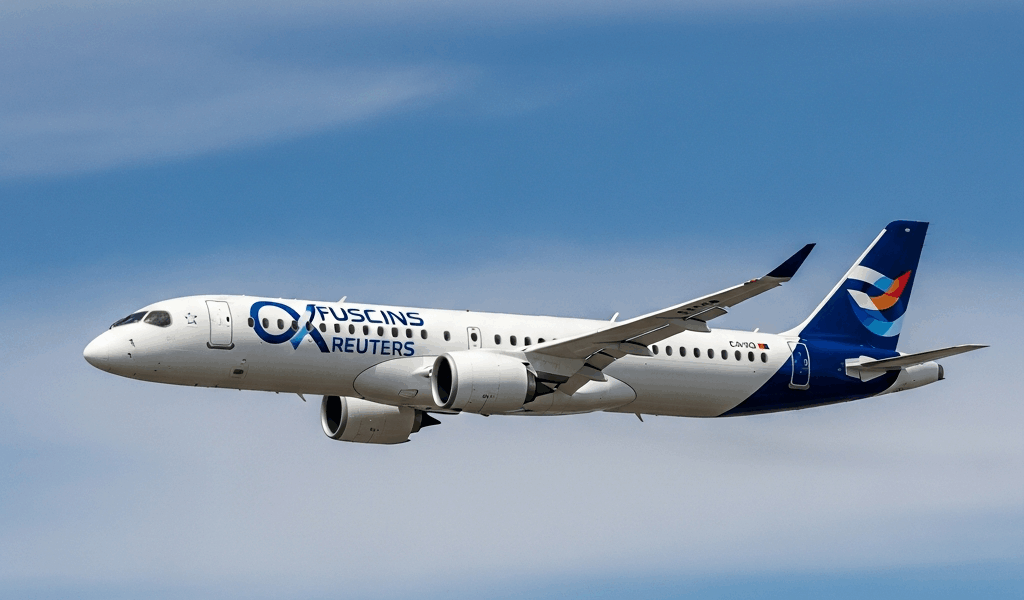
Airbus officially delivered its 500th A220 on April 10, 2026 — a milestone that would have seemed implausible a decade ago, when the aircraft was hemorrhaging cash on Bombardier’s balance sheet and Boeing was weaponizing US trade law against it. The announcement came one day after Airbus published March delivery figures showing eight A220s handed over in a single month, part of a broader acceleration that saw 60 commercial aircraft delivered in March alone, outpacing January and February’s combined total of 54.
The symbolic 500th airframe is believed to have gone to airBaltic. The Latvian carrier took delivery of its fourth A220-300 of 2026 in the final days of March — registered YL-BTF — at its Riga base. airBaltic has operated the type since 2016 and has carried approximately 24.4 million passengers on it, making the airline one of the program’s most loyal early adopters.
From Near-Collapse to Cornerstone
The numbers demand context. Bombardier delivered just 37 CSeries aircraft — 29 CS300s and eight CS100s — before Airbus took majority control in July 2018. Bombardier fully exited the program in February 2020, selling its remaining share to Airbus for $591 million. Airbus has since delivered 464 more. The program now sits at 959 orders and 501 deliveries, with 497 aircraft in active revenue service across 21 commercial operators flying more than 1,900 routes to 500 destinations.
The backstory is one of aviation’s sharpest reversals. After Delta Air Lines placed a landmark CSeries order and handed Bombardier a critical foothold in the US market, Boeing lobbied Washington to impose punishing tariffs on the Canadian manufacturer. The gambit nearly killed the program. Instead, Airbus stepped in — rebranded the CS100 and CS300 as the A220-100 and A220-300, opened a second assembly line in Mobile, Alabama, and added nearly 600 new orders. Within hours of the rebrand on July 10, 2018, JetBlue signed for 60 A220-300s to replace its Embraer 190s, citing roughly 40% lower fuel burn per seat.
“So far, our game-changing single-aisle has carried over 220M passengers across nearly 2,000 routes, offering better fuel efficiency, lower CO₂ emissions and a roomy and bright cabin. Big shoutout to #TeamAirbus, our partners and customers.” — Airbus, official statement, April 10, 2026
The Aircraft Itself
The A220 earns its commercial success on performance merits. Powered by Pratt & Whitney PW1500G geared turbofan engines, the family uses a carbon composite wing, aluminium-lithium fuselage, and fly-by-wire flight controls. The A220-100 seats 108 to 133 passengers in a 35-meter airframe. The longer A220-300 accommodates 130 to 160 across 38.7 meters. The A220-100 covers a range of up to 3,600 nautical miles; the A220-300 up to 3,400 nautical miles.
The A220-300 is approximately 6 tonnes lighter than the A319neo and nearly 8 tonnes lighter than the 737 MAX 7 — a weight advantage that translates to operating cost savings of up to 12%. List price sits at $91.5 million for the A220-300, below the A319neo’s $101.5 million, a spread that has quietly driven the A220-300 to outsell both the A319neo and the Boeing 737-7.
By February 2026, the global fleet had logged more than 1,990,000 flights over 3,500,000 block hours, posting 99.0% operational reliability over the preceding three months. Delta Air Lines leads all operators with 85 jets — a mix of both variants — and 62 more on order. JetBlue operates 61 A220-300s; Air France 55; Breeze Airways 54.
What Comes Next
Airbus is targeting 12 A220s per month by mid-2026, stepping toward an eventual rate of 14 per month. That ambition is complicated by persistent Pratt & Whitney engine shortages that CEO Guillaume Faury flagged publicly in February 2026. Supply chain friction may push the 14-per-month target toward year-end at the earliest.
Longer term, Airbus Commercial Airplanes CEO Lars Wagner told Reuters in January 2026 that he favors a stretched A221 variant capable of seating 165 passengers in single-class configuration — a move that would push the family directly into 737 MAX 8 and A320neo territory. New airframes are also beginning to receive Airspace XL overhead bins starting in early 2026, following Airbus’s April 2025 announcement integrating the jet into its Airspace cabin family.
The A220’s market share now exceeds 55% in the sub-160-seat narrowbody segment. PwC estimates the program will generate more than $40 billion in economic impact in Canada over the next 20 years.
Sources
- NomadLawyer.org — Airbus Celebrates 500 Deliveries of the A220
- Airbus Newsroom — Official Press Releases
- Wikipedia — Airbus A220 Program History and Specifications


Leave a Reply