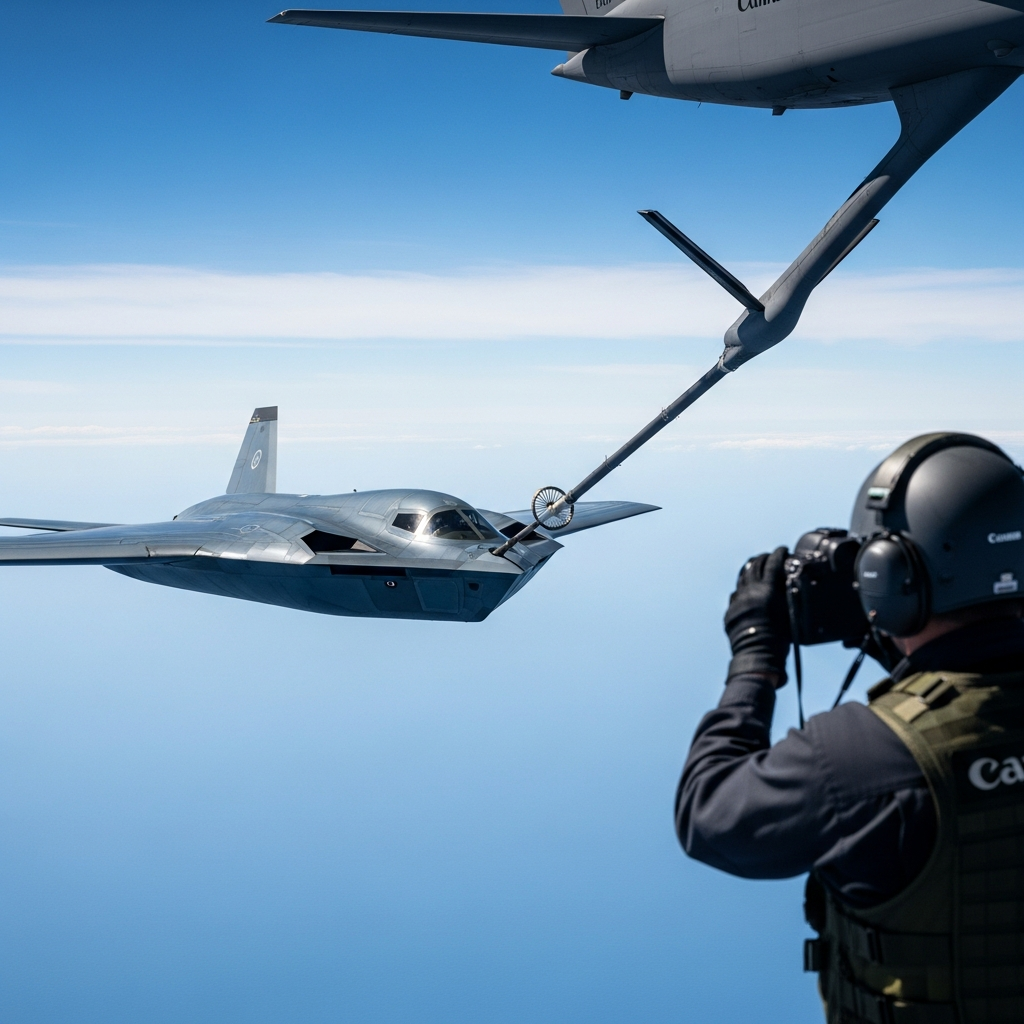
The U.S. Air Force officially confirmed on April 14, 2026, that the B-21 Raider stealth bomber has completed aerial refueling with an NKC-135 — eliminating the last theoretical constraint on the aircraft’s global strike reach. The announcement came jointly with prime contractor Northrop Grumman and included two photographs that offer the clearest look yet at the Raider’s upper fuselage, its distinctive dorsal refueling receptacle, and deeply recessed exhaust outlets.
The first publicly observed refueling event took place on March 10, 2026 — though the official April 14 announcement did not confirm this as the date of the first refueling, nor did it specify when the released photos were taken. The first B-21 prototype — serial AF-0001, nicknamed Cerberus, identifiable by its orange air data probe — flew a 5-hour, 33-minute mission over Eastern California at approximately 23,000 feet. The tanker was NKC-135 serial 61-0320, assigned to the 370th Flight Test Squadron at Edwards Air Force Base. That aircraft carries specialized instrumentation to monitor aerodynamic interaction and fuel transfer behavior during test events. It’s not a standard fleet tanker.
When footage of the March 10 mission surfaced on Flightradar24, the Air Force acknowledged on March 12 that the B-21 had conducted “a close-proximity flight with a KC-135.” The April 14 statement formalized what aviation observers already knew.
What the Photos Reveal
The overhead imagery released April 14 is significant beyond the milestone itself. Observers can now clearly see the B-21’s two-piece clamshell refueling receptacle — positioned just aft of the cockpit, a departure from the B-2 Spirit’s rotating receptacle design. The photos also show chevron-shaped exhaust outlets sunk far forward of the aircraft’s trailing edge, oriented inverted compared to the B-2’s exhaust design. That’s a deliberate choice to suppress the aircraft’s infrared signature from below and behind.
The B-21’s cockpit glazing is notably minimal. The tradeoff comes from needing to reduce frontal radar cross-section while still meeting aerial refueling visibility requirements. Test pilots have reported exceptional handling characteristics during refueling approaches, with strong stability reducing the workload typically associated with flying a large aircraft into the refueling envelope.
Why This Milestone Matters
Aerial refueling isn’t a checkbox. It’s the capability that transforms the B-21 from a long-range bomber into a true global-strike platform with no meaningful range ceiling. With an estimated internal fuel capacity of 110,000 to 120,000 pounds — significantly less than the B-2’s approximately 167,000 pounds — the B-21 compensates through a planform optimized for fuel-efficient, high-altitude flight, making it more economical per mile than the B-2 it will eventually supplement. Add unlimited refueling, and a single B-21 crew can remain airborne for days.
“For our bomber crews and the combatant commanders they support, this is about endurance and mission readiness. This capability ensures we can deliver penetrating long-range strike anywhere in the world, at any time.”
— Gen. S.L. Davis, Commander, Air Force Global Strike Command
“Our teams are moving the B-21 Raider through testing at an unprecedented pace, continually proving its outstanding performance — including aerial refueling.”
— Tom Jones, Corporate VP & President, Northrop Grumman Aeronautics Systems
Production Is Accelerating in Step With Testing
The refueling milestone arrives as the program enters a new production phase. On February 23, 2026 — at the Air & Space Forces Association Warfare Symposium — the Air Force and Northrop Grumman announced a $4.5 billion deal to increase the annual B-21 production rate by 25 percent. Northrop CEO Kathy Warden cited more than $5 billion in prior investment in digital engineering and manufacturing infrastructure at the Palmdale facility as the foundation making that acceleration possible.
The flight test program continues to perform. Multiple aircraft are flying, with most sorties returning “code one” — meaning the aircraft is ready to fly again without maintenance action. For a developmental platform this early in its test campaign, that’s an unusually strong readiness signal.
Defense analyst Mark Gunzinger, a former B-52 pilot, put the milestone plainly: “It’s a great sign that, once again, what we’ve been hearing for a few years is the program is on track and on time, maybe even ahead of schedule.”
What to Watch Next
Testing will now move toward validating the full operational refueling envelope — different altitudes, airspeeds, and fuel transfer rates under varying atmospheric conditions. The first official flight of aircraft T-3 is also worth watching; that would signal the production pipeline is healthy enough to add a third airframe to the flight test rotation. Initial operational capability remains on the horizon. Every milestone between now and then carries weight — and this one landed clean.

Stay in the loop
Get the latest aircraft insider updates delivered to your inbox.