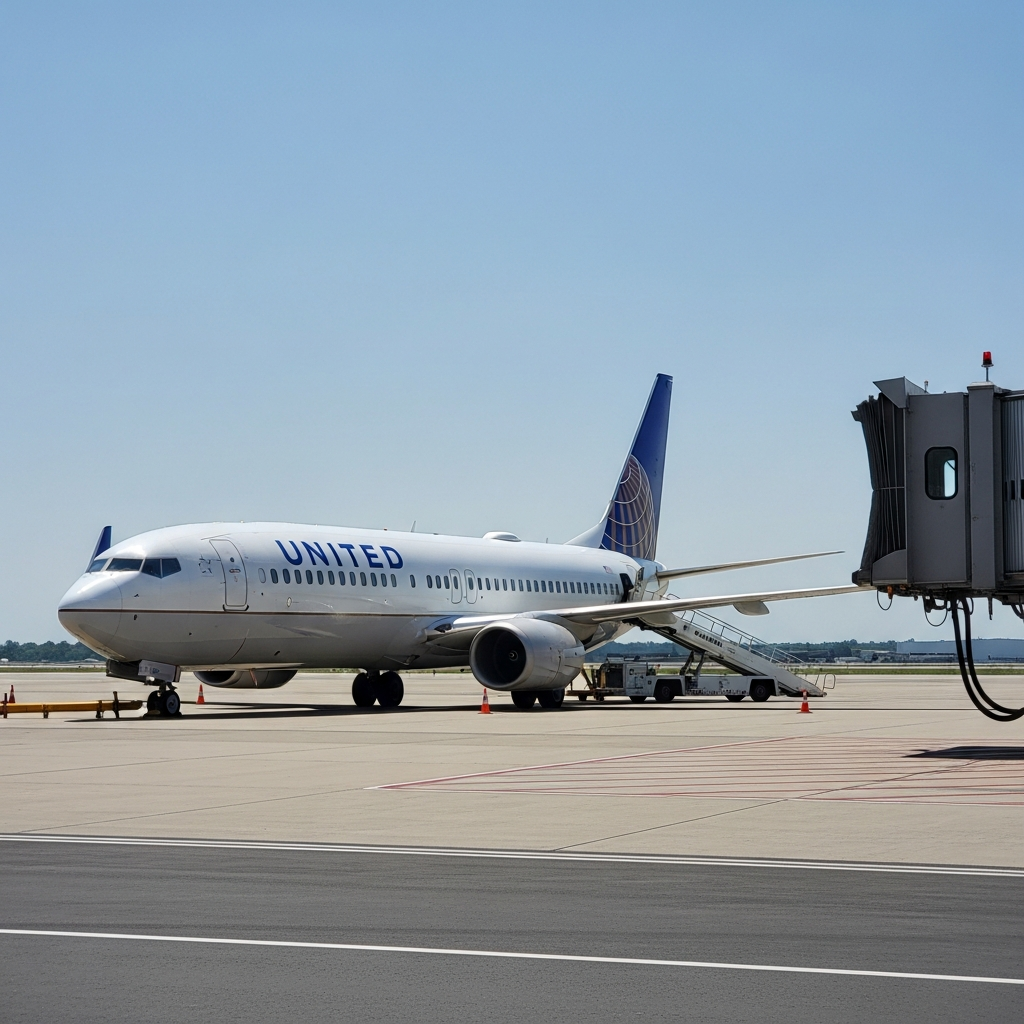
A United Airlines Boeing 737 MAX 8 was diverted to Pittsburgh International Airport on Saturday, April 18, after the flight crew declared a general emergency mid-flight — triggered by a mysterious sequential beeping sound nobody could identify, and ultimately treated as a potential bomb threat.
Flight UA2092 was working the Chicago O’Hare to LaGuardia route. It departed ORD at 9:54 a.m. CDT, nearly two hours late, with 159 passengers and six crew aboard tail number N37325 — a 2.5-year-old MAX 8 fitted with CFM International LEAP-1B28 engines. The aircraft had already flown in from Harrisburg (MDT) that morning before picking up the New York leg.
Somewhere around the halfway point, the crew started hearing it. A repeating sound — one beep per second — appearing to come from beneath the floorboards, according to the pilot. Flight attendants said it got louder. The pilot declared a general emergency and activated Squawk 7700, the internationally recognized emergency transponder code, while the plane was still over Lake Erie, then banked hard right toward Pittsburgh. ACARS messages later circulated on social media carried the phrase: “ONE SECOND COUNT PER BEEP / POSSIBLE BOMB.”
In audio captured on LiveATC.net, the pilot put it simply:
“We’ve got an issue up here. We’re getting a sequential beeping of a suspected item onboard. We are going to have to start treating this as a potential bomb.”
The aircraft touched down at Pittsburgh International at approximately 11:45–11:47 a.m. local time, according to some reports, though FlightAware data has also placed the landing at 12:03 p.m. — a discrepancy in the underlying sources that has not been publicly resolved. By 12:30 p.m., all 159 passengers and six crew had evacuated — not through a terminal gate, but via emergency slides directly onto the runway. No injuries were reported. Passenger video shared on social media showed flight attendants directing people to jump, slide, and move away from the plane immediately.
Response on the Ground
The Allegheny County Police Department’s bomb squad had already been requested at 11:47 a.m. FBI Special Agents and bomb technicians from FBI Pittsburgh arrived alongside explosive detection K-9 units. They swept the aircraft, the passengers, and the luggage. Everything came back negative.
The Allegheny County Police Department confirmed:
“Our EOD team and K9s conducted a sweep of the aircraft, passengers and luggage with negative results. The incident has since been cleared.”
FBI Pittsburgh posted to X: “FBI Pittsburgh is aware of a reported threat onboard a flight headed to New York,” confirming that Special Agent Bomb Techs were on the ground coordinating with local authorities.
United Airlines called it a “potential security concern” and confirmed the slide evacuation. Passengers were eventually put on a replacement 737 — notably, not a MAX — which left Pittsburgh at 4:24 p.m. and landed at LaGuardia at 5:45 p.m., roughly six hours and 32 minutes behind the original schedule. As for N37325, it stayed on the Pittsburgh apron overnight and returned to service the next day, operating UA2267 back to O’Hare.
Source of the Beeping — Still Unknown
As of April 20, no one has publicly identified what made the sound. Speculation on social media ran from a wristwatch alarm to an iPad notification. Aviation security analysts point out that sequential beeping has historically indicated equipment malfunctions rather than deliberate threats — but standard protocol requires treating any unidentified signal aboard a pressurized aircraft as credible until it’s cleared.
The FAA confirmed it monitored the situation and coordinated with the FBI throughout, stating all safety protocols were followed and that a standard post-incident review of flight communications and crew actions will be conducted, which may result in updated guidance for similar scenarios.
No arrests have been made. The FBI’s investigation into the origin of the beeping remains open. The source of the sound — still unidentified — is the key outstanding question in a case that, for now, remains officially unresolved.

Stay in the loop
Get the latest aircraft insider updates delivered to your inbox.