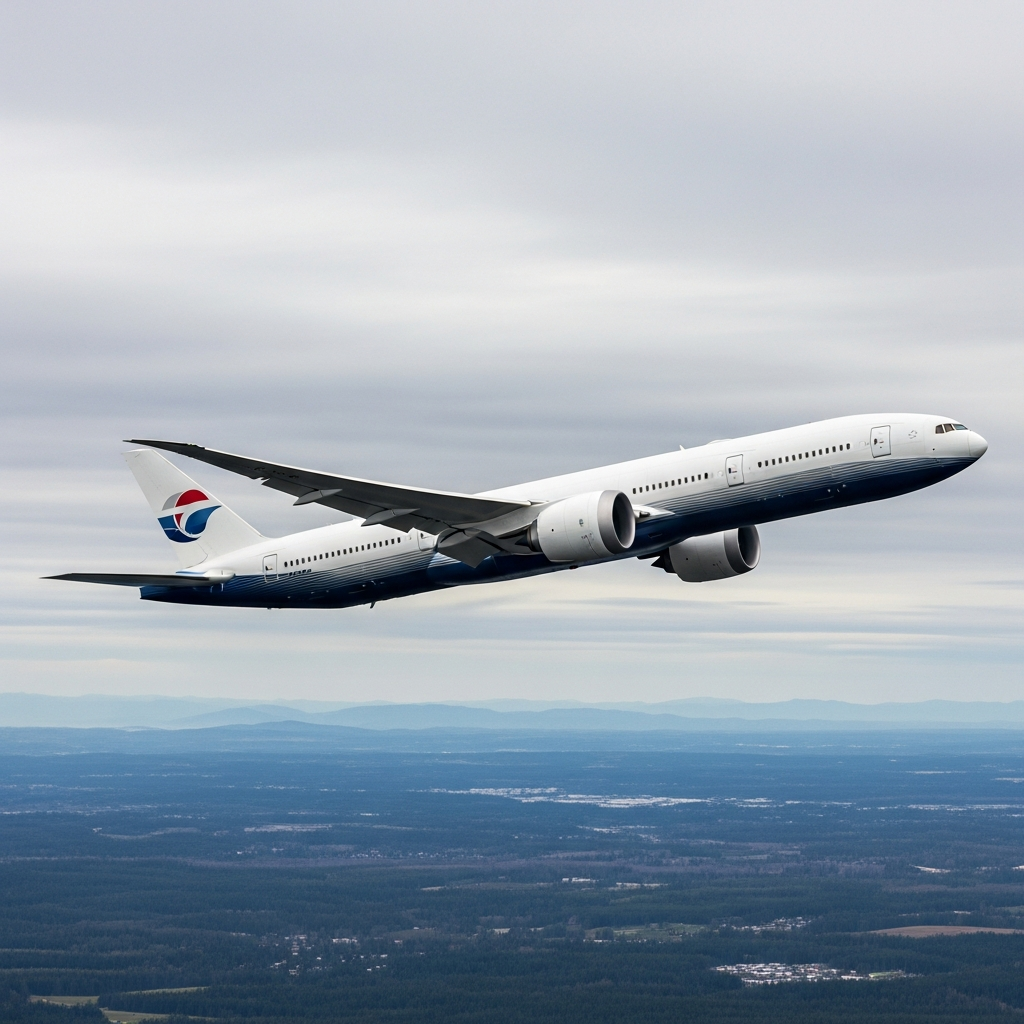
Shortly after 20:40 UTC on May 7, 2026, the first production Boeing 777-9 lifted off from Everett’s Paine Field (PAE) and stayed airborne for three hours and 27 minutes — a flight that marks one of the most consequential milestones in a program that has been defined, for years now, by setbacks. The aircraft, tracked publicly on Flightradar24 under registration N20080 (serial number 1781, callsign BOE128), climbed to 39,000 feet and hit a top speed of 492 knots over Washington state and part of Oregon before touching down at Paine Field at 4:52 p.m. PT.
This was not another test prototype. WH128 is a production-conforming airframe — the sixth 777-9 to fly, but the first built to delivery standard, complete with a fully outfitted passenger cabin configured for launch customer Lufthansa. That distinction matters enormously for certification. Flight hours logged on a production-standard airframe carry direct FAA credit toward type certification in a way that earlier pre-production test aircraft simply could not. Boeing has crossed the line from testing a prototype to certifying a product.
What the Flight Tells Us
Boeing’s 777/777X chief pilot didn’t oversell it after landing:
“The airplane performed as we expected. The 777-9 continues to handle beautifully.” — Grady, Boeing 777/777X Chief Pilot
Boeing’s official statement confirmed the aircraft “performed as expected” and will “continue with planned ground and flight testing in the weeks ahead” — adding a pointed line: “We thank Lufthansa for their partnership.” The more candid voice came from engineering ship captain Sam Damico, who oversaw the airframe’s preparation after rollout, including clear coat application, fueling, engine runs, and taxi tests:
“We’re taking part in something really significant for the company. There’s a lot of pride from everyone who helped bring all of these pieces together, working late nights and weekends, so this airplane can go and do its mission.” — Sam Damico, Boeing Engineering Ship Captain
At the time of the flight, N20080 was still wearing its bare green protective coating. Full Lufthansa livery comes before delivery.
A Program Seven Years Behind Schedule
The 777-9 was originally scheduled to enter service in 2020. It hasn’t. The delays have stacked up relentlessly — a cargo door failure during 2019 ground stress testing, a GE9X technical issue that paused the test program in late 2022, and a fleet-wide grounding in August 2024 after cracks were discovered in engine thrust links connecting the GE9X to the wing. Boeing has absorbed roughly $15 billion in charges on the program. At an estimated $50 million profit per aircraft against a $440 million list price, the company needs to deliver approximately 300 jets just to break even on overruns.
The certification campaign is now in FAA Type Inspection Authorization Phase 4A — a phase Boeing entered in March 2026 that involves FAA test pilots flying alongside Boeing crews in formal evaluation. More than 4,700 flight test hours have been logged to date. April’s maximum-energy brake test at Edwards Air Force Base, where fuse plugs melted as designed under a rejected-takeoff load, cleared another critical box.
One open item demands watching. GE Aerospace is still analyzing a potential durability issue involving a seal in the GE9X engine that could require redesign or retrofit during maintenance. Boeing has said this does not threaten the 2027 delivery target. It has also said that before.
Lufthansa’s Position
Lufthansa Group CEO Carsten Spohr confirmed during the airline’s March 2026 annual press conference that first delivery is targeted for Q1 2027, with the jets entering service that summer. He’s been candid about contingency planning — confirming the Airbus A340-300 will continue to fly in 2027. Emirates, another major customer, has publicly stated it expects its first 777-9s from Q2 2027.
The production flight is a genuine milestone, not a marketing exercise. But FAA certification is still outstanding, the GE9X durability question remains unresolved, and the delivery target has moved four times in five years. Every subsequent test flight bears watching.
Stay in the loop
Get the latest aircraft insider updates delivered to your inbox.