The Boeing 777X was supposed to revolutionize long-haul aviation. Instead, it became a masterclass in delay, cost overruns, and regulatory humbling. Launched in 2013 with promises of 2020 deliveries, the world’s largest twin-engine jet still hasn’t carried a single paying passenger.
But here’s the thing: when it finally arrives—now expected in 2027—the 777X will be genuinely remarkable. The largest commercial jet engines ever built. The first folding wingtips on a passenger aircraft. Windows bigger than any competitor. And a composite wing so massive Boeing built a $1 billion factory just to make it.
This is the story of Boeing’s most ambitious—and most troubled—aircraft program.
Dimensions and Capacity
The 777X comes in two passenger variants, with a freighter on the way:
777-9 (larger variant):
- Length: 251 feet 9 inches (76.7 m)—longer than the Boeing 747-8
- Wingspan: 235 feet 5 inches extended, 212 feet 9 inches folded
- Passengers: 426 typical (two-class)
- Range: 7,285 nautical miles
777-8 (longer-range variant):
- Length: 229 feet (70 m)
- Passengers: 395 typical (two-class)
- Range: 8,745 nautical miles
777-8F (freighter):
- Launching with Qatar Airways
- Replacing aging 747 freighters worldwide
The 777-9 is the launch variant—and it’s massive. At 251 feet, it’s actually longer than Boeing’s own 747-8 jumbo jet.
Performance and Range
The 777X targets the ultra-long-haul market with serious capability:
- Maximum range (777-8): 8,745 nautical miles (16,190 km)
- Maximum range (777-9): 7,285 nautical miles (13,500 km)
- Cruise speed: Mach 0.85
- Maximum takeoff weight: 775,000-805,000 lbs depending on variant
- Service ceiling: 43,100 feet
The range numbers mean the 777-8 can fly nonstop from New York to Singapore, Sydney to London, or Dubai to Los Angeles. The 777-9 trades some range for an extra 31 passengers.
Boeing claims 10% lower operating costs than the competition (the Airbus A350) and 20% better fuel efficiency than the aircraft it replaces.
Engines and Powerplant
The GE9X is the star of the show—and it’s genuinely unprecedented.
- Fan diameter: 134 inches (11.2 feet)
- Nacelle width: 184 inches—wider than a Boeing 737’s fuselage
- Thrust: 105,000 lbf (rated), 134,300 lbf (tested world record)
- Bypass ratio: 10:1
- Pressure ratio: 60:1
- Weight: 21,230 lbs
- Fan blades: 16 (composite)—down from 22 on the GE90
In November 2017, a GE9X set the Guinness World Record for thrust, producing 134,300 lbf. That’s 6,400 lbf more than the previous record holder—the GE90 that powers current 777s.

The engine’s size is genuinely absurd. You could fit the entire passenger cabin of a Boeing 737 inside one GE9X nacelle. The 16 composite fan blades alone are each the size of a person.
Cockpit and Avionics
The 777X flight deck builds on the current 777 with significant upgrades while maintaining pilot commonality. Type-rated 777 pilots can transition with minimal additional training.
Key features include:
- Touchscreen-capable displays with modernized interface
- Fly-by-wire flight controls (new for the 777 family)
- Enhanced situational awareness systems
- Dedicated folding wingtip controls
The folding wingtips are controlled via a dedicated overhead switch. When extended, the system shows a clear “extended” confirmation. Once locked in flight position, the wingtips are electronically isolated and mechanically locked with a physical bolt—they cannot fold in flight.
Cabin and Passenger Experience
Boeing brought Dreamliner technology to the 777X cabin:
- Windows: 162 square inches—29% larger than the A350-1000 and the largest on any commercial aircraft
- Cabin altitude: 6,000 feet (vs. 8,000 on older aircraft)
- Cabin width: 235 inches (increased from 231 on current 777s)
- LED lighting: Circadian-attuned to reduce jet lag
- Humidity: Higher cabin humidity for passenger comfort
The windows use Gentex’s latest electronically dimmable technology, eliminating 99.999% of visible light at twice the speed of previous systems. Flight attendants can control all windows centrally—no more reaching over passengers.
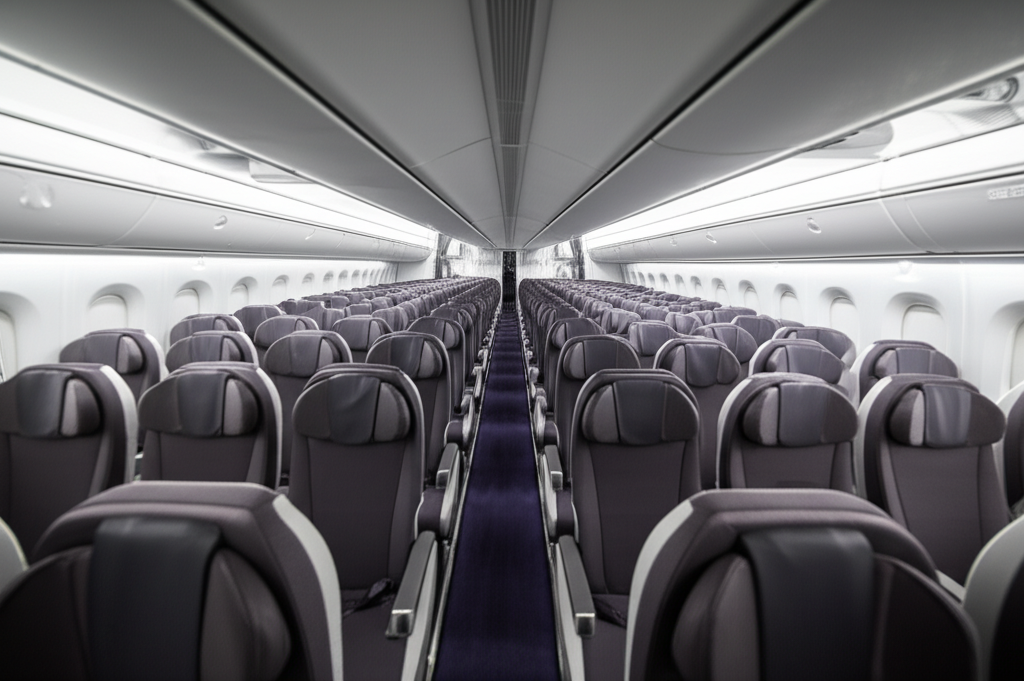
The trade-off: Most airlines will configure the 777-9 with 10-abreast seating in economy, which is tighter than the A350’s 9-abreast standard. The extra capacity is the point, but long-haul comfort depends heavily on your airline’s configuration choices.
Economic Impact
The 777X’s business case centers on one metric: cost per seat.
- 20% lower fuel consumption than the 777-300ER it replaces
- 10% lower operating costs than the Airbus A350-1000
- 40% smaller noise footprint than predecessor aircraft
- List price: $442.2 million (777-9), $410.2 million (777-8)
The math works best on high-demand, slot-constrained routes where airlines need maximum seats. Think Dubai-London, Singapore-Sydney, or any major hub-to-hub route where filling 426 seats is realistic.
For airlines already operating 777s, fleet commonality means reduced training and parts costs. Emirates, with 270 777X on order, is betting its future on this aircraft.
Environmental Considerations
Boeing claims the 777X will produce 20% lower CO2 emissions than the aircraft it replaces, primarily through:
- GE9X engine efficiency improvements
- Composite wing aerodynamics (10:1 aspect ratio vs. 9:1 on current 777)
- Reduced weight from carbon fiber construction
- Higher bypass ratio engines producing less NOx
The 40% noise reduction is significant for airport communities and may allow the 777X to operate at airports with strict noise curfews.
However, like the A321XLR, the 777X’s efficiency gains may be offset by enabling more ultra-long-haul flights that weren’t previously economical.
Safety Features
The 777X’s most novel safety consideration is its folding wingtips—unprecedented on a commercial aircraft.
Boeing designed multiple redundancies:
- Mechanical lock: Large physical locking bolt secures wingtips when extended
- Electronic isolation: Wingtip controls are electronically disabled in flight
- Visual confirmation: Clear cockpit display shows locked/unlocked status
- Automatic fold: Wingtips fold automatically at 50 knots after landing
The certification process for folding wingtips has been extensive—this is the first time the FAA has certified such a system for commercial passenger operations.
Comparisons with Competitors
| Specification | 777-9 | A350-1000 | 777-300ER |
|---|---|---|---|
| Passengers | 426 | 369 | 396 |
| Range | 7,285 nm | 8,700 nm | 7,370 nm |
| Length | 251 ft 9 in | 241 ft | 242 ft 4 in |
| Status | Certification 2027 | In service (2018) | In production |
| List Price | $442M | $367M | $375M |
The A350-1000 has been flying since 2018, giving Airbus a nearly decade-long head start. But the 777-9 carries 57 more passengers—a meaningful difference on high-demand routes.
Six airlines have ordered both: Qatar Airways, Etihad, Cathay Pacific, British Airways, Air India, and Lufthansa. They’re hedging their bets.
Airlines and Orders
As of late 2025, the 777X has 619 orders from 12 customers:
- Emirates: 270 aircraft (largest customer by far)
- Qatar Airways: 94 aircraft (including 777-8F freighters)
- Lufthansa: 27 aircraft (announced launch operator)
- Cathay Pacific: 21 aircraft
- Singapore Airlines: 31 aircraft
- British Airways: 18 aircraft
- All Nippon Airways: 20 aircraft
- Etihad Airways: 25 aircraft
Launch operator: Lufthansa was announced as launch customer when it ordered 20 aircraft in 2013, initially planning 2020 debut. After repeated delays, first delivery is now expected 2027.
Notable: Emirates added 65 more 777-9s at the November 2025 Dubai Airshow, bringing their total to 270. They’re replacing their iconic A380 fleet with the 777X.
Concerning: No new 777X customers have emerged since 2019. Airlines are waiting to see it actually fly.
The Real Story
Seven years late and $15 billion over budget:
The 777X was supposed to enter service in 2020. Then 2022. Then 2025. Now 2027. Each delay has cost Boeing billions—the program has accumulated roughly $15 billion in cost overruns, including a $4.9 billion charge in Q3 2025 alone.
The door that blew off:
Certification testing began in September 2019 and immediately went wrong. During an extreme pressurization test, a cargo door blew off the aircraft in a hangar—while the FAA was watching. Testing halted for months.
The pylon crack:
In mid-2024, a scheduled inspection found a structural crack in a thrust link—the component that transfers engine thrust to the airframe. Flight testing stopped for four months while Boeing redesigned and reinforced the component. This wasn’t a minor issue; it was a fundamental structural problem.
The engine issue (late 2025):
During a borescope inspection in November 2025, an unspecified issue was discovered with a GE9X test engine. Flight tests paused again while Boeing and GE investigated. The drumbeat of problems continues.
Post-MAX scrutiny:
The 777X’s delays aren’t just technical—they’re regulatory. After the 737 MAX crashes, the FAA has become dramatically more rigorous. Boeing CEO Kelly Ortberg acknowledged the delays stem from “a mountain of work” on certification, not new technical problems. The FAA isn’t rushing anything.
The $1 billion wing factory:
Boeing built an entirely new factory in Everett just to fabricate the 777X’s composite wing—the first Boeing has made in-house rather than outsourcing (as they did with the 787). The wing is the largest they’ve ever designed, and making it required massive robotic machinery and high-pressure ovens. Sunk cost: $1 billion before a single wing was complete.
Fun Facts and Trivia
The GE9X is absurdly large: The engine nacelle is 184 inches wide. The Boeing 737’s fuselage is 148 inches wide. You could literally fit a 737’s cabin inside one 777X engine.
Fighter jet heritage: The 777X is the first commercial aircraft with folding wingtips, but the technology has been used in military aviation for nearly 100 years. Like an F/A-18 Super Hornet folding its wings to fit on an aircraft carrier, the 777X manages its size to fit at airport gates designed for smaller aircraft.
The 20-second transformation: From start to finish, the entire wingtip folding process takes 20 seconds. They fold automatically when the aircraft slows below 50 knots after landing.
First flight drama: The 777X first flew on January 25, 2020. After 3 hours and 52 minutes circling Mount Rainier for air-to-air photos, it landed at Boeing Field to cheering employees. Boeing described it as “a moment of brightness.” Five years later, it still hasn’t carried a paying passenger.
The world record engine: On November 10, 2017, a GE9X produced 134,300 lbf of thrust—a Guinness World Record. That’s enough force to accelerate a 747 from standstill to 60 mph in under 2 seconds.
16 fan blades vs. 22: Despite being larger than the GE90, the GE9X uses only 16 composite fan blades compared to the GE90’s 22. Each blade is roughly the size of an adult human.
The composite wing weight savings: Boeing built the 777X wing from carbon fiber composites rather than aluminum. The weight savings allow the 71.8-meter wingspan that makes the aircraft so efficient—an aluminum wing that size would be too heavy to fly.
Future Prospects
The 777X’s future hinges on 2027 certification. If Boeing delivers:
- Emirates’ A380 replacement accelerates, potentially ordering more 777Xs
- New customers emerge from the fence-sitting phase
- The 777-8F becomes the dominant widebody freighter
- Boeing regains ground lost to Airbus in the widebody market
If delays continue:
- Customer patience runs out—conversions to A350 orders
- Cost overruns mount further, threatening program viability
- Boeing’s credibility in the widebody market suffers permanent damage
The 777X remains a unique aircraft with no direct competitor. Only the A350-1000 comes close, and it carries 57 fewer passengers. For airlines needing maximum capacity on premium routes, the 777X is still the only answer—if it ever arrives.
Conclusion
The Boeing 777X is either a cautionary tale of overpromising and underdelivering, or an engineering marvel delayed by unfortunate circumstances and post-MAX regulatory reality. Probably both.
The aircraft itself is genuinely impressive: the largest commercial jet engines ever built, the first folding wingtips on a passenger plane, composite wings Boeing fabricated in a $1 billion purpose-built factory, and a cabin with the largest windows in aviation.
But none of that matters until passengers board. And passengers have been waiting since 2020.
With 619 orders and Emirates betting its fleet future on the 777X, the stakes couldn’t be higher. If Boeing pulls off certification in 2027, the 777X will be worth the wait. If delays continue, it becomes a case study in how not to manage an aircraft program.
For now, the 777X remains the world’s most impressive aircraft that almost nobody has flown.


Leave a Reply