Cessna 172 Engine Won’t Start — What To Check First
Diagnosing a no-start Cessna 172 has gotten complicated with all the forum noise and contradictory checklist advice flying around. As someone who’s logged several hundred hours in Skyhawks — including one genuinely embarrassing morning at Peachtree City where I cranked N7342R for a solid 45 seconds while a line guy watched — I learned everything there is to know about why these engines refuse to wake up. Today, I will share it all with you.
So, without further ado, let’s dive in.
Is the Engine Flooded? Start Here
But what is a flooded engine, exactly? In essence, it’s raw liquid fuel pooling inside the combustion chambers before ignition. But it’s much more than that — it’s also the single most common reason a 172 sits silent on the ramp while you sweat through your headset.
Raw fuel has no business being inside those cylinders in liquid form. The spark plugs are wet. The magnetos are working fine. The compression is there. Nothing fires anyway. On a 172 this almost always traces back to over-priming — three pumps when the engine needed one — or sitting at idle with the mixture way too rich before shutdown.
The symptom is hard to miss. Walk around to the cowl and take one breath. If it smells like a Shell station in August, you’re flooded. The engine won’t even cough when you crank it.
Here’s the unflood procedure:
- Set mixture control to Idle Cutoff — full aft, no exceptions.
- Open throttle completely. All the way forward.
- Engage starter and crank for 10 to 15 seconds without touching the primer.
- Wait 10 seconds. Repeat if the fuel smell is still strong.
Cranking with throttle wide open pumps air through the cylinders and pushes liquid fuel out through the exhaust. After two or three cycles, that sharp smell fades noticeably. That’s your signal. Prime normally — one pump, maybe two — crack the throttle about a quarter inch, move mixture to full rich, and try a normal start. The engine catches immediately when the cylinders are actually clear.
That’s what makes this step endearing to us Skyhawk pilots — it fixes itself in under 60 seconds and requires zero tools.
Check the Basics Before You Blame the Engine
Probably should have opened with this section, honestly. Flooded engines jumped the queue because they’re statistically more common. Still — run through these before touching anything else. Even 3,000-hour pilots get caught by these on a busy Saturday morning.
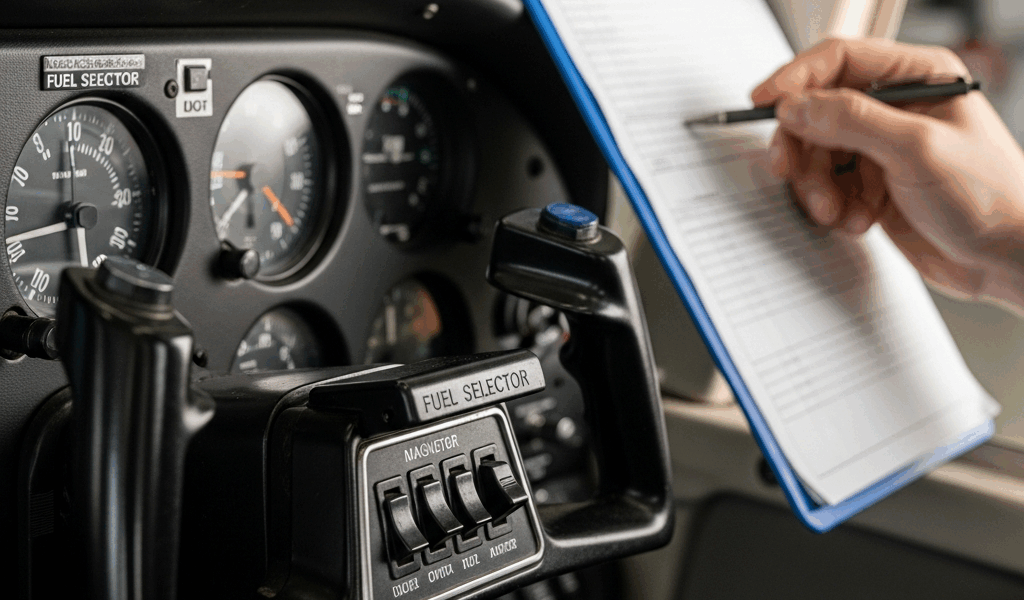
Fuel selector in BOTH position. Not LEFT. Not RIGHT. Both. Look at the handle physically — don’t assume. A 172 running on one tank alone behaves unpredictably depending on fuel state, and it almost certainly won’t start reliably that way.
Master switch actually ON. Flip it and then look at the panel. Avionics lit? G1000 or the old steam gauges showing voltage? If the screen is dark and the bus voltage reads zero, the master didn’t engage. I’m apparently bad at confirming this under pressure and my pre-start habit of touching the switch twice works for me while a single flip never quite does.
Mixture not sitting at Idle Cutoff. Different situation from a flooded engine. If you’re attempting a normal cold start at sea level and mixture is already full aft, nothing will happen. Full rich for cold starts at field elevations under 3,000 feet. Don’t make my mistake of forgetting this after an unflood attempt.
Primer pump locked. Older 172 models — anything pre-1996 or so — have a lock ring on the primer knob. Turn it counterclockwise before pulling. A locked primer won’t deliver fuel to the cylinders regardless of how many times you pump it.
All four issues produce the same symptom. Engine cranks. Nothing fires. Fixing any one of them takes five seconds flat.
Battery and Electrical System Issues
First, you should rule out the basics above — at least if you want to avoid chasing an expensive electrical ghost that turned out to be a selector handle.
That said. If everything checks out and the starter is still giving you trouble, the sound tells you what you need to know.
Rapid clicking — fast, mechanical, almost frantic — means the solenoid is engaging but there isn’t enough voltage to spin the starter motor. The battery is low or compromised. You’ll also notice the avionics are dim. The nav lights look tired. That combination is the giveaway.
Silence means nothing is happening at all. Zero solenoid engagement. The battery voltage on the bus reads under 10 volts when master goes on, sometimes less. That’s a dead battery, not a bad starter.
A sluggish, slow crank — maybe one labored rotation per second — points to a partially discharged battery struggling against cold oil. At 40°F on a Wisconsin December morning, even a battery at 70% charge may not have the authority to turn a cold O-320. That’s not a coincidence. Cold oil is thick and the engine fights back hard.
Field checks worth doing:
- Look at both battery terminals — the main battery is typically in the engine compartment forward of the firewall on most 172 models. White or blue-green crust means corrosion. Clean it with a wire brush. Corrosion resistance alone can kill enough voltage to prevent starting.
- Check whether your airplane has a ground power receptacle — most 172s built after 1968 or so do, usually on the left side of the cowl. A ground power unit at 28V with 300+ amp capacity will start the engine even if the onboard battery is nearly dead.
- Tap the starter solenoid lightly with a wrench handle while someone presses the starter button. Bad solenoid contacts occasionally make momentary connection under light impact. It’s not a fix — it’s a diagnostic tap.
Corrosion is pilot-addressable. A dead battery needs a GPU or a replacement. Hand-propping is an option only if you’re current and trained on it and the conditions actually support it — which, at a busy FBO, they often don’t.
Magneto and Ignition System Problems
So the starter is turning the engine over with real authority. The prop is spinning. Nothing fires. No cough, no brief catch, nothing.
Suspect the magnetos. A Cessna 172 runs two independent magneto systems — left and right — each with its own harness and set of spark plugs. Both fire under normal operation. If one is dead, you’ll know it on runup. If both are compromised, the engine turns over without igniting at all.
Check the magneto switch position first. It needs to be in BOTH. Not LEFT, not RIGHT. This sounds obvious and it is obvious, which is exactly why it gets missed during a rushed preflight.
A more nuanced diagnostic — if the engine starts briefly then dies on BOTH but runs rough on one position alone:
- Switch to LEFT only and attempt a start. Engine fires and runs rough? Your right magneto is the problem.
- Switch to RIGHT only. Same result? Left magneto is the issue.
- If neither alone produces any start, both systems have a problem — or you’re looking at something deeper in the ignition harness.
A bad magneto means no spark on that side. The engine will technically run on a single magneto — rough, weak, and alarmingly reluctant — but won’t sustain normal operation. That’s what makes magneto issues dangerous on solo flights: the problem is real, but the airplane technically moves. Don’t fly it.
This is where pilot troubleshooting ends. Call your mechanic. Tell them specifically which magneto position produced what result. That information cuts their diagnostic time in half.
When To Stop Troubleshooting and Call a Mechanic
While you won’t need a full avionics bay or specialized ignition tester, you will need a handful of specific observations to make your mechanic’s job actually productive.
The line between what you can address and what requires an A&P is real. You cross it the moment you’ve confirmed the engine isn’t flooded, the preflight items are all correct, the battery has authority, and the thing still won’t fire.
Here’s what to report — specifically:
- Fuel smell present or absent when you opened the cowl?
- Did the starter engage? Did the engine actually turn over, and at what speed?
- What happened when you tested individual magneto positions?
- Did the engine cough, catch briefly, or show any sign of wanting to fire?
- When did it last start successfully, and what were conditions like?
A bad starter solenoid might be the best option to suspect if you’re hearing clicks with no crank, as the ignition system requires confirmed mechanical engagement first. That is because a solenoid failure mimics a dead battery almost perfectly — same sound, different fix entirely. An internal fuel leak smells wrong and doesn’t respond to priming. A broken ignition harness kills one magneto cleanly. A failed fuel pump leaves the engine turning over endlessly without ever catching fuel.
These all feel different in the seat. Your observations are diagnostic data. Write them down if you need to — time of attempt, temperature, what the starter sounded like, what the fuel smell was doing. Then let your mechanic open the cowl. Don’t guess. Don’t assume it’s catastrophic. And don’t try to jump or bypass anything you didn’t install yourself.
Most no-start situations on a 172 resolve in under ten minutes with zero tools. The ones that don’t resolve that way have clear, describable symptoms — and a mechanic who gets good information fixes them faster and cheaper than one chasing vague complaints. That’s the whole game.

Leave a Reply