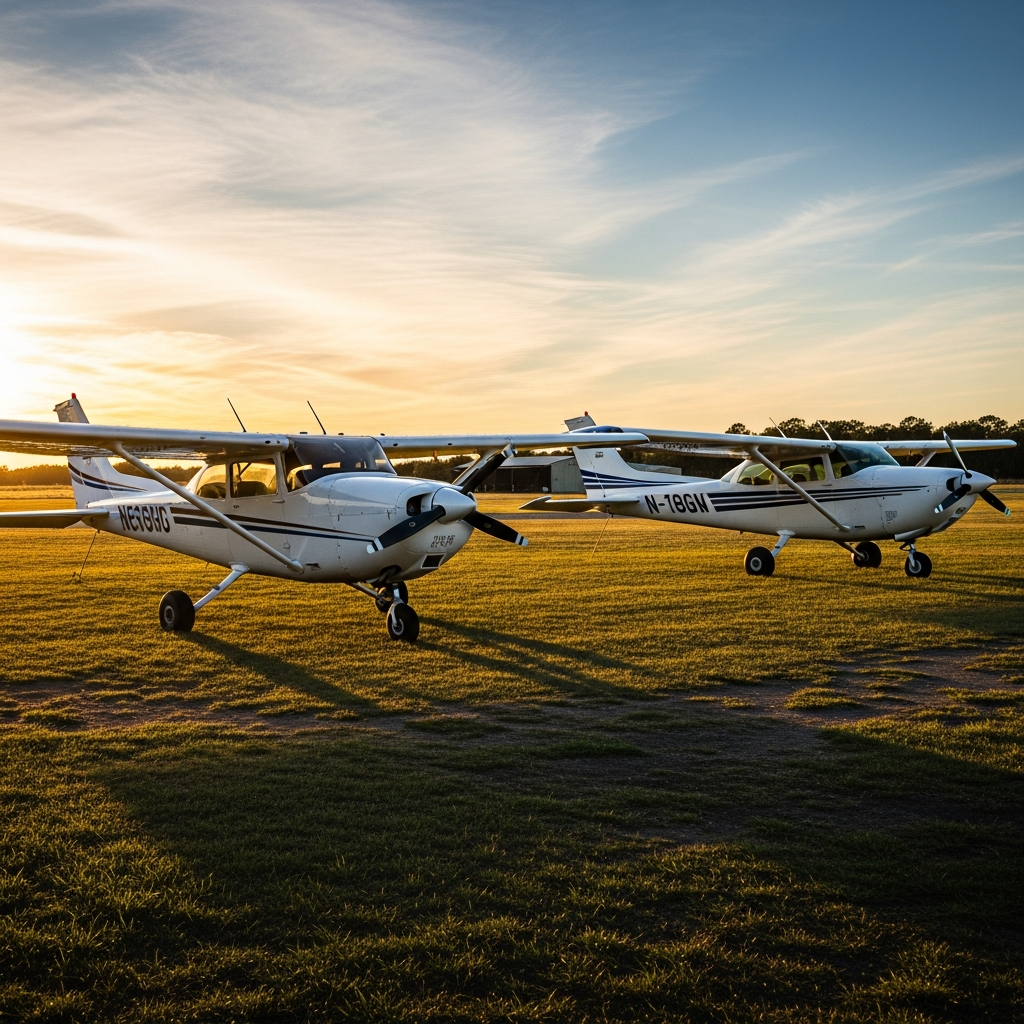
Cessna 172 vs 182 — Which One Should You Actually Buy?
The Quick Answer — Which Cessna Should You Buy?
The Cessna 172 vs 182 debate has gotten complicated with all the bad advice flying around — hangar talk, forum posts, YouTube guys who owned one airplane for six months. My answer has gotten less diplomatic over the years. Buy the 172 if you’re training, stacking hours, or mostly flying solo. Buy the 182 if you regularly need three adults, real luggage, and runways above 3,000 feet density altitude without sweating the climb out. Those are two genuinely different missions. Pretending one airplane handles both equally doesn’t help anyone make a good decision.
I owned a 1978 Cessna 172N for four years before getting into a partnership on a 1998 Cessna 182S. On paper the jump looked significant — 160 horsepower versus 230, fixed pitch versus constant-speed prop, roughly $85,000 versus $210,000 on today’s market. In practice, the differences showed up in places I didn’t fully expect. Some went my way. A few cost me money before I figured out what I was actually dealing with.
This isn’t a spec-sheet comparison. You can find those anywhere. This is what it actually feels like to own and fly both airplanes, with real numbers attached.
Engine and Performance — 160 HP vs 230 HP in Practice
The first time I flew a 182, I was genuinely surprised by how little the horsepower difference mattered on a calm morning at sea level. Standard conditions flatter both airplanes. The real separation shows up the moment conditions stop cooperating.
The 172N’s Lycoming O-320-H2AD puts out 160 horsepower. The 182S runs a Lycoming IO-540-AB1A5 — 230 horsepower, fuel injected, constant-speed prop. On paper that’s a 44% power bump. In practice, at 5,500 feet density altitude on a 95-degree afternoon in Colorado, it’s the difference between climbing at 400 feet per minute and climbing at 900.
Here are the book numbers, which track pretty close to what I’ve seen in actual conditions:
- Cessna 172S (current production baseline): Sea-level climb rate 730 FPM, cruise at 75% power approximately 122 knots, service ceiling 14,000 feet
- Cessna 182T (current production baseline): Sea-level climb rate 924 FPM, cruise at 75% power approximately 145 knots, service ceiling 18,100 feet
That cruise speed gap — roughly 23 knots — adds up on a four-hour cross-country. We’re talking nearly 90 miles. Flying 200-mile trips, it matters less. Flying 500-mile trips regularly, the 182 starts making a real scheduling argument.
What the book doesn’t capture is how the constant-speed prop changes the character of the whole airplane. The 172’s fixed-pitch prop is simple, honest, forgiving. Set power, get what you get. The 182 asks you to manage throttle and prop simultaneously — small workload increase, but you gain genuine efficiency control at cruise altitudes. Lean it properly at 8,500 feet and you’ll see 14 GPH instead of 16. That discipline pays off over time.
The IO-540 is fuel injected, which eliminates carburetor ice concerns entirely — but makes hot starts a specific skill you have to develop. I flooded the engine twice in my first month before I got the starting procedure dialed in. Embarrassing on a busy FBO ramp with three planes waiting behind you. Worth mentioning.
Density Altitude — Where the 172 Gets Honest
Take a fully loaded 172 to Leadville, Colorado — KLXV, field elevation 9,927 feet — on a warm summer afternoon and you’re staring at density altitudes above 12,000 feet. The airplane will fly. It will not impress you. Climb rates of 100–200 FPM are real numbers up there, and obstacle clearance becomes an actual planning item rather than a formality you check off.
The 182 at that same airport on the same day climbs out at 400–500 FPM. Still not aggressive. Still requires honest planning. But it’s a completely different conversation when you’ve got three passengers and bags stuffed behind the rear seats.
What Four Adults Actually Feels Like in Each Airplane
Probably should have opened with this section, honestly, because this is where most buying decisions should start — and almost never do.
The 172’s published useful load varies by year and equipment. A typical mid-1970s to 1980s model runs around 880 pounds. Modern 172S models come in around 878 pounds. The 182 — depending on year and avionics stack — typically lands between 1,050 and 1,100 pounds useful load.
Let’s do the weight and balance math that brochures quietly skip.
Four average adults at 190 pounds each — 760 pounds of people. Add 60 pounds of luggage, two bags per couple, nothing dramatic — and you’re at 820 pounds of payload before you’ve touched the fuel caps.
- 172 with 880 lb useful load: 820 lb payload leaves 60 lbs for fuel. That’s roughly 9 gallons. You are not going anywhere useful. Local pattern work, maybe.
- 182 with 1,100 lb useful load: 820 lb payload leaves 280 lbs for fuel. At 6 lbs per gallon, that’s about 46 gallons. Full tabs on a 182 hold around 56 usable gallons. You can realistically fly 2.5 to 3 hours with reasonable reserves.
The 172 is — honestly — a two-adult airplane with full fuel. Sometimes two adults and two small kids with reduced fuel. The moment someone starts talking about flying four people to the mountains for the weekend, the 172 requires a very awkward conversation about fuel stops, weight limits, and bags getting left at home. I’ve had that conversation. It doesn’t go well in a FBO parking lot when someone rolls up dragging a hard-sided Rimowa.
The 182 isn’t a cargo hauler. But it makes four-seat flying actually work in the real world rather than just theoretically on a spec sheet.
Cabin Space — The Part Nobody Measures
Both airplanes share essentially the same cabin width — about 40 inches. Rear seat legroom is comparable. The 182 sits a bit higher and some pilots find entry easier, but the difference is marginal either way. Neither airplane is comfortable for a six-foot-four passenger in the back seat for more than two hours. That’s just the Cessna four-seat reality, full stop.
Annual Cost of Ownership — The Numbers Nobody Talks About
I tracked every dollar I spent on both airplanes. Not because I’m obsessive — because my wife asked me to justify the 182 partnership and I needed hard numbers she could actually look at. Here’s what 100 hours per year realistically looks like on each.
Fuel Costs
The 172 burns 8–10 GPH depending on power setting and altitude. Call it 9 GPH as a working average. The 182 burns 13–14 GPH at cruise, sometimes 15 if you’re not leaning aggressively. Call it 13.5 GPH as a realistic number.
At $6.50 per gallon avgas — roughly the national average at self-serve pumps as of late 2024, though it swings wildly by region. I’ve paid $5.20 in Kansas and $8.90 in California within the same month:
- 172 fuel cost per hour: $58.50
- 182 fuel cost per hour: $87.75
- Annual fuel difference at 100 hours: approximately $2,925
Insurance
This one surprised me more than anything else on the list. My 172N policy through Avemco ran $1,100 per year — $0 in-motion deductible, $100,000 smooth hull. When I joined the 182S partnership — same certificate, same ratings, same hours — the quote came back at $3,200 for my share of a partnership policy on a $210,000 hull. The insurer cited the high-performance endorsement requirement, higher hull value, and more expensive replacement parts.
Insurance on a 182 also reacts more sharply to pilot experience. New private pilots under 300 hours often face either declined coverage or premiums that make ownership genuinely unworkable. The 172 is more forgiving in the underwriting room — that’s just how it is.
Annual Inspection and Maintenance
A basic annual inspection on a 172 at a shop charging $95/hour runs $800–$1,200 if the airplane is clean. Add a few squawks and you’re at $1,500–$2,000. A 182 annual starts around $1,200–$1,600 and climbs faster — the IO-540 has more cylinders, the constant-speed prop has its own inspection cycle, and parts cost more across the board. Budget $2,000–$3,000 for a clean 182 annual.
Engine reserve is where numbers get serious. The Lycoming O-320 or O-360 in a 172 has a 2,000-hour TBO, and factory overhaul runs roughly $18,000–$22,000 — call it $9–$11 per hour in reserve. The IO-540 in the 182 shares that 2,000-hour TBO, but factory overhaul runs $28,000–$35,000 depending on what they find inside. Reserve $14–$18 per hour and don’t let anyone talk you out of it.
The Annual Cost Table — 100 Hours
| Cost Category | Cessna 172 | Cessna 182 |
|---|---|---|
| Fuel (100 hrs) | $5,850 | $8,775 |
| Insurance (annual) | $1,100 | $3,200 |
| Annual inspection | $1,500 | $2,500 |
| Engine reserve | $1,000 | $1,600 |
| Prop reserve | $200 | $600 |
| Hangar/tie-down | $2,400 | $2,400 |
| Annual total | $12,050 | $19,075 |
| Cost per hour | $120.50 | $190.75 |
That $70-per-hour gap is real and it compounds fast. At 100 hours a year, the 182 runs roughly $7,000 more to operate annually. Over five years of ownership, that’s $35,000 in additional operating costs before you’ve even touched the acquisition price difference. A used 182 can run $80,000–$125,000 more than a comparable 172 depending on year and avionics. Total ownership cost gap over five years can easily clear $150,000.
Whether that’s worth it depends entirely on whether you’re using what you’re paying for. Flying four people to mountain airports four times a year — probably yes. Flying solo on $100 hamburger runs — you’re paying for a pickup truck and driving it like a sedan every single time.
The High-Performance Endorsement Question
Federal regulations require a high-performance endorsement — logged in your logbook, signed off by a CFI — to act as pilot in command of any aircraft with more than 200 horsepower. The 182’s IO-540 at 230 HP triggers this. The 172 does not.
This matters less than people make it out to, but it’s not nothing either.
Getting the endorsement typically takes 3–5 hours of dual instruction — constant-speed prop operation, power management, high-HP performance characteristics. At $200–$250 per hour for instructor plus rental aircraft, budget $600–$1,250 to get it done properly. I did mine in a rented 182RG over two afternoons with a CFII out of Scottsdale. Logged 4.2 hours dual. $920 all-in. Don’t make my mistake of trying to rush it into one long day — the prop management piece needs time to actually sink in.
The endorsement is a one-time cost with no written test, no checkride — just a logbook sign-off from a CFI who decides you’re proficient. It also isn’t airplane-specific, so once you have it, you carry it forward to any high-performance aircraft you fly.
What it does create is a gatekeeping moment that catches people off guard. Rental 182s for endorsement training aren’t sitting at every airport. Some insurance policies require a minimum number of high-performance hours before they’ll write coverage at all — which creates a genuine chicken-and-egg problem if you’re trying to insure a 182 you just bought with zero time in type.
The practical path for most people — if the 182 is truly the airplane you want — is to get the endorsement in a rental 182 before you sign the purchase agreement. Show up at closing with 10–15 hours of 182 time already in your logbook and you’ll have significantly fewer insurance headaches on day one.
Resale Value and Market Availability
The 172 is the best-selling airplane in history — Cessna has built over 44,000 of them. That market depth means you can find a 172 in almost any configuration, year, and price point within a few weeks of looking. It also means the market stays liquid. Need to sell one? You can.
Approximate price ranges for common model years as of late 2024:
- 1968–1975 Cessna 172 (C-K models): $35,000–$55,000
- 1976–1986 Cessna 172N/P: $55,000–$80,000
- 1996–2006 Cessna 172R/S (Lycoming IO-360): $130,000–$185,000
- 2010+ Cessna 172S: $220,000–$290,000 new-ish
The 182 commands a consistent premium across every era:
- 1961–1975 Cessna 182 (E-P models, O-470 engine): $45,000–$75,000
- 1977–1986 Cessna 182Q/R (O-540 era): $70,000–$105,000
- 1997–2006 Cessna 182S/T (IO-540): $185,000–$260,000
- 2010+ Cessna 182T: $310,000–$420,000
Older 172 and 182 models have held value remarkably well over the past decade — apparently better than most people expected. The general aviation supply crunch, combined with Textron’s ballooning new-aircraft prices, has pushed used values up significantly since 2019. A 172N that sold for $38,000 in 2015 is a very different story on today’s market.
Stay in the loop
Get the latest aircraft insider updates delivered to your inbox.