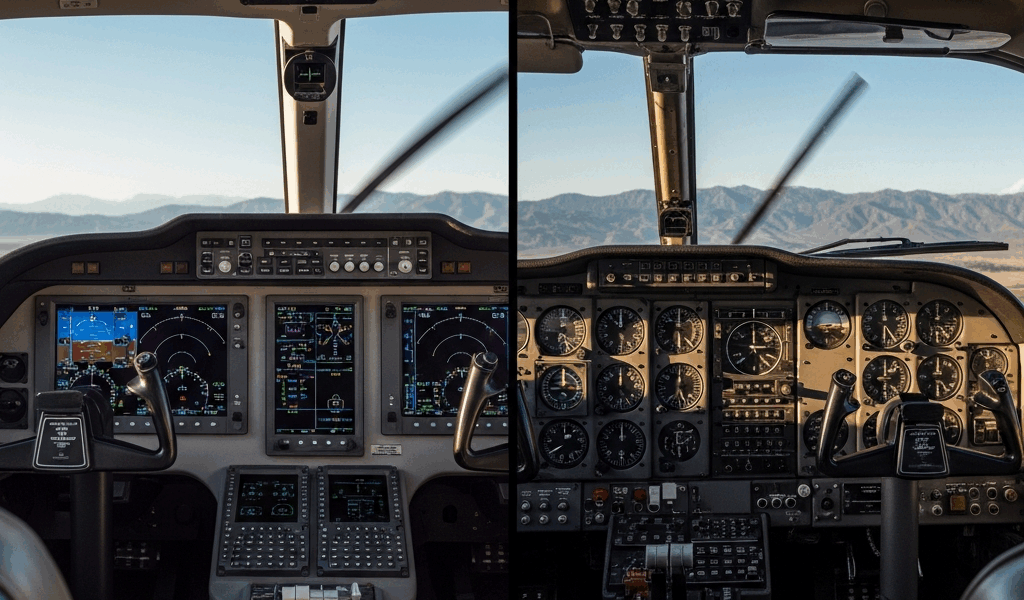
The Short Answer — Pick Your Mission
The Cirrus SR22 vs Bonanza A36 debate has gotten complicated with all the forum noise and hangar-talk flying around. I’ll cut straight to it: neither airplane wins outright. What wins is the one that matches your actual flying life — not the one that sounds impressive when you drop the name at a dinner party.
As someone who’s flown both, I learned everything there is to know about this particular comparison the hard way. Logged meaningful hours in a 2018 SR22T. Spent a summer ferrying a beautifully maintained 1998 A36 for an owner who needed it repositioned across the country — twice. Different animals. Different philosophies. Different pilots.
Here’s where I landed:
- Buy the SR22 if you fly solo or two-up most of the time, want the most capable integrated safety system in piston aviation, and can absorb the higher operating costs and monthly insurance bill in exchange for a whole-aircraft parachute and modern avionics straight from the factory.
- Buy the A36 if you routinely carry four to six people, haul gear through that gorgeous cargo door, want lower hourly costs, and are comfortable with a training transition that doesn’t require a factory-specific program.
The SR22 is faster — 183 KTAS at cruise versus roughly 176 KTAS for the A36. That’s real. But on a 400-mile trip, it’s eleven minutes. You’ll spend more than eleven minutes finding parking at most FBOs. Speed isn’t the story here. Mission fit is.
Now let’s go deeper, because both of these airplanes deserve more than a spec sheet comparison.
CAPS — The Elephant in the Hangar
Probably should have opened with this section, honestly. Nothing in the Cirrus vs. Bonanza conversation matters more to some pilots — and matters less to others — than the Cirrus Airframe Parachute System.
But what is CAPS? In essence, it’s a ballistic parachute that deploys the entire aircraft under a 55-foot canopy. But it’s much more than that. Cirrus reports it has saved over 210 lives as of recent count — and that number isn’t marketing fiction. The NTSB records are public. The pull history is documented. Real people walked away from situations that, in any other piston single, would have ended very differently.
What CAPS Actually Costs You — Beyond the Pull Handle
The parachute system requires a mandatory repack every ten years. Budget $18,000 to $22,000 for that service, depending on the shop and what else they find once they’re in there. It’s not optional. Skip it and the aircraft is technically unairworthy — and your insurance company will find out at the worst possible time.
Some pilots resent this. They see it as a forced expenditure that acknowledges a kind of helplessness. I get that. Aviation culture runs deep on the idea that a skilled pilot handles emergencies with stick-and-rudder, not a parachute. The old-guard argument: “Train harder. Engine-out landings are survivable with proper technique.”
That’s not wrong. It’s also incomplete.
The scenarios where CAPS has saved lives aren’t all engine-out emergencies. Spatial disorientation at night. Structural failure. Midair collision. Fuel exhaustion over terrain with zero landing options. No amount of training addresses all of those. The Cirrus safety record — roughly 0.99 fatal accidents per 100,000 flight hours in recent years, compared to the general piston single average hovering closer to 1.3 — tracks with what the deployment data actually shows.
The Bonanza’s Safety Case
The A36 doesn’t have a parachute. What it does have is 70-plus years of refinement, a stable and predictable flight envelope, and the distinction of being one of the most extensively trained-upon airplanes in the high-performance piston world. Bonanzas have historically posted accident rates comparable to — or better than — many complex singles. The A36 variant, with its longer fuselage, is more stable than earlier V-tail models.
The honest answer on CAPS: if you’re a low-time pilot building hours, flying frequently over hostile terrain, or simply losing sleep over the idea of an incapacitating event at altitude, the Cirrus parachute is a legitimate, statistically supported safety advantage. If you’re a 3,000-hour ATP flying primarily VFR and already holding a high-performance endorsement, that gap narrows considerably.
Know yourself. Choose accordingly.
What It Costs to Fly Each Airplane for a Year
Don’t make my mistake. Burned by bad cost estimates early in my flying life — I once budgeted for a Cessna 182 and discovered I’d forgotten to account for hangar rent increases and an unexpected prop overhaul — I now run every airplane acquisition through a full annual budget before I talk myself into anything.
Here’s a realistic annual operating budget for each airplane at 150 hours per year. Not manufacturer estimates. Numbers built from current shop rates, actual fuel burns, and insurance quotes gathered from real conversations with brokers in 2024.
SR22 — Annual Budget at 150 Hours
- Fuel (13.5 GPH average, $6.25/gal avgas): $12,656
- Engine reserve (Continental IO-550-N TBO 2,000 hrs, $50K overhaul): $3,750
- Annual inspection: $3,200–$5,500
- CAPS reserve ($20K / 10 years): $2,000/yr
- Avionics/subscription (Garmin Perspective+, databases, SiriusXM): $1,800
- Insurance (500-hour pilot, $1.25M hull): $8,500–$12,000
- Hangar: $4,800–$9,600 (market dependent)
- Estimated total: $36,706–$44,706/yr or roughly $245–$298/hr wet
A new SR22 runs approximately $1.25 million for a base 2024 model. A solid used 2016–2019 SR22T with low hours and current avionics — that’s your $650,000–$850,000 range. The used Cirrus market is remarkably strong. Depreciation is relatively shallow compared to legacy aircraft, which is either reassuring or alarming depending on your perspective.
A36 Bonanza — Annual Budget at 150 Hours
- Fuel (15.0 GPH average, $6.25/gal avgas): $14,063
- Engine reserve (Continental IO-520-BB TBO 1,700 hrs, $45K overhaul): $3,971
- Annual inspection: $2,500–$4,500
- Avionics/subscription (varies widely by panel): $800–$1,500
- Insurance (500-hour pilot, $450K hull): $4,200–$6,500
- Hangar: $4,800–$9,600
- Estimated total: $30,333–$39,634/yr or roughly $202–$264/hr wet
A new G36 Bonanza — yes, Beechcraft still makes it — lists around $880,000 to $950,000. Used A36s from the 1990s and early 2000s in good condition sit at $250,000–$420,000. An exceptional low-time example with a fresh engine might push $500,000. That price spread is enormous, and it gives the Bonanza a real advantage for buyers who want capable aircraft without a mortgage-sized acquisition loan.
The Real Cost Difference
At 150 hours per year, the SR22 costs roughly $40–$60 more per hour all-in. Over a year that’s $6,000–$9,000 extra. Over five years — $30,000–$45,000. That’s not nothing. It’s also not catastrophic if the Cirrus genuinely fits your mission. But if you’re stretching to afford either one, the Bonanza’s lower operating floor matters more than you’d think on paper.
Cabin, Comfort, and Loading
Settled into the left seat of the A36 for the first time, I immediately understood why Bonanza owners are so devoted to this airplane. The cabin is wide — 44 inches at the shoulders, genuinely comfortable for adult humans. Rear seats you can sit in for three hours without your back staging a revolt. That’s what makes the A36 endearing to us haulers who actually use every seat.
The SR22’s cabin is narrower. Not cramped — 49 inches wide in the cockpit area — but tighter in the rear. Rear-seat passengers in a Cirrus are aware they’re in a small airplane. Rear-seat passengers in an A36 sometimes forget.
Six Seats vs. Five — When It Matters
The A36 seats six. The SR22 seats five. In practice, both airplanes struggle with full-occupancy useful load under real-world conditions. But the A36’s sixth seat is genuinely usable for a child or small adult on shorter trips — relevant if you’re doing family flying missions on a regular basis.
Useful load comparison using typical equipped weights:
- SR22 (2020 model): Approximately 1,092 lbs useful load with standard equipment
- A36 Bonanza: Approximately 1,100–1,150 lbs useful load, varies by year and equipment
They’re close. Very close. The difference is how that useful load gets distributed. In the A36 with six seats installed, you’re constantly managing weight and balance across a longer fuselage. In the SR22 with five seats, the math is slightly simpler — though the parachute system eats about 53 lbs of useful load that Cirrus bakes into the empty weight figures.
The Cargo Door — A Genuine Differentiator
The A36’s double cargo doors on the right rear fuselage are legitimately useful. Loading soft luggage, golf clubs, a small dog crate, a week’s worth of gear for a family trip — the cargo door makes all of that possible without the gymnastics of loading through side doors. If you own a ranch, run a small business that involves hauling equipment, or simply travel with more stuff than the average GA pilot admits to, the cargo door matters in ways you won’t fully appreciate until you’ve loaded an SR22 in the rain.
The Cirrus rear baggage area is accessed through a small door on the right aft fuselage. Holds 130 lbs. It works. It’s not the same experience.
Avionics and Modernization Path
A new SR22 comes with the Garmin Perspective+ suite as standard equipment — dual G3X Touch displays, GFC 700 autopilot, synthetic vision, ADS-B in/out, SiriusXM weather, and on 2022 and newer models, Garmin’s Autoland system. That last feature can autonomously fly and land the airplane if the pilot becomes incapacitated. Not a concept demo. It’s certified. It works. Garmin calls it Safe Return, and it’s become a legitimate factor in the SR22’s safety case that goes well beyond CAPS.
The G36 Bonanza new also ships with the Garmin G1000 NXi and GFC 700 autopilot. Solid, proven, capable. Not Perspective+, but not behind the times either.
Used Aircraft — Where the Gap Gets Expensive
This is where the comparison tilts hard. A used SR22 from 2016 or newer almost certainly has Perspective or Perspective+ already installed. The avionics are integrated, updated, and functioning as a cohesive system. You’re buying a modern panel whether you specifically wanted one or not.
A used A36 from the 1990s or early 2000s — which represents most of the affordable used market for this airplane — likely has a steam-gauge panel or a partial glass upgrade with mismatched components. A proper modernization, meaning a Garmin G500 TXi or G3X Touch installation with GFC 500 autopilot and full ADS-B compliance, runs $50,000 to $100,000 at a reputable avionics shop. Expect six to ten weeks of shop time, give or take.
That cost can absolutely be worth it. An A36 with a modern panel and fresh engine at $350,000 total investment is genuinely competitive. But buyers need to budget for it upfront — not discover it after closing.
Autopilot — Not Optional at This Price Point
Both aircraft need a capable autopilot for IFR flying — which is the primary use case for most buyers considering $400K-plus aircraft. The GFC 700 in modern Cirrus and new Bonanzas is excellent. Holds altitude to within 10 feet in smooth air. Tracks GPS courses cleanly. The GFC 500 retrofit available for the A36 is similarly capable and represents a massive upgrade over vintage Century or S-TEC systems.
If you buy a used A36 without a functioning coupled autopilot, budget $25,000–$35,000 for a GFC 500 installation before your first serious IFR trip. Flying an approach in actual IMC hand-flying a King KAP 140 is survivable. It’s also not how you want to spend your Saturday afternoon.
Insurance and Training Transition
The insurance picture for these two airplanes is meaningfully different — and the reasons go beyond hull value alone.
Cirrus — The CSIP Requirement and What It Costs
Cirrus has its own flight instructor program: Cirrus Standardized Instructor Pilots, commonly called CSIPs. Most underwriters writing Cirrus policies require initial and recurrent training with a CSIP or at a Cirrus-approved training center — SIMCOM in Orlando, FlightSafety International’s Cirrus programs, that sort of thing.
Initial Cirrus training for a new owner — assuming a private certificate with instrument rating and 250-plus hours — typically runs $3,500–$5,500 for a two-to-three day program. Annual recurrent adds another $2,500–$3,500 per year. One broker I spoke with quoted an SR22 policy at $14,200 annually without documented Cirrus training and $8,700 with a recent CSIP endorsement. That $5,500 delta more than pays for the training itself. Do the math once and you’ll never skip recurrent again.
For low-time pilots — say, 200 hours total with an instrument rating — underwriters get more aggressive. Expect higher minimums, more required training hours, and dual-time requirements before solo flight in a new Cirrus. Some underwriters apparently won’t touch it below 300 hours total time.
Bonanza Insurance — The High-Performance Endorsement and Real Quote Numbers
The A36 requires a high-performance endorsement, which any CFI can provide in a day or two. No factory-specific program mandated, though Beechcraft recommends initial ground school through their Pilot Proficiency Program.
Insurance rates on a well-maintained A36 valued at $400,000 — for a 500-hour instrument-rated pilot — run approximately $4,200–$6,500 annually. A significant difference from the Cirrus numbers. The lower hull value drives part of that gap, but underwriters also view the A36 as a more conventional transition for pilots upgrading from a Cessna 182 or Piper Arrow. The handling characteristics are predictable, the flight envelope is well-documented, and the training path is straightforward.

Leave a Reply