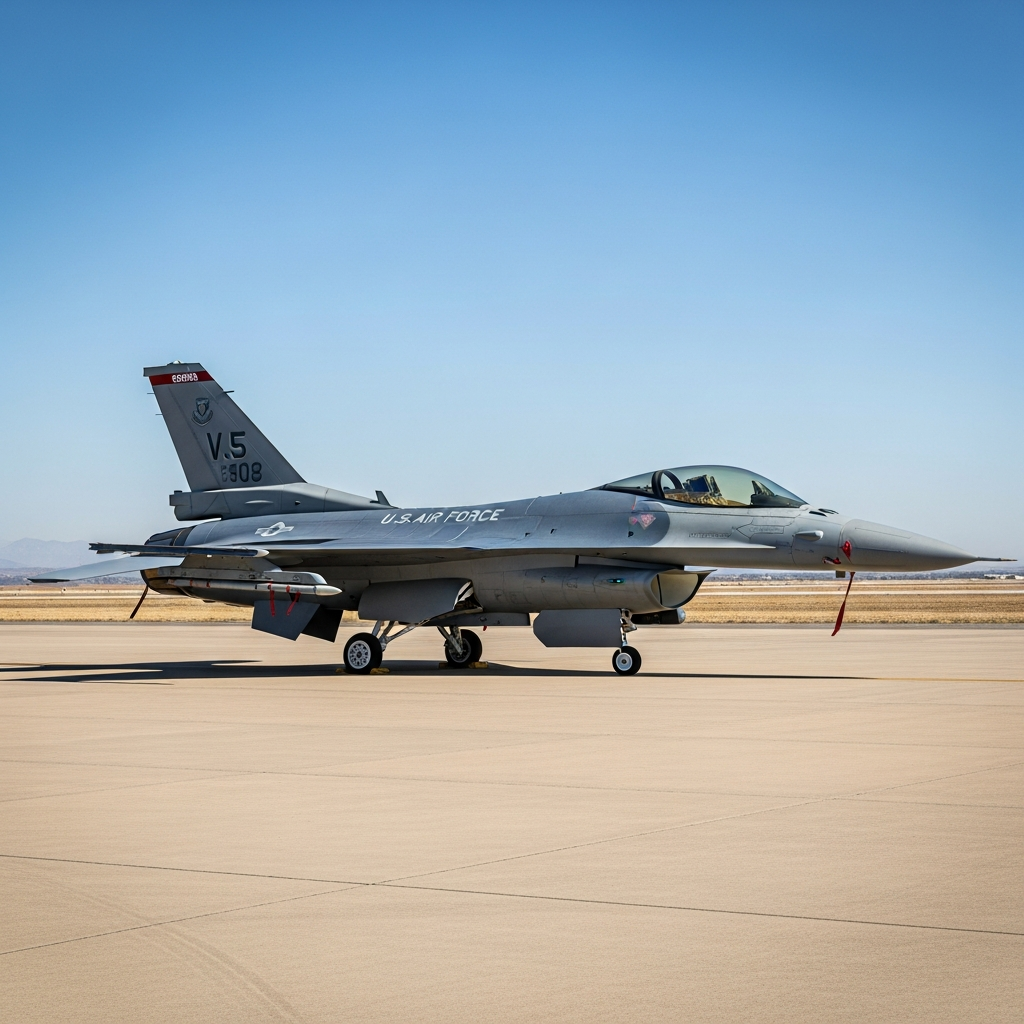
The U.S. Air Force and DARPA have successfully conducted live in-air testing of an AI-controlled F-16 Fighting Falcon equipped with the VENOM Autonomy Kit at Eglin Air Force Base, Florida. This marks the first operational demonstration of autonomous combat flight on a modified legacy fighter jet.
The milestone was announced July 16, 2026. It represents a pivotal shift in how the military approaches autonomous air combat. Rather than developing purpose-built unmanned aircraft, DARPA and Air Force engineers retrofitted at least four F-16 aircraft with the VENOM kit—a hardware and software suite that allows pilots to toggle between manual and AI control with a switch flip. A human pilot conducted takeoff during the recent test flight, then handed control to the AI agent once airborne. The pilot remained in the cockpit as an active monitor, ready to intervene if needed.
“These groundbreaking flight tests of VENOM-modified F-16s advance the infrastructure needed to develop trusted, autonomous air combat capabilities,” said Brig. Gen. James “Fangs” Valpiani, Ph.D., DARPA program manager. “The Air Force and DARPA team has automated flight controls and sensors on a standard F-16 without changing the jet’s core software. This enables an efficient pipeline for developing dominant AI for aerial combat, allowing us to rapidly innovate for the warfighter.”
How VENOM Works — And Why It Matters
The VENOM kit enables autonomous control of both flight systems and mission sensors through a novel interface that bypasses core avionics. This deliberate design choice accelerates integration and reduces certification risk. The AI performs tactical maneuvers within pre-defined physiological and structural limits—pushing performance boundaries without exceeding what human pilots experience in high-G combat.
This approach solves a critical military problem: cost and timeline. Modifying existing F-16s costs far less than developing new unmanned platforms, and it generates actionable data now rather than a decade down the road. The F-16’s demanding flight envelope—fast, high-load, unforgiving—also provides a far more rigorous test environment than slower unmanned platforms.
The testing follows years of ground validation. Three F-16s arrived at Eglin in April 2024, followed by at least one additional aircraft in 2025. Engineers conducted months of engine runs, avionics evaluations, software validation, and maintenance inspections before the aircraft were cleared for flight. Piloted validation flights began in June 2026 to verify hardware and software performed safely in the air. Only after successful completion of those trials did the program transition to autonomous flight testing in early July.
Operational Test Meets Developmental Test
At Eglin, the 40th Flight Test Squadron conducts developmental testing while the 85th Test and Evaluation Squadron handles operational suitability. This rare co-location eliminates the knowledge silos that typically separate engineering evaluation from tactical assessment. Lt. Col. Jeremy Castor, VENOM operational test lead, noted that co-locating both teams allows daily collaboration and reduces stove-piping of lessons learned.
The VENOM program sits squarely within DARPA’s Artificial Intelligence Reinforcements (AIR) initiative, which aims to develop AI-driven autonomy for beyond-visual-range, multi-ship combat. The technology will eventually transfer to unmanned combat aircraft like the General Atomics FQ-42 and Anduril YFQ-44 Collaborative Combat Aircraft—platforms designed to operate alongside crewed fighters under human command.
What Comes Next
The Air Force declined to detail specific maneuvers the AI performed or identify the autonomy software contractor. The team will refine systems after each flight and gradually increase test complexity. Future sorties will likely explore multi-ship coordination, electronic warfare scenarios, and sensor integration. That builds toward a full operational picture of how autonomous agents behave under tactical stress.
The VENOM fleet represents the first practical demonstration that legacy fighters can be efficiently retrofitted for autonomous operations. This capability could reshape platform affordability across the Air Force inventory.
Sources
- The Aviationist
- Army Recognition
- DARPA Official Press Release, July 16, 2026
- Eglin Air Force Base Public Affairs
Stay in the loop
Get the latest aircraft insider updates delivered to your inbox.