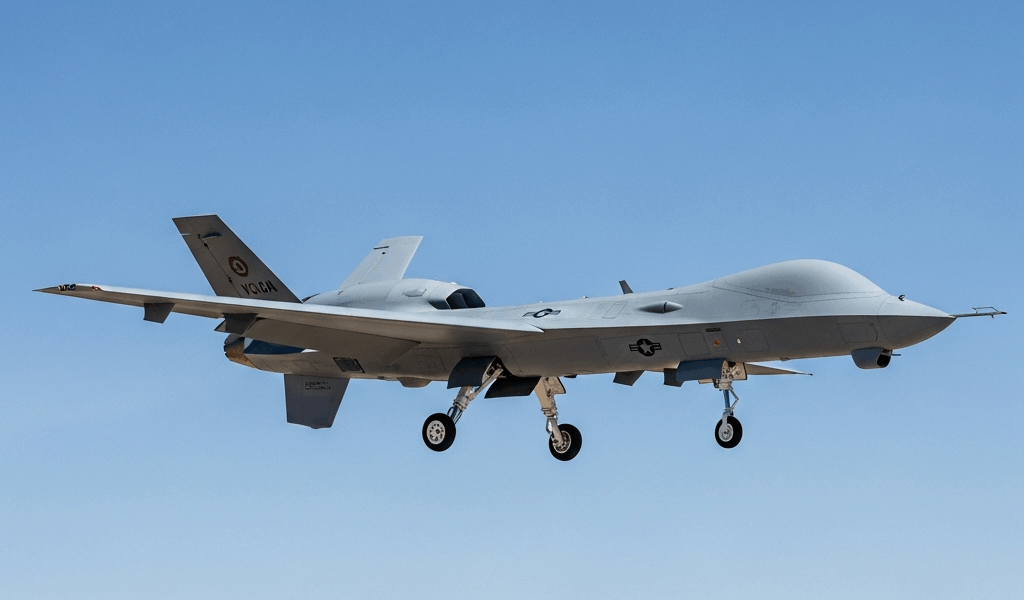
General Atomics YFQ-42A Collaborative Combat Aircraft Crashes in California — Setback for Pentagon Drone Program
A General Atomics Aeronautical Systems YFQ-42A “Dark Merlin” crashed Monday afternoon shortly after takeoff from a company-owned airport in the California desert. The loss dealt the U.S. Air Force’s flagship autonomous wingman program its first known flight mishap — and it came at the worst possible moment, just months before the Pentagon awards a production contract potentially worth billions of dollars.
The aircraft went down at approximately 1:00 p.m. Pacific on April 6, 2026. GA-ASI confirmed the crash but offered few details on what actually happened. No injuries were reported. The company paused flight test operations as a precaution and opened an investigation to determine the root cause.
“A YFQ-42A Collaborative Combat Aircraft test platform experienced a mishap following takeoff from a company-owned airport in the California desert on Monday at approximately 1 p.m. Pacific. No one was injured in the incident. Flight test operations have been paused temporarily in an abundance of caution. GA-ASI is assessing the condition of the aircraft and investigating to establish the root cause of the incident. At this early stage, it would be premature to speculate on the circumstances. As with any program, we follow a disciplined investigation process to understand exactly what occurred.” — GA-ASI official statement
GA-ASI spokesman C. Mark Brinkley added: “Safety is our top priority, for our people and the public. In this case, established procedures and safeguards worked as intended, and there were no injuries.” The U.S. Air Force confirmed it is “aware of the incident and will follow standard aircraft mishap protocols.”
Which Aircraft Was Lost
GA-ASI currently operates three airworthy YFQ-42A airframes — serials 25-1002, 25-1004, and 25-1006. The company has not said which tail number went down. The YFQ-42A is a single-engine, low-observable unmanned combat aircraft derived from the XQ-67A Off-Board Sensing Station demonstrator, part of GA-ASI’s broader “Gambit” family. Its design borrows serrated inlet edges reminiscent of the B-2 Spirit, pairs them with a higher-sweep wing, and tucks weapons inside an internal bay — a meaningful distinction from the competing Anduril YFQ-44A, which carries weapons externally. Estimated range exceeds 700 nautical miles. Most performance figures remain classified.
The aircraft flew for the first time on August 27, 2025. It logged its first semi-autonomous sortie on February 12, 2026 — a four-hour mission using Collins Aerospace’s Sidekick software, in which a human operator transmitted commands the aircraft then executed on its own. GA-ASI formally named the platform “Dark Merlin” on February 23, 2026.
The Stakes — $1 Billion Decision on the Line
The timing is brutal for GA-ASI. Pentagon budget documents released April 4 show the Air Force requesting $996.5 million in CCA procurement funding for FY2027 — enough to purchase roughly 30 Increment 1 aircraft — plus an additional $150 million in advance procurement to support FY2028. The production decision is expected within six months.
Anduril has not been standing still. The company began YFQ-44A production at its Arsenal-1 factory in Ohio on March 23, completed captive-carry testing with an AIM-120 AMRAAM, and had Shield AI’s Hivemind autonomy software flying on the airframe by February 24. Northrop Grumman’s YFQ-48A Talon Blue — also part of the CCA competition — successfully flew with Hivemind last month as well. Every day GA-ASI’s fleet sits grounded is a day the competition gains.
GA-ASI Under Broader Scrutiny
The crash arrives alongside mounting questions about GA-ASI’s combat drone portfolio. At least 16 MQ-9 Reaper unmanned aircraft — also GA-ASI products — have been lost during ongoing operations, with losses linked to multiple causes including enemy action, and cumulative losses approaching $480 million. The Reaper and the Dark Merlin are fundamentally different platforms, but critics will cite both in questioning whether GA-ASI can deliver the reliability the Air Force demands at scale. The stakes are amplified by a widening fighter shortfall — the FY2027 budget requests only 38 F-35As for the Air Force, a figure retired Lt. Gen. David Deptula has said “feels more like budget triage than a true recapitalization rate.” CCA success, in that context, is non-negotiable.
What Happens Next
The crash is unlikely to knock GA-ASI out of the competition. Prototype losses are not uncommon in developmental flight test, and the Air Force has signaled it wants two vendors in the mix for as long as possible. That said, with Anduril already in production and armed testing underway, GA-ASI needs a fast and credible investigation, a rapid return to flight, and no further anomalies before the source selection board finalizes its recommendation.
Sources
- FlightGlobal — CCA Program Coverage
- Air & Space Forces Magazine — YFQ-42A and FY2027 Budget Reporting


Leave a Reply