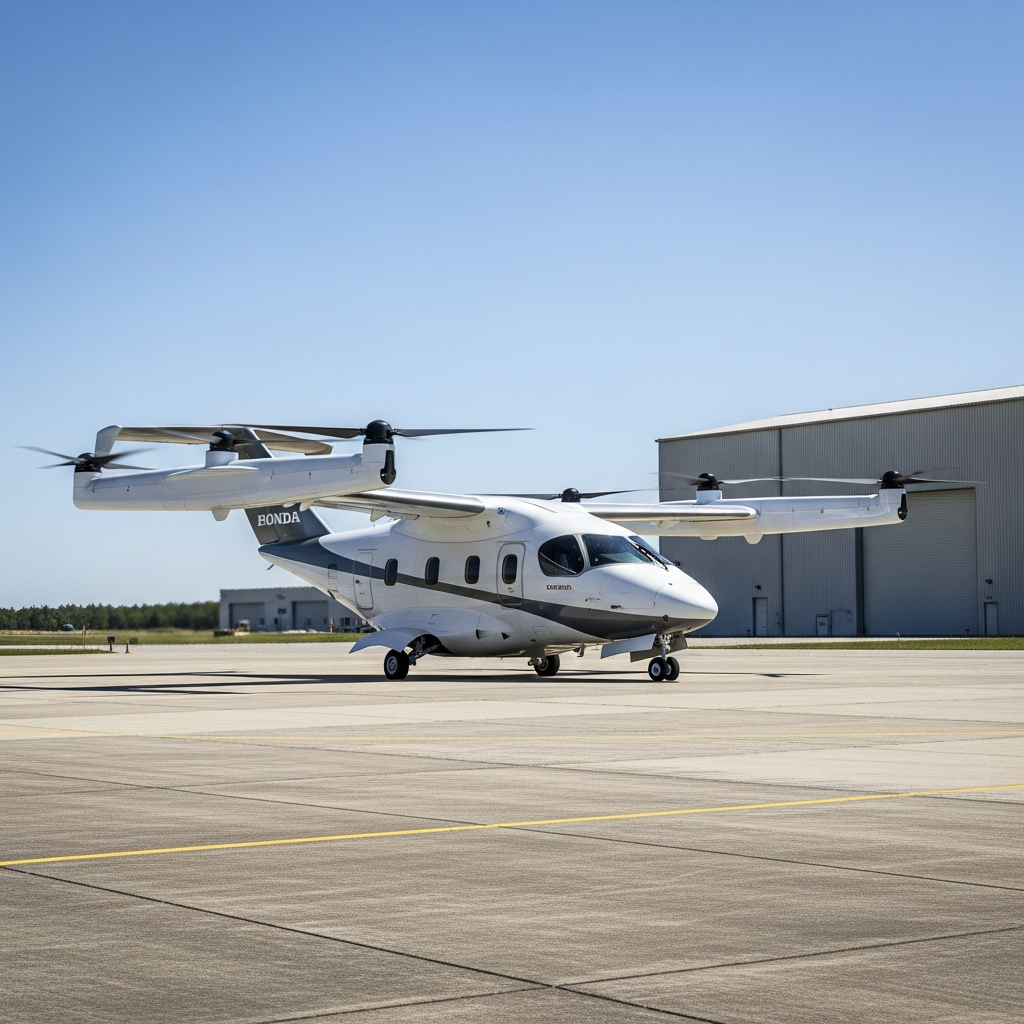
Honda just completed the first flight of its full-scale hybrid-electric eVTOL demonstrator in the United States. The aircraft, designated F1 and registered N805HX, flew remotely piloted and unmanned for 90 seconds on April 1, 2026, at Honda’s development facility in San Luis Obispo, California. The milestone was publicly announced on May 28, 2026. It’s a significant moment for the Japanese automaker and a clear signal that Honda is serious about competing in the advanced air mobility race.
The milestone puts Honda in an interesting position. Well-funded startups like Joby and Archer have dominated headlines, but Honda is taking a different path—one grounded in decades of aerospace expertise through its HondaJet program. Rather than chase the tiltrotor designs competitors are racing to certify, Honda deliberately separated lift and propulsion functions for safety redundancy.
The Aircraft — Design and Specifications
The F1 weighs approximately 7,000 pounds at maximum takeoff weight and is designed to carry four passengers. Its architecture is distinctive: eight vertical lift propellers mounted on twin curved booms connecting shorter forward and longer aft wings, plus two pusher propellers on the aft wing for horizontal flight. The five-bladed shrouded rotors are alternately angled inward and outward to enhance stability during the hover-to-cruise transition—arguably the most challenging maneuver in eVTOL operations.
This configuration reflects Honda’s safety philosophy. By keeping lift and thrust functions entirely separate, the design eliminates the single-point-of-failure risk inherent in tiltrotor designs where one rotor must handle both jobs. “Human life is very precious,” said Susumu Mashio, Honda’s eVTOL Vice President and Executive Chief Engineer. “Before moving to having a pilot on board, we wanted to make sure everything is perfect.”
April’s first flight ran on battery power alone—the turbine exhaust was capped. This allowed Honda to refine the basic airframe configuration before integrating the hybrid system in subsequent test phases. The company has logged over 400 flights with a one-third-scale demonstrator since approximately 2022, validating flight control laws and transition dynamics.
The Hybrid Engine — Heritage and Performance
Honda’s competitive advantage is its compact turbogenerator, derived directly from the HF120 turbofan that powers the HondaJet. Weighing under 100 kilograms and measuring roughly 2.6 feet long by 1.3 feet in diameter, the unit delivers between 250–300 kilowatts output and has completed continuous ground testing. It runs on 100% synthetic aviation fuel, which opens pathways toward sustainable fuel compatibility.
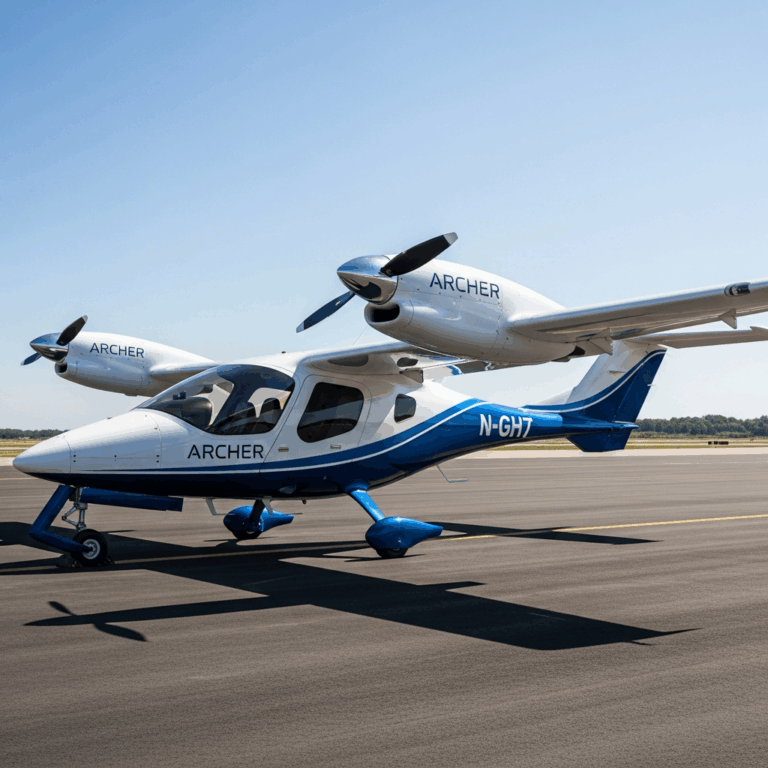
The turbogenerator delivers a striking operational advantage: maximum range of 249 miles—nearly ten times what battery-only competitors achieve. Archer’s Midnight offers 20–50 miles for typical operations; Joby targets roughly 100 miles. The hybrid architecture also provides a safety net should battery reserves deplete during a mission, a redundancy pure-electric designs simply cannot offer.
Honda notes that F1 technologies—both hardware and software—draw from the company’s racing heritage. The eVTOL incorporates ultra-high RPM generator technology from Honda’s F1 power units and racing chassis technologies, because “the speed range and airflow turbulence eVTOL needs to manage are closer to those of F1 machines than of passenger airplanes.”
The Path Forward
Honda unveiled this program publicly for the first time at the Dubai Airshow in November 2025 after four years in stealth mode. The company initially planned first flight for March 2026 and has now achieved that target in April 2026. Next phases include integration of the hybrid turbogenerator and progression toward crewed test flights.
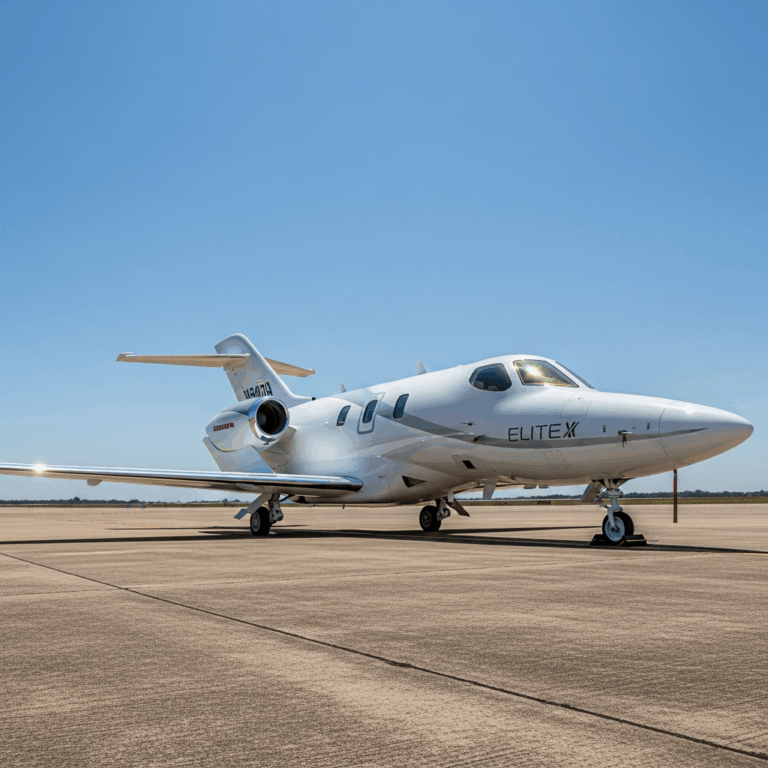
Honda possesses a singular advantage among competitors: it’s the only company worldwide holding FAA certification for both airframe and aero engines. This experience from the HondaJet certification process—approximately 250 aircraft delivered since 2015—significantly shortens the certification pathway for an eVTOL type certificate, something no startup competitor has navigated.
Hirohide Azuma, Honda’s eVTOL Chief, acknowledged the competitive landscape directly. “Joby and Archer are ahead of us, and I admit that they are moving forward.” He paused, then added: “We have a certification capability for the HondaJet. By comparison, most eVTOL competitors have not prepared that capability for now.”
Next to watch: hybrid integration flight tests and progression toward the company’s Vision 2030 mobility ecosystem, which envisions eVTOL aircraft as one component within integrated “Honda Mobility Hubs.”
Sources
- Aviation Week & Space Technology
- Honda Motor Co. official announcement and technical documentation
- Dubai Airshow 2025 program disclosure
Stay in the loop
Get the latest aircraft insider updates delivered to your inbox.