Verified update — July 30, 2026: This was an early status report. CENTCOM later confirmed that both crew members were safely recovered in separate missions completed April 4. Read the official-source F-15E shootdown and rescue account for the confirmed timeline and the details that remain unverified.
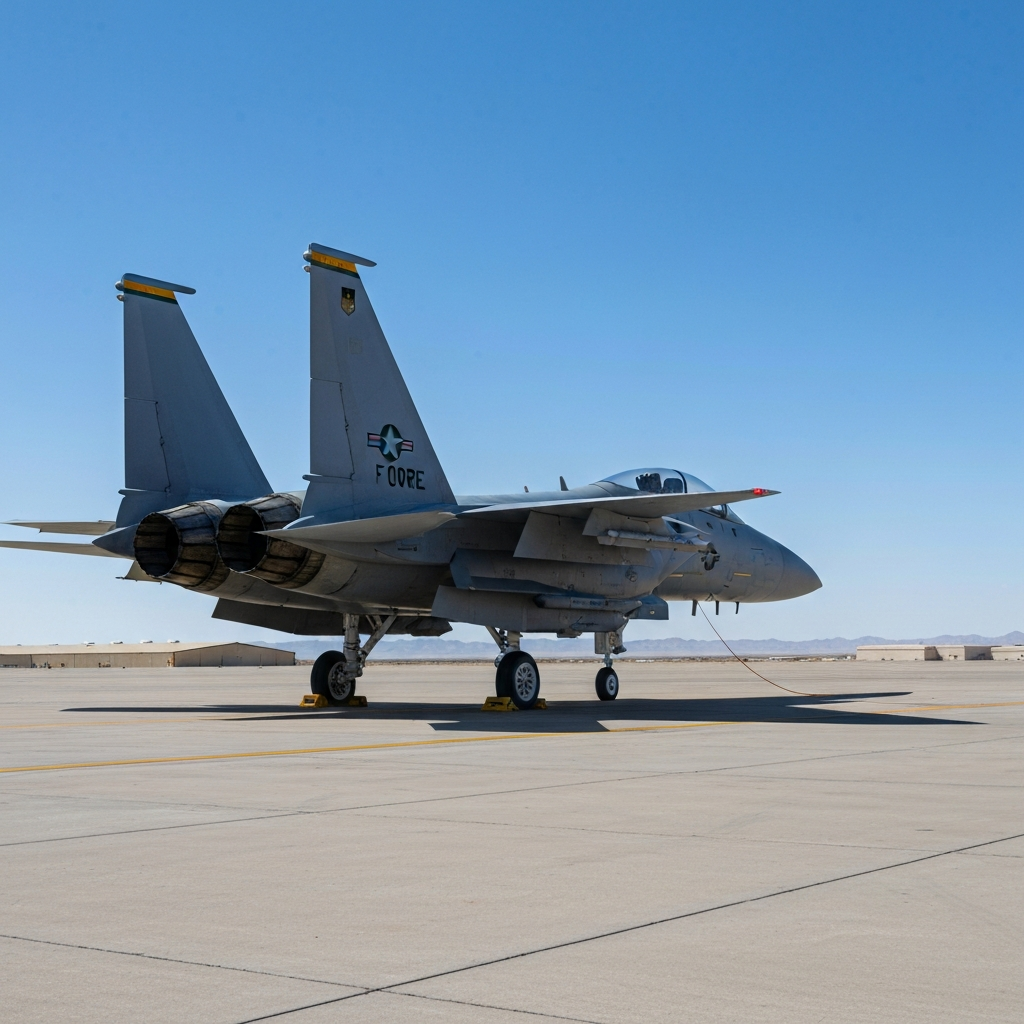
An F-15E Strike Eagle from RAF Lakenheath’s 494th Fighter Squadron was shot down by enemy fire over Iran’s Kohgiluyeh and Boyer-Ahmad Province on June 3, 2026. The shootdown triggered one of the war’s most complex combat rescue operations. One crew member was rescued alive, while the status of the second remained unknown as search efforts continued.
The two-seat fighter carried the callsign DUDE44 and was forward-deployed to Muwaffaq Salti Air Base in Jordan when it was struck during a deep-strike mission over southern Iran, roughly 290 miles south of Tehran. Both the pilot and weapons systems officer ejected safely after being hit.
Iran’s Revolutionary Guard Corps Aerospace Force claimed responsibility through its Tasnim news agency, saying it had downed the jet using “a new air defense system.” The Iranians initially claimed it was an F-35 before quietly correcting that statement. According to NBC News, citing high-ranking defense sources, the F-15E was likely hit by a Chinese-made shoulder-launched MANPADS system — a strong indication the aircraft was flying low-altitude night operations, suggesting U.S. air defenses suppression efforts had run into limitations at that point in the conflict.
The Rescue Unfolds
U.S. Central Command launched an immediate combat search and rescue mission. Within seven hours, American special forces operating on Iranian territory located and recovered the pilot. The weapons systems officer, meanwhile, avoided capture by hiking a 7,000-foot ridgeline in the Zagros Mountains foothills and hiding in a mountain crevice—deliberately keeping his emergency beacon off to prevent Iranian detection.
The operation quickly ballooned in scope. A CSAR task force of 21 aircraft—including A-10C Thunderbolt IIs, HC-130J Combat King IIs, and HH-60W Jolly Green IIs—was dispatched into the fight. An A-10 supporting the mission took Iranian fire but made it to Kuwaiti airspace, where the pilot ejected safely. U.S. officials confirmed an Iranian claim that a Black Hawk helicopter participating in the rescue was hit, though crew injuries were reported as non-critical.
President Trump was briefed immediately. White House Press Secretary Karoline Leavitt confirmed to Axios that “the President has been briefed,” and the House Armed Services Committee was notified that the status of the second F-15E crew member was unknown.
CIA Deception and Extraction
The CIA became central to finding the missing weapons officer. Before locating him, the agency spread word inside Iran that U.S. forces had already recovered him and were moving him overland for exfiltration. At the same time, using classified collection capabilities, CIA tracked the officer’s exact location in the mountain crevice and shared coordinates with the Pentagon and White House.
The final rescue phase involved dozens of special forces personnel and sustained air support. Two MC-130J Commando II transport aircraft stationed at an improvised base deep in Iranian territory were destroyed to prevent capture. Four MH-6 Little Birds were also lost. All U.S. forces successfully exfiltrated via three additional rescue aircraft that reached Kuwait just before midnight.
What It Means
The shootdown marked the first time during the conflict that Iranian air defenses successfully brought down a manned U.S. aircraft. Trump later stated the rescue mission involved 155 total aircraft—four bombers, 64 fighters, 48 refueling tankers, and 13 dedicated rescue aircraft. The incident underscores Iran’s continued access to advanced air defense systems, possibly including Chinese-supplied early-warning radars like the YLC-8B, which the Pentagon has warned can detect stealth aircraft.
Stay in the loop
Get the latest aircraft insider updates delivered to your inbox.