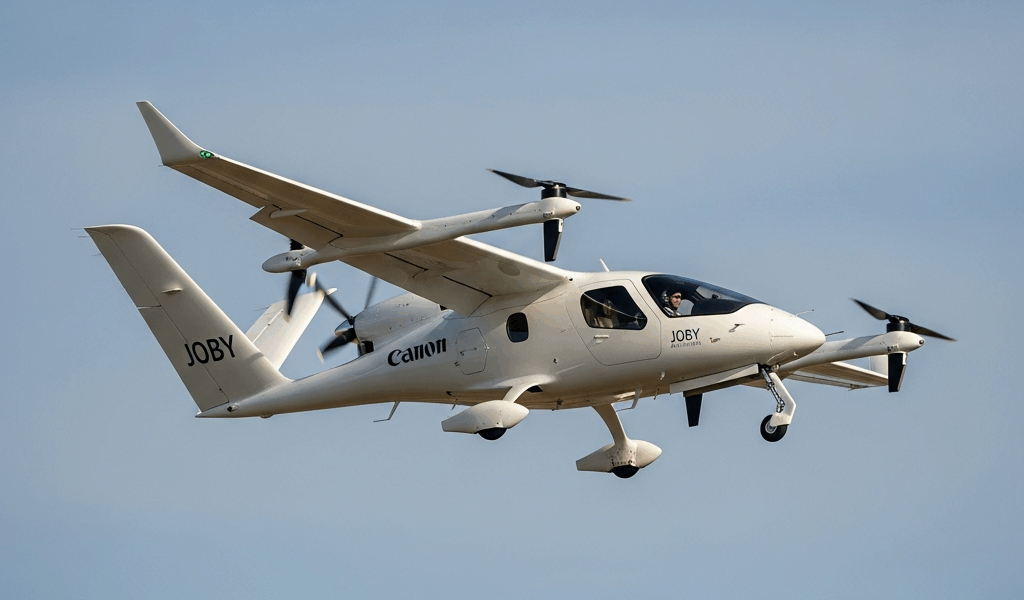
Joby Aviation Clears FAA Stage 4 Certification — Commercial eVTOL Passenger Flights Could Launch by End of 2026
In late March 2026, the FAA confirmed that Joby Aviation has successfully completed Stage 4 of its type certification process — the critical airworthiness conformity review that brings the Marina-based company to the threshold of receiving the first commercial certificate ever issued to an electric vertical takeoff and landing aircraft in U.S. history.
Stage 4 is where certification gets real. It moves from theory to hardware, with every structure, subsystem, flight mode, and failure case tested under FAA oversight and logged as a compliance finding. The FAA confirmed Joby’s S4 aircraft satisfied requirements covering propulsion system reliability and fly-by-wire redundancy — two of the most technically demanding elements of the certification plan. Passing Stage 4 doesn’t mean the aircraft is certified. It means the FAA has validated that the hardware being tested actually matches the design described in the certification application.
The Aircraft Behind the Milestone
The aircraft doing the heavy lifting here is N547JX — Joby’s first FAA-conforming S4, which began its flight campaign on March 11 at the company’s Marina, California test facility. It’s distinct from N545JX, the preproduction prototype that made the high-profile Golden Gate Bridge demonstration flight on March 13, piloted by Andrea Pingitore. N547JX is the one that counts toward certification.
The S4 carries a pilot and four passengers. Top speed is 200 mph, range approximately 150 miles on a single charge, with a charging cycle of under 20 minutes. Six propulsion stations, each with a five-bladed composite variable-pitch propeller driven by an independent electric motor, backed by a triple-redundant fly-by-wire system. Acoustically, the aircraft measures 65 dBA at 100 meters during takeoff and landing — roughly equivalent to two people conversing — and approximately 45 dBA on flyover at 500 meters altitude and 100 knots airspeed. For urban operations, those numbers matter enormously.
What Stage 5 Means — and What Comes After
One stage remains. Stage 5 involves a comprehensive conformity inspection and an operational demonstration — a final audit confirming that production aircraft match certified designs and perform as expected under real-world conditions. After that, Joby still needs a type certificate issuance, a separate air carrier certificate authorizing commercial passenger operations, and FAA-approved vertiport infrastructure at each service location. The finish line is visible, but it isn’t close yet.
Joby is certifying under FAA Part 21.17(b), a provision that allows the agency to assemble a custom certification basis when an aircraft doesn’t fit existing airplane or rotorcraft categories. The FAA’s 2024 special federal aviation regulation for powered-lift operations also establishes that S4 pilots must hold at minimum a private pilot certificate with a powered-lift category rating.
“We are working methodically with the FAA to complete the remaining steps. The goal has always been to build something people can trust with their lives.” — JoeBen Bevirt, Founder & CEO, Joby Aviation
The FAA offered no timeline guarantees, stating in a written response that certification schedules “depend on applicant performance and the resolution of any open compliance findings.”
Delta Partnership and the Commercial Picture
Joby is targeting a late 2026 commercial launch in partnership with Delta Air Lines — which made a $60 million investment in the company back in October 2022, with initial service planned for New York City and Los Angeles airport connections. Projected fares run approximately $150 to $300 per trip, putting it squarely in premium helicopter shuttle territory.
“Our partnership with Joby is about giving Delta customers a premium, quiet, zero-emission connection between the city and the airport. We believe urban air mobility is not a distant concept — it is an infrastructure investment we are making now.” — Delta Air Lines executive, investor statement
Delta CEO Ed Bastian has described the arrangement on recent earnings calls as a “long-term infrastructure bet” rather than a near-term revenue driver — an honest framing, given the regulatory steps still ahead.
In March 2026, Joby was also selected for five of the pilot projects under the FAA’s eVTOL Integration Pilot Program, covering the New York/New Jersey area, Texas, Florida, North Carolina, and Utah. That geographic footprint signals how seriously the agency is treating near-term urban air mobility operations.
“What Joby has done is demonstrate that the eVTOL certification process, while long, is workable under the new powered-lift standards. That matters enormously for every other applicant behind them.” — Richard Aboulafia, Managing Director, AeroDynamic Advisory
Joby’s certification work is approximately 8 years in the making — the company began the FAA type certification process in 2018 — and it’s now setting the regulatory precedent that every subsequent eVTOL manufacturer in the United States will be measured against. Stage 5 and the remaining post-certificate authorizations are the only barriers between Joby and commercial revenue.
Sources
- Altitudes Magazine — FAA Moves Closer to First eVTOL Commercial Certification: Joby Aviation
- Altitudes Magazine — Joby Aviation Targets Late 2026 Commercial Launch, FAA Certification


Leave a Reply