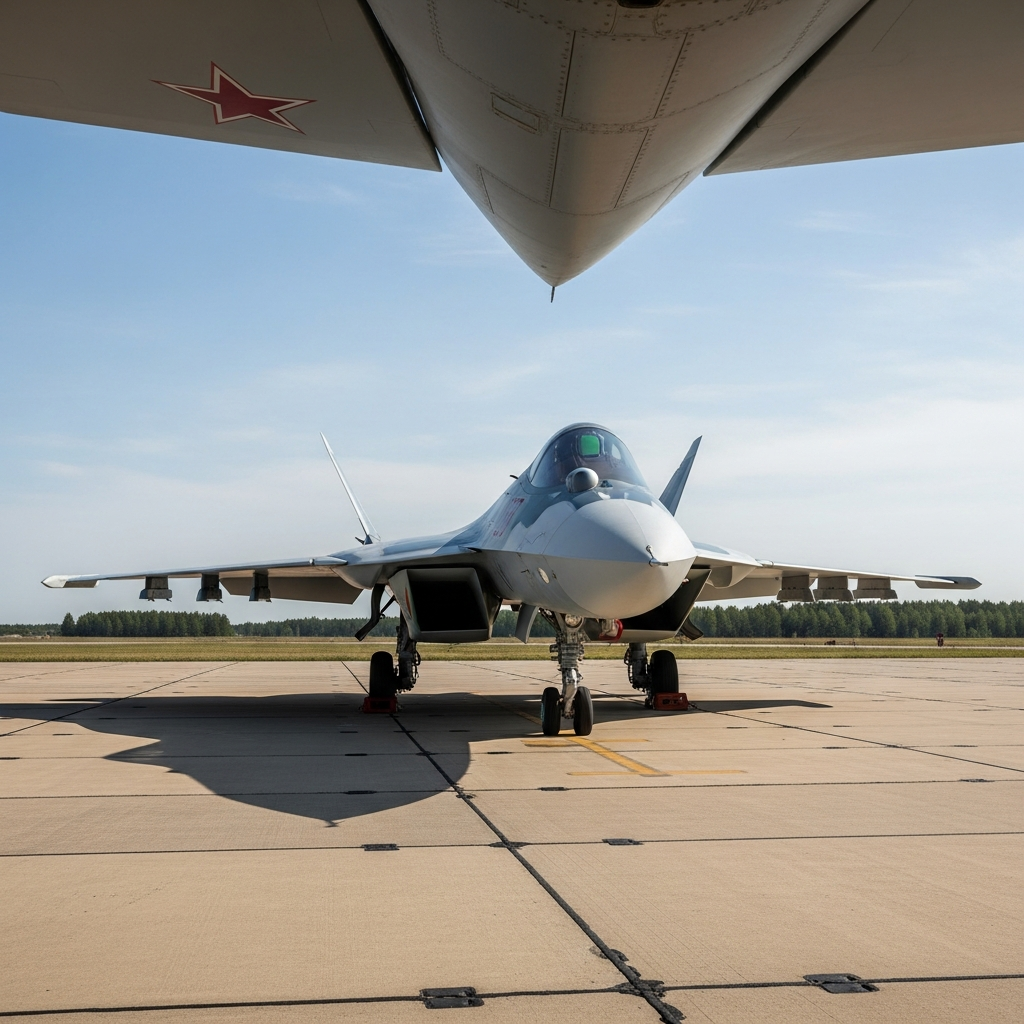
A fighter jet crashed during a training flight near Moscow on July 23, 2026, with multiple pro-Kremlin media outlets and military bloggers identifying it as Russia’s advanced Su-57 Felon stealth fighter. The pilot ejected safely, but the aircraft was destroyed. Russia’s Ministry of Defense has not officially confirmed the aircraft type — a distinction that matters significantly, as identification shapes interpretation of what went wrong.
The crash happened in the Odintsovo district near Zvenigorod, roughly 60 kilometers west of Moscow and close to Kubinka air base. Telegram and social media quickly filled with images of flames and thick smoke rising from an open field. The Russian Investigative Committee opened a criminal case under Article 351 of the Russian Criminal Code, which covers violations of flight regulations.
The Russian Ministry of Defense issued a brief statement via TASS: “a combat trainer aircraft crashed during takeoff in the Moscow Region on July 23. The pilot ejected, and his life is not in danger. The aircraft crashed in an uninhabited area, causing no damage on the ground.” Officials blamed an unspecified “technical malfunction” and confirmed the jet carried no ordnance.
Friendly Fire Theory Gains Traction
Russian military bloggers immediately questioned that account. Prominent milblogger Romanov posted on Telegram suggesting investigators should “address several questions to the BARS-Moscow air defence crew,” implying the jet may have been shot down by friendly fire. The Russian channel arrowsmap went further, directly asking: “Did a shoulder-fired missile fell a fifth-generation fighter?”
Ukrainian cyber intelligence outlet InformNapalm claimed a Ukrainian cyberattack may have manipulated Russian air defense systems into downing their own aircraft — a highly speculative assertion that remains entirely unconfirmed and lacks credible supporting evidence. Local social media accounts reported hearing explosions and surface-to-air missile activity in the area. Yet the Russian Air Force–associated page Fighterbomber, which has proven relatively reliable on Russian losses, attributed the crash to technical malfunction rather than friendly fire.
Growing Strain on an Expensive Platform
If confirmed as a Su-57, this crash represents another blow to a program already strained by reported combat losses in Ukraine. Ukraine’s military has reported striking Su-57s at Akhtubinsk airbase in June 2024, in the Chelyabinsk region on April 25, 2026, and again at Shagol airfield in May 2026. Each Su-57 costs an estimated $100–120 million to build.
Russia operates roughly 20 to 32 production Su-57s as of mid-2026. Total construction exceeds 44 airframes including prototypes. The program has weathered previous crashes — a December 2019 loss during factory testing and a 2014 prototype accident. Notably, in October 2024, a Su-57 shot down its own S-70 Okhotnik drone, raising questions about friendly fire risks in complex air operations. A twin-seater variant recently entered flight testing.
Western analysts have questioned the Su-57’s stealth credentials for years. Recent intelligence showed Russian pilots mounting external wing pylons carrying air-to-air missiles to hunt Ukrainian drones — a configuration that completely compromises radar cross-section and makes the jet visible to air defense systems. That vulnerability may explain why a supposed fifth-generation stealth fighter could be locked onto by its own air defenses.
Export Push at Risk
The crash arrives as Moscow aggressively markets the Su-57 internationally. Algeria remains the only confirmed foreign buyer. Russian officials announced undisclosed Middle Eastern export contracts in February 2026. Export credibility hinges on demonstrated reliability — a crash near the capital undermines that narrative.
The identification remains unofficial pending Russian Ministry of Defense confirmation. The distinction matters: a technical malfunction suggests design problems, while friendly fire indicates command and control failures — both damaging for a platform Moscow is betting its fifth-generation future on.
Sources
- The Aviationist
- Russian Ministry of Defense statement via TASS
- Kommersant (pro-Kremlin business newspaper)
- Russian Investigative Committee official statement
- Ukrainian General Staff reports on Su-57 strikes
- InformNapalm Ukrainian cyber intelligence outlet


Stay in the loop
Get the latest aircraft insider updates delivered to your inbox.