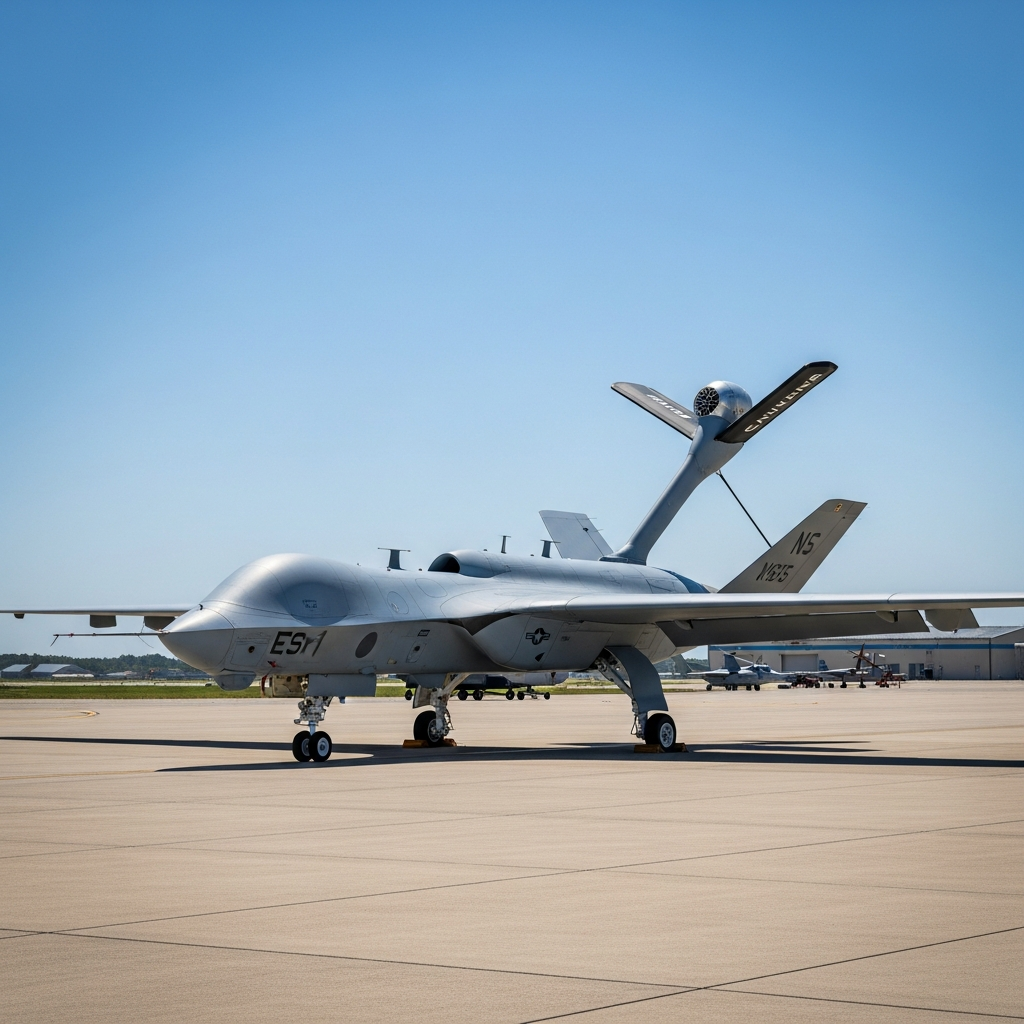
Boeing and the U.S. Navy flew the first production representative MQ-25A Stingray on April 25, 2026. The aircraft lifted off from MidAmerica St. Louis Airport in Mascoutah, Illinois at 10:49 a.m. CDT and completed a two-hour autonomous flight — the most significant milestone in the carrier tanker program since its 2018 contract award. The Navy officially announced the achievement on April 27.
The aircraft is Engineering Development Model 3, or EDM-3, the first of four EDMs to be delivered under Boeing’s original $805 million contract. It flew a pre-programmed mission validating its flight controls, navigation systems, and integration with the Unmanned Carrier Aviation Mission Control System (UMCS) MD-5 ground control station. Both Boeing and Navy Air Vehicle Pilots commanded the aircraft from the MD-5, which runs Lockheed Martin’s MDCX platform — the same ground control architecture already installed aboard USS George H.W. Bush and at shore sites since 2024.
Two chase aircraft accompanied the flight: a Boeing-owned TA-4J Skyhawk and a U.S. Navy UC-12M Huron. Crews came from the “Salty Dogs” of Air Test and Evaluation Squadron (VX) 23 and the “Ghost Wolves” of Air Test and Evaluation Squadron (VX) 24. A first attempt at the maiden flight had been aborted on April 22 for undisclosed reasons.
What EDM-3 Brings That T1 Didn’t
EDM-3 is a materially different aircraft from the Boeing-owned T1 test asset. T1 first flew in September 2019 and accumulated roughly 125 flight hours, including multiple demonstrations of unmanned aerial refueling with the F/A-18F, F-35C, and E-2D. EDM-3 carries a retractable electro-optical/infrared (EO/IR) turret — along with provisions for signals intelligence and Automatic Identification System (AIS) receivers — giving the Stingray a secondary ISR capability beyond its core tanking mission. The airframe retains the T1’s stealthy fuselage shaping, flush engine inlet, and V-tail, but it now represents the configuration the Navy intends to actually operate.
Power comes from a single Rolls-Royce AE 3007N turbofan producing 10,000 lbf of thrust, a derivative of the engine that also drives the MQ-4C Triton. Rolls-Royce is scheduled to deliver four additional AE 3007N engines to Boeing in 2026 to support production spares.
At 51 feet long with a 75-foot wingspan — folding to just over 31 feet for carrier stowage — the Stingray will be one of the largest aircraft on any carrier flight deck, rivaling the E-2D Hawkeye in span. The Cobham Aerial Refueling Store, the same system employed by F/A-18E/F Super Hornet tanker variants, allows the MQ-25 to offload between 14,000 and 16,000 pounds of fuel at a 500-nautical-mile radius. According to Vice Adm. Mike Shoemaker, that’s enough to push a Super Hornet’s combat radius from roughly 450 to beyond 700 nautical miles.
Quotes From the Program
“Today’s successful flight builds on years of learning from our MQ-25A T1 prototype and represents a major maturation of the program. The MQ-25A is the most complex autonomous system ever developed for the carrier environment, and this historic achievement advances us closer to safely integrating the Stingray into the carrier air wing.” — Dan Gillian, VP & GM, Boeing Air Dominance
“The first flight of the MQ-25A is a landmark achievement for the Navy-Boeing team and a critical step toward the future of the carrier air wing. The MQ-25A is not just an aircraft. It’s the first step in integrating unmanned aerial refueling onto the carrier deck, directly enabling our manned fighters to fly further and faster. This capability is vital to the future of naval aviation.” — Rear Adm. Tony Rossi, Program Executive Officer, Unmanned Aviation and Strike Weapons
The Road to the Fleet — and the Delays
The program has slipped considerably. Initial Operational Capability was once projected for 2024, with first deliveries in 2022. That milestone is now targeted for 2029 — defined as three MQ-25As with trained personnel and equipment deployable aboard an MQ-25A-capable carrier. Initial Operational Test and Evaluation (IOT&E) is planned between the second and fourth quarters of FY2029. The first deployment aboard USS Theodore Roosevelt (CVN-71), once penciled in for this year, has been pushed back alongside those delays.
The strategic case for the program, though, has only grown sharper. Super Hornet “buddy tanker” sorties currently consume up to one-third of the F/A-18’s flight hours — a structural drain on strike capacity that the MQ-25 is designed to eliminate. Navy leadership has also framed the Stingray as the gateway to broader manned-unmanned teaming aboard carriers, with Boeing already demonstrating software that lets an F/A-18 pilot command the MQ-25 directly from the cockpit during refueling operations.
Still ahead: EDM-3’s next flight series, the delivery schedule for the remaining EDM aircraft, and carrier suitability trials expected aboard a Nimitz- or Ford-class hull before the end of the decade.
Stay in the loop
Get the latest aircraft insider updates delivered to your inbox.