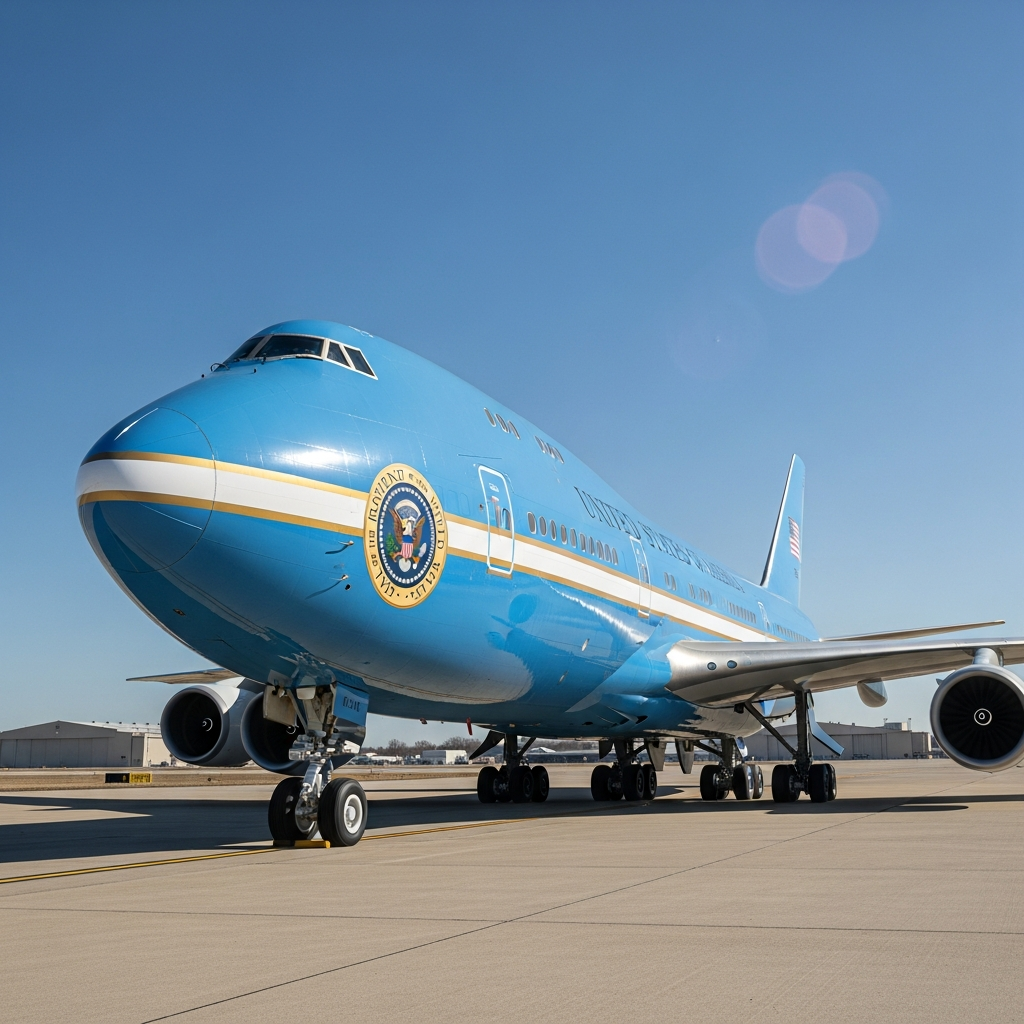
A converted Qatar Amiri Flight Boeing 747-8I built for Air Force One has finished final testing and moved into active commissioning flights. It’s a major turning point in a presidential aircraft replacement program that’s been mired in controversy for nearly a decade.
The jet, registered N7478D and officially called the VC-25B “Bridge,” was unveiled by President Donald Trump at Joint Base Andrews on June 19, 2026. The ceremony spotlighted how quickly officials moved on what they’re describing as a temporary fix to keep the aging VC-25A fleet flying.
Why the Rush
The timeline is urgent for good reason. On January 20, 2026, a VC-25A carrying President Trump to the World Economic Forum in Davos experienced a catastrophic electrical failure mid-flight and had to turn back to Andrews. Trump switched to a backup C-32 to finish his trip—a stark reminder of how fragile a presidential aircraft fleet now 36 years old has become.
The two VC-25As that have served every president since George H.W. Bush are demanding more maintenance with each passing year. Boeing’s actual next-generation VC-25B program, launched in 2016 under a $3.9 billion fixed-price contract, has slipped from its original 2024 target to sometime mid-2028—and some Pentagon officials privately warn it could slip into 2029.
That’s where the Qatari 747-8 came in. After special envoy Steven Witkoff arranged for Qatar to offer the former head-of-state aircraft to the Trump administration in February 2025, the U.S. accepted it and sent it to L3Harris in Waco, Texas for conversion.
The Technical Rebuild
L3Harris pulled off the modification in approximately 7 to 8 months running three shifts around the clock—something the traditional Boeing program would never have attempted. The 250-foot, four-engine 747-8 got encrypted SATCOM systems, classified communications suites, and hardened defensive systems designed to eliminate risks from the aircraft’s previous ownership.
The retrofit required trade-offs. The Bridge aircraft doesn’t match the full VC-25B specification in six critical areas: EMP hardening, power generation, security, survivability enhancements, nuclear command-control-and-communications (NC3) capability, and optimal interior layout. In-flight refueling capability is also uncertain. Secretary of the Air Force Troy Meink told Congress the choice was speed over perfection.
“The safety and security of the commander in chief is our highest priority,” Meink stated. “This effort proves that the U.S. Air Force can move fast without sacrificing quality, security, or reliability.”
The aircraft finished modifications and flight-testing on May 1, then underwent painting in a new presidential livery—ditching the robin’s-egg blue Kennedy-era scheme. The new design features a bold red, white, navy blue, and gold scheme with the presidential seal and full-tail American flag.
What Comes Next
Commissioning flights now serve as the final validation phase. The Air Force is running what it calls a “final exam” to ensure the aircraft meets standards for presidential transport. The target is an operational debut on July 4, 2026—America’s 250th birthday—when the aircraft is scheduled to lead a ceremonial flyover of Washington.
The retired VC-25As will move into the executive airlift fleet serving senior government officials. Aviation analysts have noted that the Bridge aircraft’s compressed timeline—impressive as it is—highlights the problems plaguing Boeing’s multi-year program.
L3Harris CEO Christopher Kubasik called the effort “proof that the U.S. defense industrial base can move at maximum velocity when the mission demands it.” Whether that velocity translates into sustainable presidential air operations is a question we’ll be watching closely in the months ahead.
Stay in the loop
Get the latest aircraft insider updates delivered to your inbox.