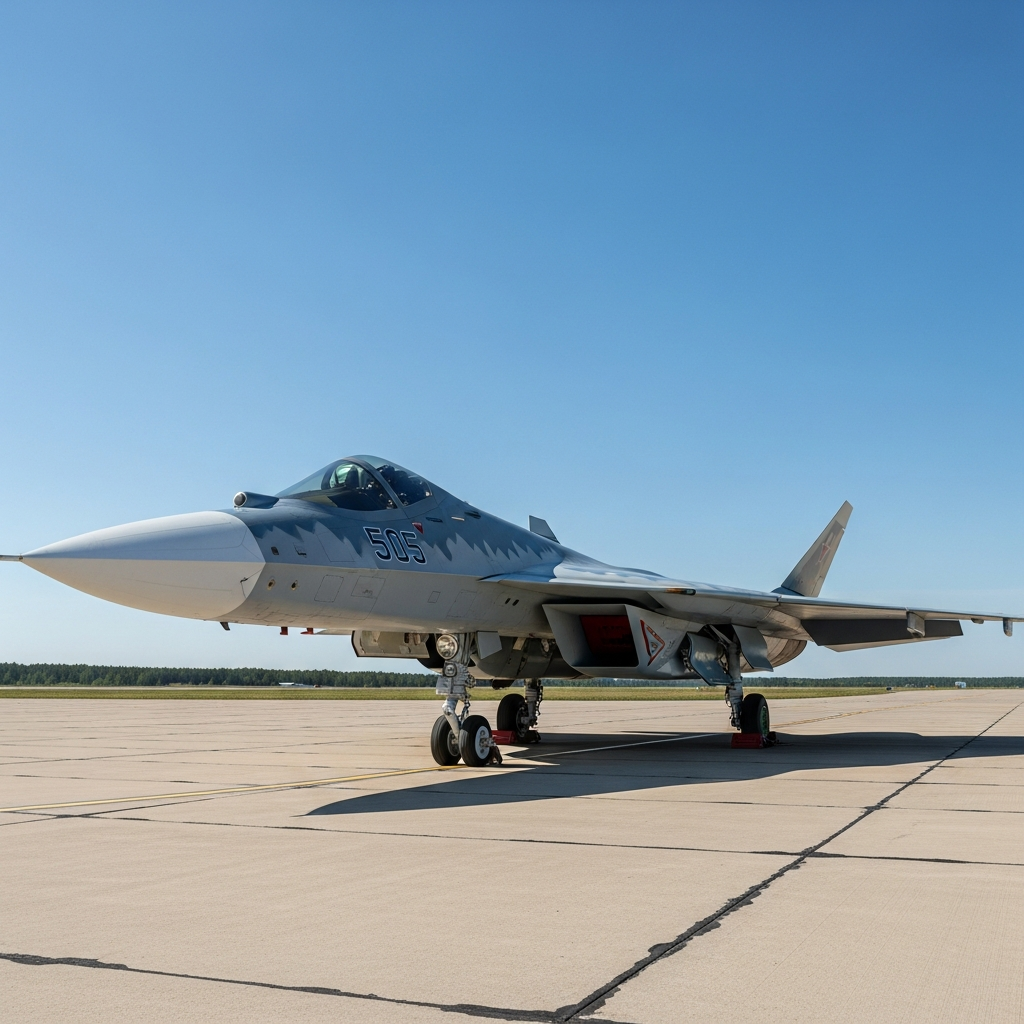
Russia has successfully conducted the maiden flight of the Su-57D, a twin-seat variant of its fifth-generation stealth fighter, marking a significant expansion of the country’s most advanced combat aircraft program. United Aircraft Corporation (UAC) confirmed the milestone on May 19, 2026, when chief test pilot Sergei Bogdan flew the prototype—designated with bort number 055—from the Komsomolsk-on-Amur Aircraft Plant, following taxi trials conducted on May 16, 2026.
The flight went according to plan, complete with a parachute-assisted landing sequence. Initial evaluations confirmed that systems operated within expected parameters, though UAC declined to release specific data on flight duration or detailed testing results.
Structural Changes and Cockpit Configuration
The Su-57D swaps the standard single-seat cockpit for a tandem dual-seat arrangement beneath an elongated canopy that stretches farther aft along the fuselage. The rear cockpit sits elevated relative to the pilot’s position—a configuration borrowed from proven two-seat platforms like the Su-30SM—to improve visibility and mission management for the second crew member.
That second operator will function as a weapons systems officer and command-and-control specialist, supervising drone coordination, datalink management, sensor fusion, and electronic warfare sequencing while the pilot focuses on tactical flight operations. Russian sources indicate the platform can control four to eight loyal wingman drones, including the stealthy S-70 Okhotnik-B, which has conducted integration flights with single-seat Su-57s since September 2019.
The redesign comes with trade-offs. The enlarged canopy and modified upper fuselage profile increase frontal radar reflections relative to the single-seat variant, whose frontal radar cross-section was estimated between 0.1 and 1 square meters according to Russian patent material. Additional weight from the second cockpit and mission equipment will likely reduce fuel fraction, endurance, and maneuverability.
Official Confirmation and Export Strategy
“Flight tests have begun on the prototype of the Su-57, a fifth-generation two-seater fighter. This aircraft, developed independently by our aircraft manufacturers, will, in addition to its unique combat characteristics, also possess the capabilities of a combat trainer and a command and control aircraft,” said Denis Manturov, First Deputy Prime Minister of Russia.
The development appears driven internally by Sukhoi and UAC rather than by state directive. A patent covering the twin-seat configuration was registered in November 2023, and the aircraft flew less than 30 months later—unusually fast for major structural modifications to a fighter platform, suggesting heavy reliance on existing developmental infrastructure.
Vadim Badekha, CEO of UAC, emphasized that the variant forms part of a broader effort to expand operational flexibility and export appeal. “We continue to work on improving and expanding the capabilities of our most advanced fifth-generation aeronautical system,” Badekha stated. “I am confident that the two-seat version of the aircraft will contribute significantly to its success in international markets.”
Why Two Seats Matter for Exports
Single-seat combat aircraft typically require dedicated two-seat trainer variants for foreign customers whose pilots lack institutional training pipelines and simulator infrastructure. Russia cannot realistically export the single-seat Su-57 at scale without burdening customer nations with unsustainable training demands. The Su-57D solves this problem while positioning the aircraft as a network-management platform—aligning with how Russia views future air superiority as dependent on managing interconnected combat ecosystems rather than individual aircraft performance alone.
India, which withdrew from the joint FGFA program in 2018, has recently renewed talks on Su-57 production. The Indian Defence Ministry confirmed in January 2026 that negotiations had reached an advanced technical stage, with analysts speculating that New Delhi could focus exclusively on twin-seat variants. Moscow has offered to help build up to 100 fighters at Hindustan Aeronautics Limited in Nashik.
The tail marking on prototype 055 carries silhouettes of the S-70 Okhotnik-B, Su-75 Checkmate fighter, and stealthy S-71 air-launched missile—a clear indication that the Su-57D is intended to coordinate across an entire family of Russian air combat systems.
Sources
- The War Zone
- Army Recognition
- FlightGlobal
- Zona Militar
- Aviation Week
- Military Watch Magazine
- Defence Security Asia
Stay in the loop
Get the latest aircraft insider updates delivered to your inbox.