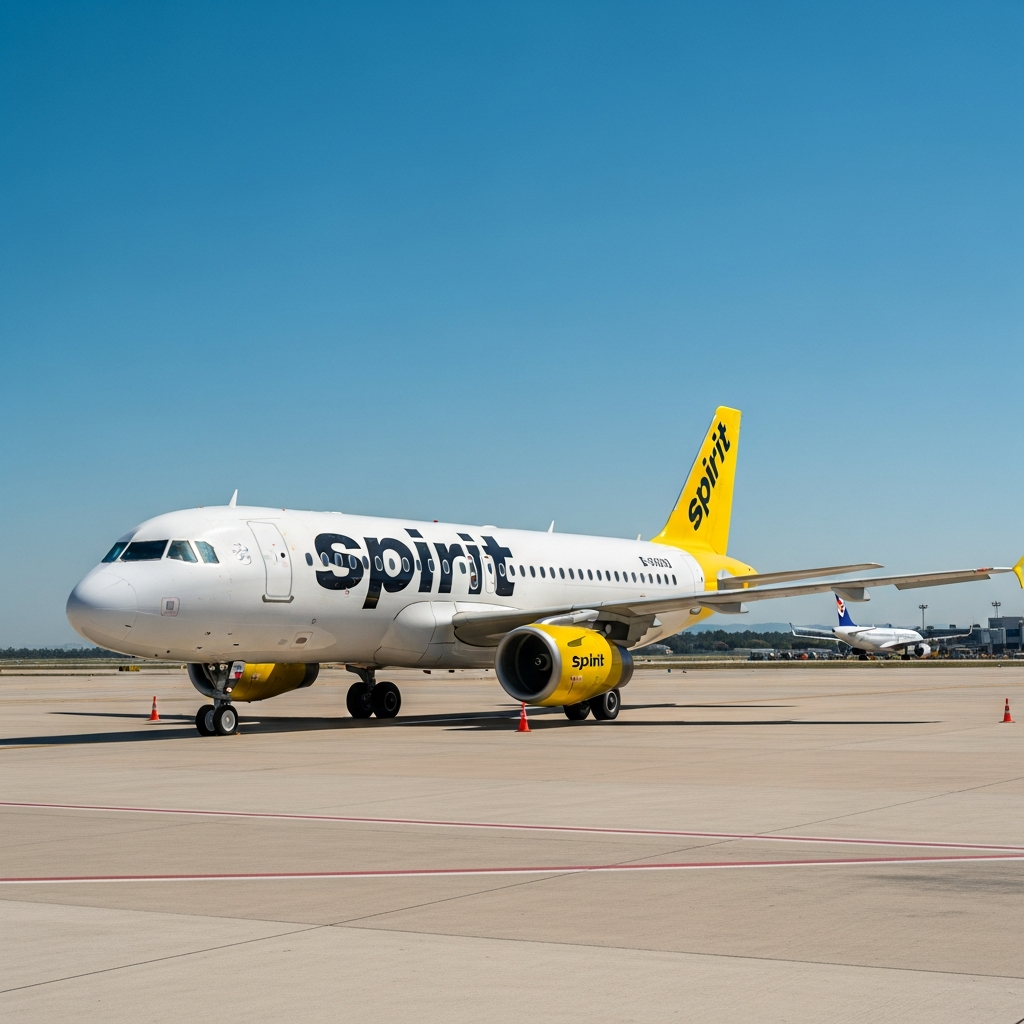
Spirit Airlines could be forced into liquidation as early as this week. The Trump administration is now in advanced talks over an emergency financing package that could provide a path to give the federal government a possible 90% equity stake in America’s largest ultra-low-cost carrier — according to sources cited by CNBC and confirmed in bankruptcy court Thursday, April 24.
An attorney for Spirit confirmed during Thursday’s hearing that a federal rescue deal is close. A source told CNN an announcement could come any day, with a follow-on bankruptcy court hearing tentatively scheduled for April 30 to consider the terms.
Fuel Costs — The Trigger
The immediate catalyst is jet fuel. When U.S. and Israeli forces began military operations against Iran on February 27–28, Tehran responded by closing the Strait of Hormuz — the chokepoint for roughly 20% of the world’s traded oil. Jet fuel hit approximately $4.88 per gallon in major U.S. markets by early April, up nearly 95% since the war began. For Spirit, already uniquely exposed to fuel cost swings, the timing couldn’t have been worse.
Spirit’s restructuring plan, filed with the U.S. Bankruptcy Court for the Southern District of New York in March, had assumed fuel costs of just $2.24 per gallon for 2026. By mid-April, prices had already blown past $4.24 a gallon. JPMorgan analyst Jamie Baker calculates that sustained fuel at $4.60 a gallon would drag Spirit’s forecast operating margin from negative 7% to negative 20% — piling on an additional $360 million in costs, more than the airline’s entire $337 million cash balance at the end of 2025.
“Spirit is flying on financial fumes.” — Aviation analyst Henry Harteveldt
A Carrier Already on Life Support
Spirit had not turned a net profit since 2019. The airline filed for Chapter 11 in November 2024, emerged in March 2025, then filed again on August 29, 2025 — its second bankruptcy in under a year — citing a ruinous combination of post-COVID fare pressure and a disproportionate exposure to Pratt & Whitney’s troubled geared turbofan (GTF) engine crisis. At its worst, Spirit had 38 GTF-powered A320neo-family jets grounded simultaneously awaiting engine repairs, with nearly all 79 of its P&W GTF engines expected to cycle through inspection over two years. A settlement with IAE provided up to $140 million in credits as partial compensation.
The fleet has shrunk dramatically. From a peak of around 220 Airbus A320-family aircraft, Spirit has shed 73 airframes since early 2025 — many now parked at Pinal Airpark in Arizona. Two jets, MSN 10769 and MSN 10921, A320neo-family aircraft delivered new in December 2021 and July 2022 at list prices above $110 million each, are already being dismantled for parts. The restructuring plan had targeted a surviving fleet of just 76–80 aircraft by Q3 2026.
Washington Divided
President Trump told CNBC’s Squawk Box on Tuesday, April 21: “Spirit’s in trouble, and I’d love somebody to buy Spirit. It’s 14,000 jobs, and maybe the federal government should help that one out.” Not everyone in his administration agrees. Transportation Secretary Sean Duffy, at a press conference on April 21, said he was “taking a look” at the airline but expressed skepticism, warning: “What we don’t want to do is put good money after bad.” FAA Administrator Bryan Bedford, appearing alongside Duffy on April 22, was blunter still, stating Spirit “can’t have any of our money.”
Congressional reaction split along familiar lines. Sen. Ted Cruz, who chairs the Senate Commerce Committee, called the bailout idea “an absolutely terrible idea.” Sen. Elizabeth Warren took a different angle: “Donald Trump’s war with Iran caused the sky-high fuel prices that finally did Spirit Airlines in. What do the American people get out of this taxpayer bailout?” United Airlines CEO Scott Kirby publicly opposed any rescue, arguing Spirit’s business model was “fundamentally flawed and the airline was not going to be able to make it even before the fuel spike.”
“If you do Spirit, who comes next?” — Transportation Secretary Sean Duffy
What to Watch
The April 30 bankruptcy hearing is the critical date. If a federal financing package — reportedly structured around $500 million in government funds — clears the court, Spirit survives in sharply reduced form. If talks collapse before then, liquidation proceedings could begin immediately, stranding passengers holding tickets and loyalty credits and eliminating the lowest-cost option on hundreds of domestic routes.

Stay in the loop
Get the latest aircraft insider updates delivered to your inbox.