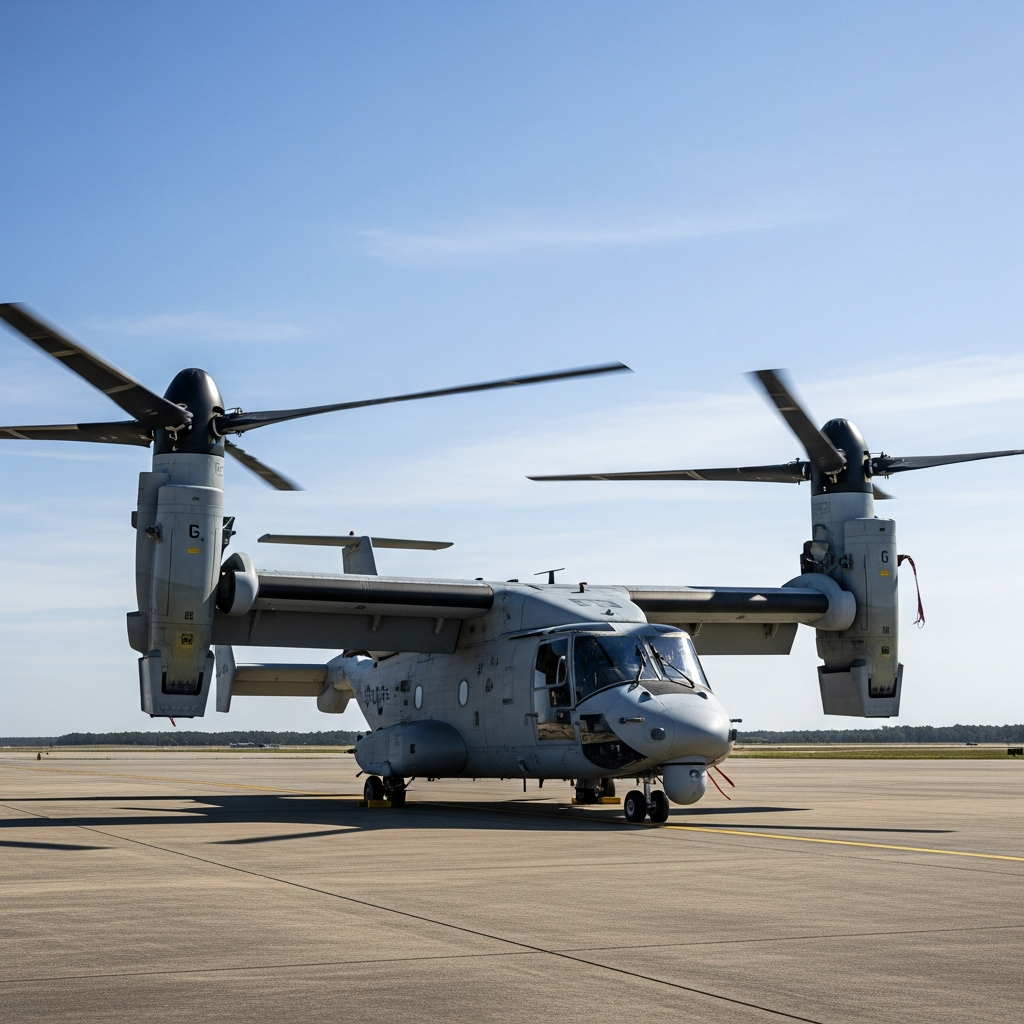
The U.S. Army officially named its Future Long-Range Assault Aircraft the MV-75 Cheyenne II on April 15, 2026, during the Army Aviation Warfighting Summit — resurrecting one of military aviation’s most storied names and attaching it to what the service describes as its most capable assault aircraft ever developed.
The designation honors the Cheyenne Tribes and their traditions of mobility, resilience, and disciplined strength. It also deliberately echoes the Lockheed AH-56 Cheyenne — the advanced compound helicopter that made its maiden flight on September 21, 1967, achieved a cruise speed of 224 mph and dash speeds above 240 mph using a pusher propeller and a nearly 4,000-horsepower turbine, and was ultimately cancelled in two stages: the production contract was cancelled in May 1969 following a fatal crash and persistent rotor-oscillation problems, and the full program was cancelled in August 1972 amid mounting costs. The “II” in the name signals continuity with that bold vision. An assertion, too, that this time the Army finishes what it started.
What Was Announced April 15
The naming wasn’t the only news. Bell rolled out an updated full-scale model of the MV-75 Cheyenne II at the same event, reflecting a design that Bell Senior Vice President and FLRAA Program Director Ryan Ehinger described the following day as “essentially locked,” with more than 90% of the aircraft’s details finalized. The new model shows a substantially strengthened landing gear — designed to handle operations from austere forward locations — among the most visible changes.
U.S. Army Special Operations Aviation Command also unveiled a rendering of a dedicated SOAR variant at the summit, fitted with an aerial refueling probe, advanced radar systems, and enhanced sensor packages. That configuration underscores the platform’s reach well beyond conventional assault missions.
What the MV-75 Brings to the Fight
The MV-75 is a tiltrotor — the Army’s first conventional one. It was selected in December 2022 over the Sikorsky-Boeing SB>1 Defiant to replace the UH-60 Black Hawk in the long-range assault role. The “MV” designation stands for Multi-Mission Vertical Takeoff; the “75” references 1775, the year the Army was founded.
The performance figures are hard to ignore. The Cheyenne II is designed to exceed 300 mph, carry up to 12 soldiers or an external load up to 10,000 lbs, and fly at least 1,700 nautical miles without refueling. For comparison, the Black Hawk cruises at roughly 151 knots with a substantially shorter unrefueled range. The Army’s stated requirement is a cruise speed of up to 280 knots at altitudes of 6,000 feet in 95°F heat — conditions that degrade legacy rotorcraft significantly.
The team studied the MV-22 Osprey closely, and the lessons show. Unlike the Osprey, the Cheyenne II features fixed engines with rotating proprotors, reducing mechanical complexity. It also incorporates an integrated particle separator — a retrofit on the V-22 — along with a simplified straight wing, lower-pressure hydraulics with fewer components, and a V-tail replacing the Osprey’s H-tail for improved maintainability and maneuverability.
The Voices Behind the Name
“In naming the MV-75 Cheyenne II, we honor the enduring contributions of the Cheyenne people to our Nation — both their distinguished service in uniform and their legacy as steadfast protectors of their way of life.” — Col. Jeffrey Poquette, Project Manager, FLRAA
“The Cheyenne people represent a resilient warrior culture and embody the key attributes of the MV-75 — speed, reach, lethality, and adaptability.” — HON Brent Ingraham, Army Acquisition Executive
“To be the first to field the MV-75 Cheyenne II is an honor for the ‘Wings of Destiny’ Brigade. The speed and range of the MV-75 Cheyenne II will fundamentally change how we conduct air assaults.” — Col. Tyler Partridge, Commander, 101st Combat Aviation Brigade
Timeline and What Comes Next
The program entered Milestone B — Engineering and Manufacturing Development — on August 2, 2024, authorizing detailed design and construction of six prototype aircraft. First prototype delivery is now targeted for the end of 2026, with flight testing beginning in early 2027. The 101st Combat Aviation Brigade at Fort Campbell is slated to become the first unit equipped, receiving 24 aircraft by 2030 — four years ahead of the original 2034 fielding target. A November 2024 congressional briefing projected up to 334 aircraft delivered by the end of FY2040, and Congress provided $1.26 billion for FLRAA research, development, test, and evaluation in FY2025 alone.
Aerial refueling has been flagged as a near-term priority. Army officials and Bell have both pointed to a future where tanker drones — including the Navy’s forthcoming MQ-25 Stingray — could help extend the Cheyenne II’s reach.
With design locked, components already in production, and a first-unit-equipped date pulled sharply left, the Cheyenne II is a program to track on a delivery schedule now — not just one to watch. Prototype rollout and the start of flight testing in early 2027 will be the next major milestones.
Stay in the loop
Get the latest aircraft insider updates delivered to your inbox.