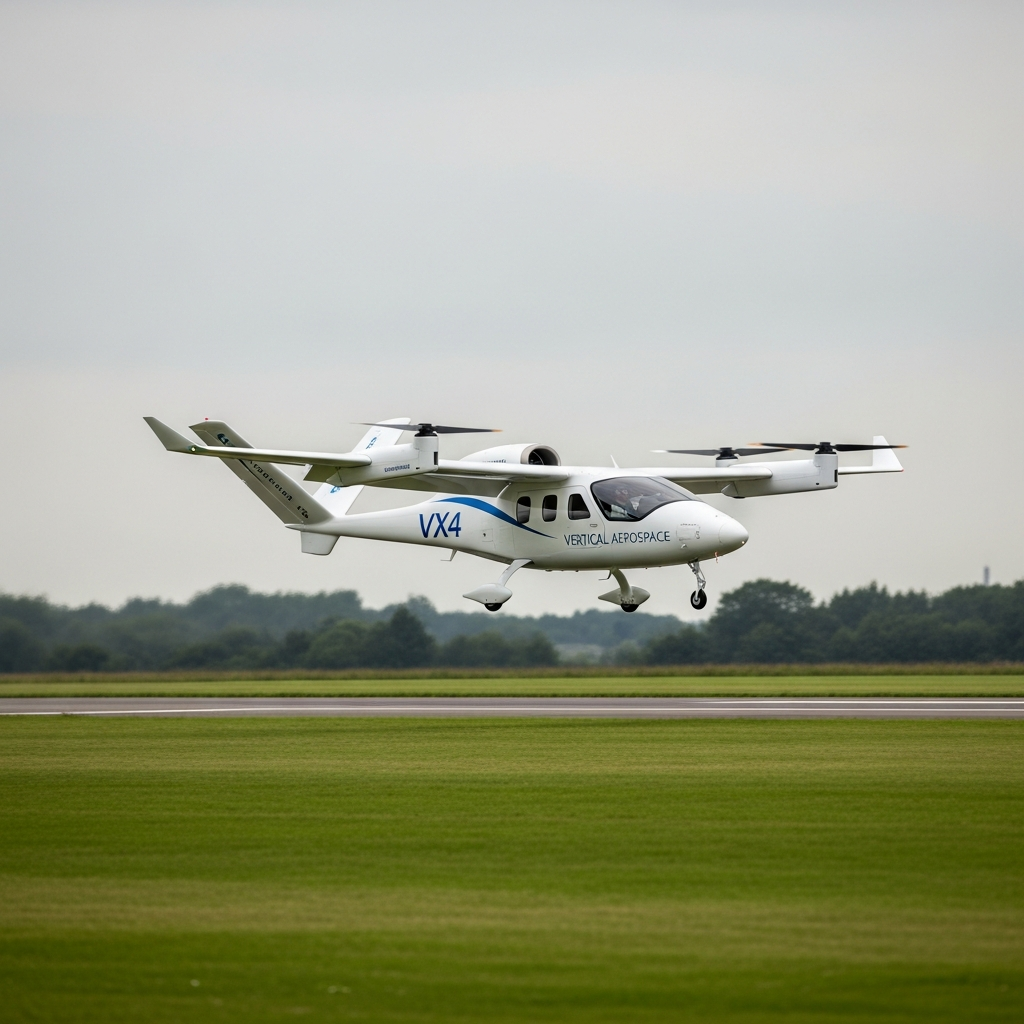
Vertical Aerospace’s chief test pilot Simon Davies flew the company’s full-scale Valo tiltrotor eVTOL through a complete two-way transition on Monday, April 14, 2026 — taking off vertically, converting to wingborne cruise, then returning to a vertical landing in a single continuous flight from the company’s test centre at Cotswold Airport in Gloucestershire.
It’s the second time in history a full-scale tiltrotor eVTOL has completed a two-way piloted transition. But Vertical is claiming a distinction no one else can: they did it under civil aviation Design Organisation Approval (DOA) regulatory oversight — and that difference matters more than it might sound.
Why the DOA Distinction Matters
Joby Aviation pulled off a two-way piloted transition in April 2025, but under the FAA’s experimental permit framework. Vertical’s flight was conducted under direct oversight of the UK Civil Aviation Authority, which holds a DOA — a formal certification granted to organisations demonstrating the capability, processes, and authority to design aircraft to approved safety standards. Every data point from Monday’s flight is traceable, audited, and directly usable toward Valo’s type certification. It doesn’t just prove the technology works. It counts.
The April 14 flight came less than two weeks after test pilot Paul Stone completed Phase 4a on April 2 — a one-way thrustborne transition where the VX4 prototype took off vertically, tilted its four front propellers forward, stowed its four rear propellers, and accelerated into wingborne cruise before a conventional runway landing. Davies’ flight closed the loop, adding the wingborne-to-vertical conversion that defines true transition-capable eVTOL operation.
“This is now the most significant technical milestone in our history. Full piloted transition is the most critical and complex challenge in eVTOL development, and we’ve achieved it under more rigorous regulatory oversight than anyone in the category.” — Stuart Simpson, CEO, Vertical Aerospace
Davies — a former UK Royal Navy pilot — was unambiguous about what the flight meant to him personally, describing it as the defining moment of his career.
“This is by far and away the most significant; it was fantastic, just amazing.” — Simon Davies, Chief Test Pilot, Vertical Aerospace
The Aircraft — VX4 Prototype
The aircraft flown on April 14 is Vertical’s second full-scale VX4 prototype. It uses a distributed electric propulsion architecture with eight motors across multiple electrically isolated power lanes — four front propellers tilt forward to drive wingborne cruise, while four rear propellers reduce output and stow as wing lift takes over. The airframe is all-composite, with Syensqo supplying materials and Honeywell providing fly-by-wire controls and avionics.
The production Valo will carry one pilot and four passengers at 130 knots over up to 100 miles. It differs from the VX4 in several key ways: a 20% lower wetted area, a 1-metre wingspan increase, a shorter 10.6-metre fuselage versus the VX4’s 12.3 metres, and a 15% lower take-off mass.
Certification is targeted for 2028 under the SC-VTOL Category Enhanced pathway — the airliner-equivalent standard requiring a 10⁻⁹ failure probability — with commercial routes including Canary Wharf to Heathrow and JFK to Manhattan planned for entry into service shortly after.
Prototype 3 — Days Away
Attention is already shifting to the third prototype, registered G-EVTB, which rolled out on December 22, 2025. Davies confirmed it’s ready to fly.
“We are getting ready to fly aircraft three. It’s been on the back burner a little bit because we wanted to get through the transition. Now that is in the bag we will get that prototype up and running. It’s days or weeks away rather than months.” — Simon Davies
Prototype 3 is slated for hybrid-electric propulsion testing in 2026, pushing the envelope beyond what the current aircraft has demonstrated. That expanded test programme runs alongside a recently announced financing package of up to $850 million — secured in principle on March 30 — designed to carry Vertical through to type certification and into commercial service.
Peter Kyle, UK Secretary of State for Science, Innovation and Technology, called Monday’s flight “a fantastic milestone not only for Vertical, but for the UK’s position in the future of aerospace.” American Airlines, both an investor and a customer, also weighed in — Vice Chair Steve Johnson describing the transition flight as “a foundational step” toward scalable eVTOL operations.
The next major markers: Prototype 3’s first flight and the start of envelope expansion testing.

Stay in the loop
Get the latest aircraft insider updates delivered to your inbox.