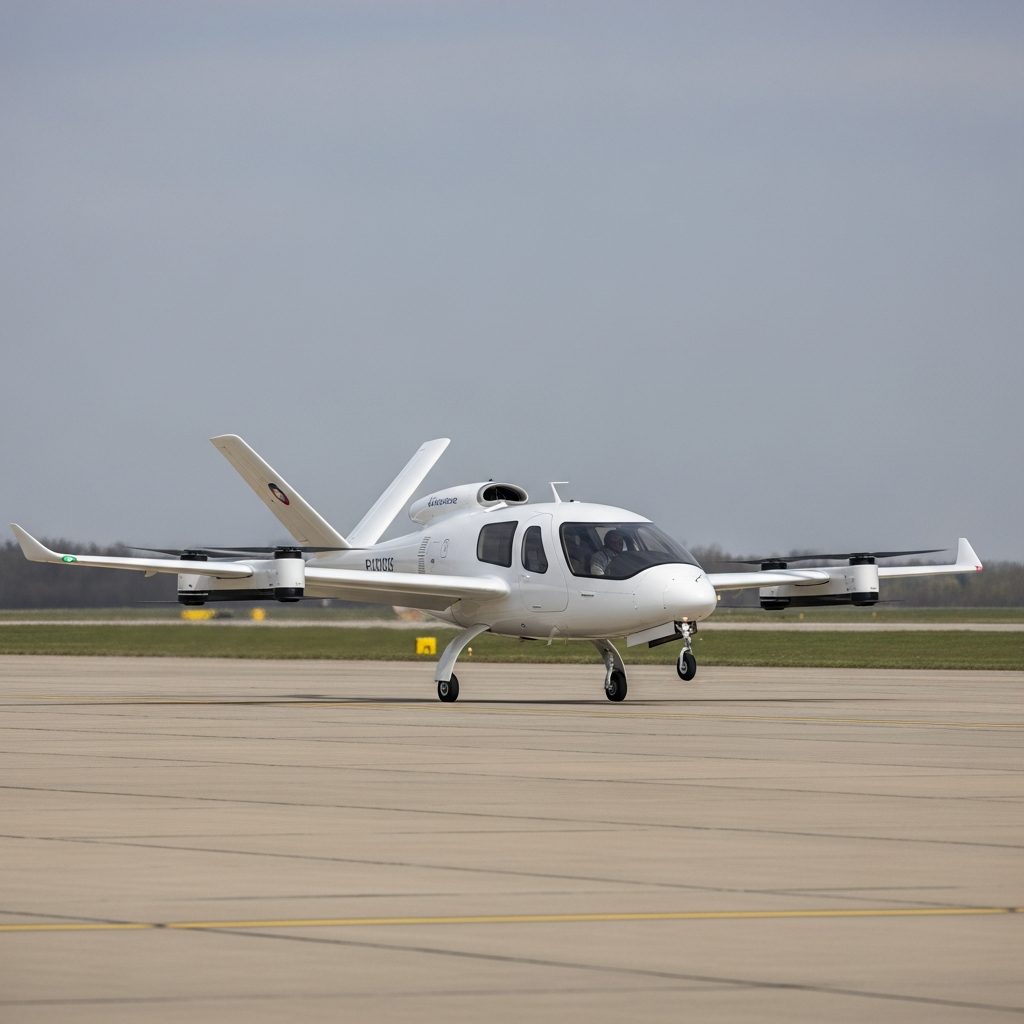
Wisk Aero flew its second Generation 6 eVTOL prototype on May 4, 2026, at Hollister Airport in California — bringing the company’s active FAA type certification test fleet to two aircraft for the first time. The aircraft, registered N607WA, completed vertical takeoff, hover, and chirp maneuvers on its maiden sortie, following the same initial test profile flown by the first Generation 6 example, N606WA, on its December 16, 2025 debut.
Four and a half months between first and second flying examples is a meaningful pace for an eVTOL programme. More importantly, Wisk can now run parallel test campaigns rather than working through the FAA’s certification evidence matrix one flight at a time.
What N607WA Actually Did in the Air
The chirp inputs performed during Sunday’s flight are worth unpacking. A chirp — formally a frequency-sweep maneuver — injects controlled oscillations into the flight control system at progressively increasing rates. The technique maps how the aircraft responds across a range of dynamic conditions in a single structured sortie, generating data on structural loads and control law accuracy that would otherwise take weeks of qualitative observation to produce. Standard first-flight procedure for fly-by-wire aircraft. The fact that Wisk ran it on day one signals a mature, disciplined test programme.
The data from N607WA feeds directly into the same validation database N606WA has been building since December, accelerating Wisk’s ability to demonstrate control law performance, structural margins, and system reliability to the FAA across the full certification evidence matrix.
The Aircraft — A Refresher
The Generation 6 is a four-passenger, fully autonomous eVTOL with a 50-foot (15.2 m) wingspan and 12 rotors — six dedicated lift rotors and six convertible lift/cruise units that enable transition from hover to wing-borne flight. Cruising speed is between 100 and 120 mph (160 to 195 km/h) at altitudes between 2,500 and 4,000 feet, with a projected range of 90 miles (145 km). There are no onboard flight controls; a ground-based operator supervises multiple aircraft simultaneously through Wisk’s Multi-Vehicle Supervisor system.
That autonomy-first architecture is what separates Wisk from every other funded U.S. eVTOL programme. Joby, Archer, and Beta are all certifying piloted aircraft where the human crew is part of the safety case. Wisk is asking the FAA to certify an aircraft where the autonomy stack is the safety case — a structurally harder regulatory argument that demands a larger body of flight evidence.
CEO Statement
“Seeing the second Gen 6 aircraft take to the skies is a proud moment for Wisk. This pace of execution is exactly what is required to meet the rigorous safety standards of commercial aviation. Having multiple aircraft in flight testing allows us to move faster, learn quicker, and stay on the leading edge of autonomous aviation. Every flight provides crucial data that matures our aircraft and autonomous system, bringing us one step closer to delivering a certified, autonomous air taxi service.” — Sebastien Vigneron, CEO, Wisk Aero
Programme Standing
Wisk received its Stage 2 G-1 issue papers from the FAA in fall 2024 and has since moved into Stage 3 — the phase focused on compliance demonstration. The programme has accumulated more than 1,750 test flights across Wisk’s five previous aircraft generations, prior to Gen 6. No other eVTOL developer has flown six generations of the same type.
On the commercial side, the U.S. Department of Transportation selected TxDOT as an eIPP participant on March 9, 2026, under the FAA’s eVTOL Integration Pilot Program (eIPP), with Wisk serving as TxDOT’s primary private-sector eVTOL partner and Houston as its primary target launch market. Commercial service entry is targeted for 2030.
What to Watch
The dual-aircraft phase will expand the flight envelope into the most critical test territory: the transition corridor between hover and wing-borne flight. Longitudinal and lateral transitions, pedal turns, and progressive airspeed expansion will generate the certification evidence Wisk needs at a pace a single-ship programme simply cannot match. The aircraft can fly — that much is established. The outstanding question is whether the FAA’s autonomy certification standard will be in place in time to support a 2030 service entry. Both the Hollister flight line and the regulatory calendar bear watching.
Stay in the loop
Get the latest aircraft insider updates delivered to your inbox.