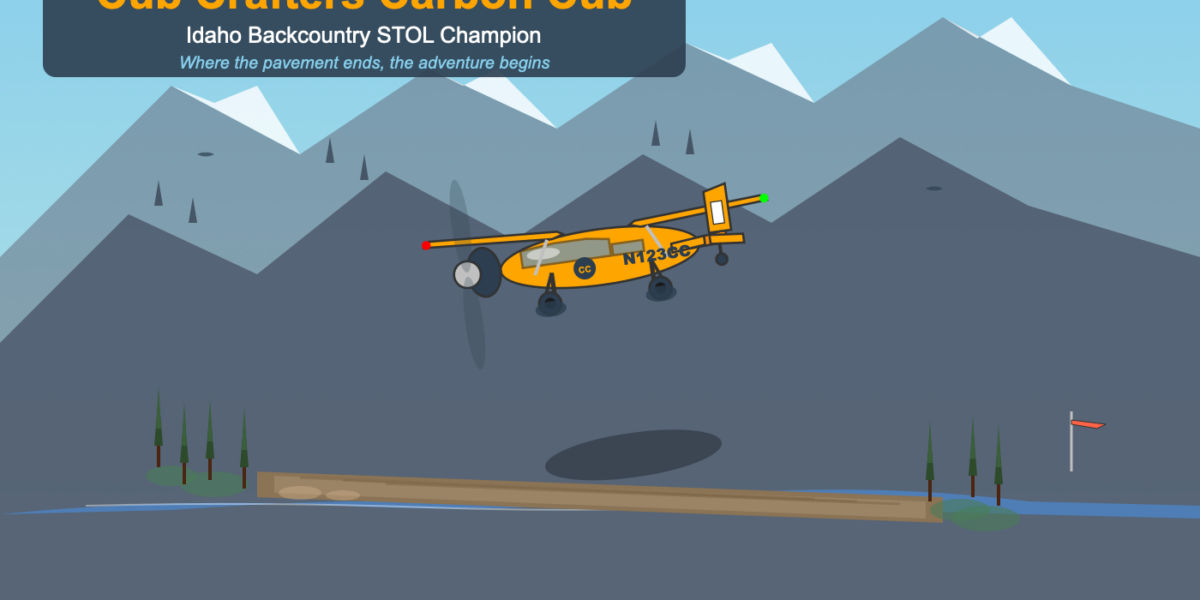
The Call of the Backcountry: Why Cub Crafters Owns the Western Wilderness
There’s a moment every backcountry pilot knows—you’re on final approach to a 1,200-foot dirt strip carved into an Idaho ridgeline, mountains rising 8,000 feet on either side, and you realize: this is why we fly.

Welcome to the world of Cub Crafters, where the pavement ends and the adventure begins. These aren’t your grandfather’s Super Cubs (well, they kind of are, but with 21st-century engineering). These are purpose-built STOL machines that turn the impossible into Tuesday afternoon.
Meet the Fleet: Cub Crafters Carbon Cub, EX-3, and FX-3
Carbon Cub SS: The Backcountry Legend
The Carbon Cub SS is what happens when you take the classic Super Cub DNA and inject it with carbon fiber steroids and a 180 HP Lycoming powerhouse. This aircraft doesn’t just land short—it lands *absurdly* short.
- Takeoff distance: 100-150 feet (yes, you read that right)
- Landing distance: 75-100 feet (with good technique)
- Engine: Lycoming O-360 (180 HP)
- Cruise speed: 100-110 mph (but who’s cruising?)
- Useful load: 800+ lbs
- Price: $369,000 – $450,000 depending on configuration
What makes it special: The Carbon Cub can literally land in spaces that would make a helicopter pilot think twice. Combine the massive 31″ Alaskan Bushwheel tires, vortex generators on the wings, drooped wing tips, and that gloriously light carbon fiber airframe—you’ve got an aircraft that laughs at physics.
EX-3: Build Your Dream Bush Plane
Want the Carbon Cub experience but enjoy building? The EX-3 is Cub Crafters’ experimental kit that lets you construct your own backcountry beast. It’s the same proven airframe, same incredible STOL performance, but you get to turn wrenches and earn that “experimental” placard.
- Kit cost: Starting around $185,000
- Build time: 800-1,200 hours
- Performance: Identical to Carbon Cub SS
- Experimental freedom: More flexibility with avionics and modifications
FX-3: Light Sport Backcountry
The FX-3 is Cub Crafters’ answer to the Light Sport category. Same STOL DNA, but it meets LSA requirements—perfect for Sport Pilot certificate holders or those who prefer the simplified medical requirements.
- Max weight: 1,320 lbs (LSA limit)
- Engine options: Rotax 912 ULS or 912 iS
- Performance: Still impressively short takeoffs and landings
- Cost advantage: Lower operating costs than the 180 HP Carbon Cub
The Western Backcountry: Where Cub Crafters Come Alive
The Western United States—Idaho, Washington, Oregon, Utah, California—offers some of the most spectacular and challenging backcountry flying on Earth. This is Cub Crafters’ natural habitat.
Idaho: The Backcountry Mecca
Idaho is backcountry flying’s promised land. With over 80 designated backcountry airstrips and thousands of square miles of wilderness, Idaho draws pilots from around the world.
Must-Visit Idaho Strips
- Johnson Creek (3U2): 3,400 feet of dirt at 4,882′ elevation. The backcountry gateway—if you can land here, you’re ready for serious strips
- Sulphur Creek (U78): 2,650 feet with a 5.5% uphill gradient. Land uphill, takeoff downhill. Your first time here will get your heart racing
- Thomas Creek: 2,700 feet but narrow with trees on both sides. This is where technique matters
- Big Creek (U60): 3,650 feet, relatively “easy” by backcountry standards. Great overnight camping
- Chamberlain Basin: Multiple strips, stunning scenery, excellent camping
- Cold Meadows: 2,400 feet at 6,841′ elevation. High, hot, and humbling
The Idaho Backcountry Flying Experience: Picture this—you’re departing McCall at dawn, Carbon Cub loaded with camping gear. Thirty minutes later, you’re landing at a strip that sees maybe 50 aircraft all summer. You’re camping next to natural hot springs with elk grazing 100 yards away. The nearest road? Fifty miles. The nearest cell tower? Good luck. This is pure, unfiltered freedom.
Washington: Cascades and Coastal Strips
Washington offers dramatic mountain flying in the Cascades and unique coastal strips. Cub Crafters is based in Yakima, Washington—these aircraft were literally designed for this terrain.
Washington Highlights
- Ranger Creek (USFS): Short strip in the North Cascades. Pine trees, granite peaks, and crystal-clear lakes
- Stehekin (6S9): 2,360 feet surrounded by 8,000′ peaks. No road access—fly in or boat in only
- Darrington (1S2): Gateway to North Cascades flying
- Copalis State (S16): Beach flying! Land on hard-packed sand at low tide
Mount Rainier Scenic Flights: Taking a Carbon Cub around Mount Rainier on a clear day is bucket-list aviation. Slow flight at 10,000 feet with glaciers passing 1,000 feet below your wheels—this is what Cubs were made for.
Oregon: High Desert and Coastal Beauty
- Steens Mountain area: High desert strips with stunning geology
- Hart Mountain: Remote eastern Oregon strip at 7,000 feet
- Siletz Bay (S45): Another beach flying opportunity on Oregon coast
- Trout Creek (OG12): Private strip but often open to visitors with permission
Utah: Canyon Country Flying
Utah’s red rock country provides a completely different backcountry experience—landing in desert strips surrounded by sandstone formations that defy belief.
- Mexican Hat (UT25): 3,200 feet dirt strip near Monument Valley
- Bullfrog Basin (U07): Lake Powell access, stunning views
- Moab (CNY): Gateway to Arches and Canyonlands aerial tours
- Blanding (BDG): Base for exploring Canyon Country
Flying over Canyonlands at 500 feet AGL in a Carbon Cub with the doors off on a 75-degree day—you can smell the sage, feel the thermals lifting you, see bighorn sheep on cliff faces. This is sensory aviation at its finest.
California: Sierra Nevada High Country
- Kern Valley (L05): Gateway to Sierra backcountry
- Independence (0Q5): Base for Mount Whitney flights
- Mammoth Lakes (MMH): High altitude (7,128 feet), spectacular mountain scenery
- Pine Mountain Lake (E45): Yosemite area access
Why the Carbon Cub Dominates Backcountry Flying
1. STOL Performance That Defies Reality
Let’s talk numbers that matter. A well-piloted Carbon Cub can:
- Take off in under 150 feet
- Land in under 100 feet
- Climb at 1,500+ FPM at sea level
- Maintain a 20-degree climb angle
- Approach at 25-30 mph
This isn’t marketing speak—this is what owners achieve regularly. At a 5,000-foot strip at 6,000 feet elevation on a hot day, you’re still comfortable. At a 1,200-foot strip? You’re barely using half of it.
2. Tundra Tires and Bush Modifications
Those massive 31″ Alaska Bushwheels aren’t just for show. They transform the Carbon Cub from an aircraft to a go-anywhere machine:
- Soft field performance: Land on sand, gravel, grass, dirt—pick your poison
- Obstacle clearance: Roll over rocks and ruts that would destroy standard gear
- Shock absorption: Forgive rough landings (we’ve all had them)
- River bar landings: Yes, you can land on river gravel bars. Yes, it’s amazing
3. Visibility and Maneuverability
The tandem seating configuration puts both occupants on the centerline with exceptional visibility. The massive windows and high wing provide 360-degree awareness—crucial when threading narrow mountain valleys or spotting short strips from the air.
Want to inspect a strip before committing? Fly a low, slow orbit at 35 mph. The Carbon Cub will practically hover while you check for rocks, ruts, or wildlife.
4. Simple, Reliable, Maintainable
When you’re landing at remote strips 50 miles from the nearest mechanic, reliability matters. The Carbon Cub’s design philosophy: proven components, robust construction, minimal complexity.
- Lycoming O-360: One of the most reliable engines ever built
- Simple systems: No hydraulics, no complex electronics (unless you add them)
- Accessible maintenance: Easy to inspect and service
- Bush modifications: Designed to handle abuse
Learning Backcountry Flying: Training and Technique
Disclaimer: Don’t fly into backcountry strips without proper training. The mountains are beautiful, unforgiving, and permanent.
Get Proper Training
- Backcountry flying courses: Several organizations offer mountain flying training
- Mentorship: Find experienced backcountry pilots and learn from them
- Start easy: Begin with longer, easier strips before attempting challenging terrain
- Mountain flying seminars: Idaho Aviation Foundation and others offer excellent programs
Essential Skills
- Density altitude calculations: High, hot, and heavy is a deadly combination
- Canyon turns: How to turn around in narrow valleys
- Approach technique: Reading strip conditions, wind, slope
- Go-around discipline: Know when to abort
- Weather assessment: Mountain weather changes rapidly
The Backcountry Community
Backcountry flying isn’t just about the aircraft—it’s about the community. Pull into Johnson Creek on a summer Saturday, and you’ll find Cubs, Cessna 180s, Maules, and Huskies lined up wingtip to wingtip. Pilots sharing beta about strip conditions, swapping stories, helping each other with maintenance.
Annual events:
- Idaho Backcountry Film Festival: Held at various Idaho locations
- High Sierra Fly-In: California backcountry gathering
- Northwest Backcountry Pilots: Active community with fly-outs and training
- Recreational Aviation Foundation: Maintains and improves backcountry strips
Operating Costs: What to Expect
The Carbon Cub isn’t cheap to buy, but it’s reasonable to operate:
| Cost Category | Annual Estimate (100 hours) |
|---|---|
| Fuel (11-12 GPH) | $7,000 – $9,000 |
| Insurance | $2,500 – $4,500 (tail dragger rates) |
| Annual Inspection | $2,000 – $3,500 |
| Engine Reserve | $3,500 – $4,500 |
| Tires/brakes/misc | $1,000 – $2,000 |
| Total | $16,000 – $23,500 |
The Bottom Line: Is Backcountry Flying For You?
You should consider a Cub Crafters and backcountry flying if you:
- Want to access places most pilots only dream about
- Value experience over speed (cruising at 100 mph is fine when the destination is extraordinary)
- Enjoy the challenge of precision flying
- Love camping, hiking, fishing, and outdoor adventure
- Want to be part of an amazing pilot community
- Can commit to proper training and safety discipline
Backcountry flying isn’t for you if you:
- Prioritize going places quickly over the journey itself
- Prefer traveling with 3-4 passengers and full luggage
- Want weather-independent, instrument-capable transportation
- Aren’t comfortable with risk management and conservative decision-making
The Magic of Backcountry Aviation
There’s something magical about shutting down your Carbon Cub at a remote Idaho strip, 75 miles from the nearest road, with nothing but the sound of wind in the pines and a creek babbling nearby. You pitched your tent next to your airplane. You’ll catch trout for dinner. Tomorrow you’ll fly over ridgelines to another remote strip.
This is aviation in its purest form—not transportation, but exploration. Not efficient, but extraordinary. Not fast, but unforgettable.
The Western backcountry is calling. Cub Crafters built the aircraft to answer that call. The only question is: are you ready to go?
Blue skies and soft landings, pilots. See you in the backcountry.

Leave a Reply