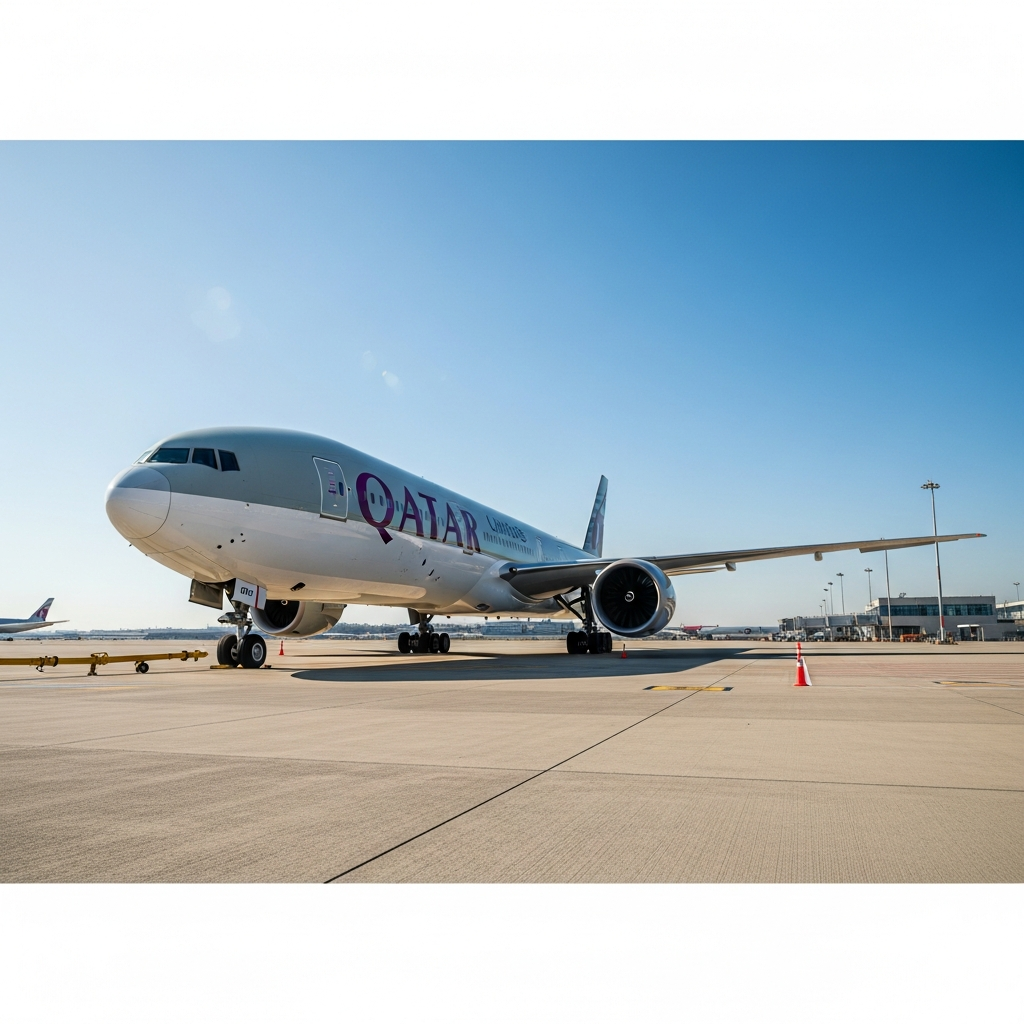
Middle East Airspace Shuts Down — Emirates, Qatar Airways and Etihad Grounded as War Disrupts 90,000 Daily Passengers
The Middle East’s three dominant hub carriers are effectively at a standstill. Sweeping airspace closures triggered by U.S.-Israel strikes on Iran have left approximately 90,000 transiting passengers stranded or rerouted each day — a disruption that is now reshaping intercontinental aviation on a scale not seen in years.
Airspace Collapse — What’s Closed and Why
It started on February 28, 2026. U.S. and Israeli forces launched coordinated strikes on Iran — designated Operation Epic Fury by the Pentagon and Operation Roaring Lion by Israel — and the airspace fallout was immediate. NOTAM-confirmed closures followed for the Iranian, Iraqi, Kuwaiti, and Syrian FIRs. The Emirates FIR (OMAE) remains partially open, though overflights are now restricted to a single western corridor via waypoint LUDID. Qatar’s Doha FIR (OTDF) permits only approved arrivals via LAEEB and departures via DATRI.
Then came March 7. A drone struck near Terminal 3 at Dubai International Airport (OMDB), halting operations briefly and forcing several inbound aircraft into holding patterns before the airport cleared the area and resumed flights. On March 16–17, the UAE closed its entire airspace overnight as a precautionary measure during a fresh wave of missile and drone threats — a two-hour blackout that sent reverberations across dozens of intercontinental routings.
EASA’s current Conflict Zone Information Bulletin (CZIB), valid through April 10, advises operators to avoid the FIRs of Bahrain, Iran, Iraq, Israel, Jordan, Kuwait, Lebanon, Qatar, UAE, Oman, and Saudi Arabia. GPS jamming and radar spoofing remain active across the region — a risk environment drawing uncomfortable comparisons to the circumstances preceding the 1988 shoot-down of Iran Air Flight 655.
Qatar Airways A380 Fleet — All Eight Aircraft Grounded
Qatar Airways has grounded its entire active Airbus A380 fleet through April and May. All eight superjumbos are now parked at Hamad International Airport (DOH) in Doha — the largest A380 standdown since the COVID-19 pandemic. The airline has cancelled more than 12,000 flights and suspended service to over 60 destinations.
The aircraft were recalled from across the network between late March and early April. Tail numbers confirmed grounded include A7-APC (arrived from Teruel storage, April 1), A7-APD (London Heathrow, March 28), A7-APE (Bangkok, March 25), A7-APF (London Heathrow, March 24), A7-APG (Rayong, March 28), A7-APH (Bangkok, March 24), and A7-APJ (Paris CDG). None of the eight have been airborne since April 1. The Boeing 777 is now serving as the primary replacement on affected long-haul routes.
A commercial return is tentatively penciled in for June 1, targeting London Heathrow, Bangkok, Singapore, Paris CDG, and Sydney. That date hinges entirely on whether regional airspace conditions improve.
Fuel Prices — The Secondary Crisis
Jet fuel is a crisis of its own. U.S. jet fuel prices nearly doubled — from $2.50 per gallon on February 27 to $4.88 per gallon by April 2 — while the broader global rise since the start of the Iran conflict has exceeded 50%. The global IATA average reached $209 per barrel for the week ended April 3, up 7.1% week-on-week, 13.7% month-on-month, and more than 132% year-on-year. On April 3, northwest European jet fuel hit $1,840 per metric ton on the Platts assessment, a new record. The effective closure of the Strait of Hormuz is choking refined product exports and severing the traditional pricing correlation between crude benchmarks and jet fuel.
“The reality is, jet fuel prices have more than doubled in the last three weeks. If prices stayed at this level, it would mean an extra $11 billion in annual expense just for jet fuel. For perspective, in United’s best year ever, we made less than $5 billion.” — United Airlines CEO Scott Kirby, internal memo to employees, March 20
TD Cowen analyst Tom Fitzgerald has already moved on earnings: “We lower our estimates for the big 6 U.S. airlines with fuel looking likely to remain elevated vs. antebellum prices for the remainder of 2026.” Avia Solutions Group chairman Gediminas Ziemelis went further — warning that global airlines could face bankruptcies within weeks if the conflict persists.
The Scale — Europe, Asia, Australia Disconnected
Emirates, Qatar Airways, and Etihad jointly carry roughly one-third of all passenger traffic between Europe and Asia, and more than half of all passengers flying from Europe to Australia and New Zealand. John Strickland, Director at JLS Consulting, put the daily exposure plainly on Aviation Week’s Window Seat podcast: “We’re talking about maybe half a million people a day going through these Gulf hubs, a large percentage of which are transferring.”
What to Watch
The June 1 Qatar Airways A380 return-to-service date is the clearest near-term signal of whether the region’s carriers believe the airspace will stabilize. Also worth tracking: NOTAM updates on Emirates FIR routing restrictions, any expansion of the southern Egypt-Oman contingency corridor, and whether Emirates formally grounds its own A380 fleet — its superjumbo operations are already down 14% week-on-week. Schedule data for all three carriers will be monitored as the situation develops.

Stay in the loop
Get the latest aircraft insider updates delivered to your inbox.