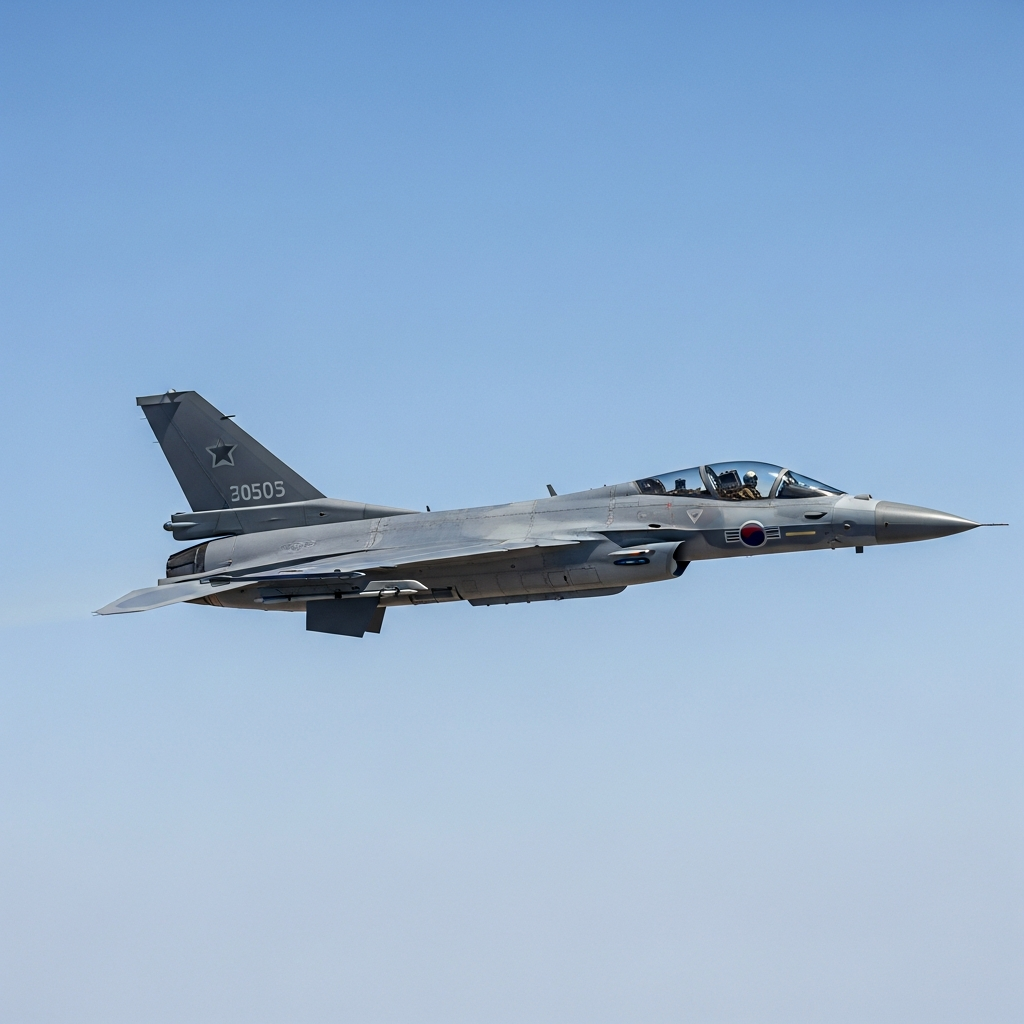
South Korea’s first serial-production KF-21 Boramae fighter took to the skies on April 15, 2026 — just 22 days after rolling out of Korea Aerospace Industries’ assembly hall with tail number 26-001 painted on its fuselage. The maiden flight took place at the Republic of Korea Air Force’s 3rd Training Wing in Sacheon. No anomalies were reported. The aircraft now moves into the acceptance and evaluation phase ahead of planned ROKAF delivery later this year.
This flight means something different from everything that came before it. The six KF-21 prototypes proved the design. This airframe proves the production line. South Korea now joins a very short list — among them the United States, Russia, France, China, and Sweden — of nations capable of designing, developing, and series-producing an indigenous supersonic combat aircraft. When the ROKAF formally accepts 26-001, it will mark the first time an indigenously developed fighter has ever entered Korean military service.
From Assembly Hall to Supersonic — The Road to Production
The program’s roots go back to 2001, when President Kim Dae-jung announced the KF-X initiative. Development formally kicked off in January 2016 with KAI as prime contractor. The first prototype was unveiled in April 2021 and flew on July 19, 2022. What followed was 42 months of rigorous testing — six prototypes, roughly 1,600 accident-free flights, 13,000 test conditions validated. Highlights included a supersonic flight breaking the sound barrier in January 2023 and a first-attempt nighttime aerial refueling trial with a KC-330 tanker in April 2025. DAPA declared the flight test phase complete on January 13, 2026.
Serial production began in July 2024 under a 1.96 trillion-won ($1.41 billion) contract signed in June 2024 for 20 Block I aircraft. A second batch of 20 followed in June 2025. Final assembly of 26-001 started at a ceremony on May 20, 2025, and the aircraft rolled out on March 25, 2026 — with President Lee Jae-myung in attendance.
“The government will leverage this success as a solid foundation for advancing Korea into one of the top four defense-industrial nations.” — President Lee Jae-myung, rollout ceremony, March 25, 2026
Twenty-two days from rollout to first flight is remarkably fast. The Gripen E needed roughly 390 days between those same milestones; the Rafale A demonstrator took about 210. The KF-21 moved so quickly because the prototype campaign had already pre-validated the flight control laws, avionics baseline, and flight envelope. The production aircraft had almost nothing left to prove on day one.
Block I — What 26-001 Actually Is
The aircraft is a two-seater built to Block I standard. Twin General Electric F414-GE-400K turbofans — each producing approximately 98 kN of thrust — push it to a maximum speed of Mach 1.81, with a combat radius approaching 1,000 km. The airframe spans 11 meters, stretches roughly 17 meters in length, and can carry up to 7,700 kg of stores across multiple hardpoints and fuselage missile stations.
At the center of the avionics suite sits the Hanwha Systems APY-016K AESA radar, delivered in production form on August 5, 2025. It carries approximately 1,000 transmit-receive modules, detects targets at 150–200 km, and can track around 20 simultaneously. Block I is air-to-air focused. Certified weapons at entry into service include the MBDA Meteor and IRIS-T, with AIM-120 AMRAAM and AIM-9X integration to follow. Air-to-ground capability comes later, with Block II.
The KF-21’s blended wing-body shaping, canted twin tails, and recessed fuselage missile stations give it a lower radar cross-section than conventional fourth-generation types. That said, the absence of RAM coating and internal weapons bays keeps it short of true stealth — an evolution the program has reserved for later blocks.
What Comes Next
Eight KF-21s are scheduled for ROKAF delivery in 2026, with operational deployment expected to begin in September. All 40 Block I aircraft are to be handed over by 2028. Eighty Block II airframes follow by 2032, bringing the total fleet to 120. KAI is targeting a production rate of 31 aircraft in 2027 and 47 in 2028 — a pace that also supports the export negotiations DAPA says the production milestone will accelerate.
The KF-21 is slated to replace the F-4 Phantom II, retired in 2024, and the aging F-5 Tiger II, flying alongside F-15K Slam Eagles, KF-16s, and F-35As. The acceptance evaluation is now underway. We’ll report on the first formal ROKAF delivery when it occurs.
Stay in the loop
Get the latest aircraft insider updates delivered to your inbox.