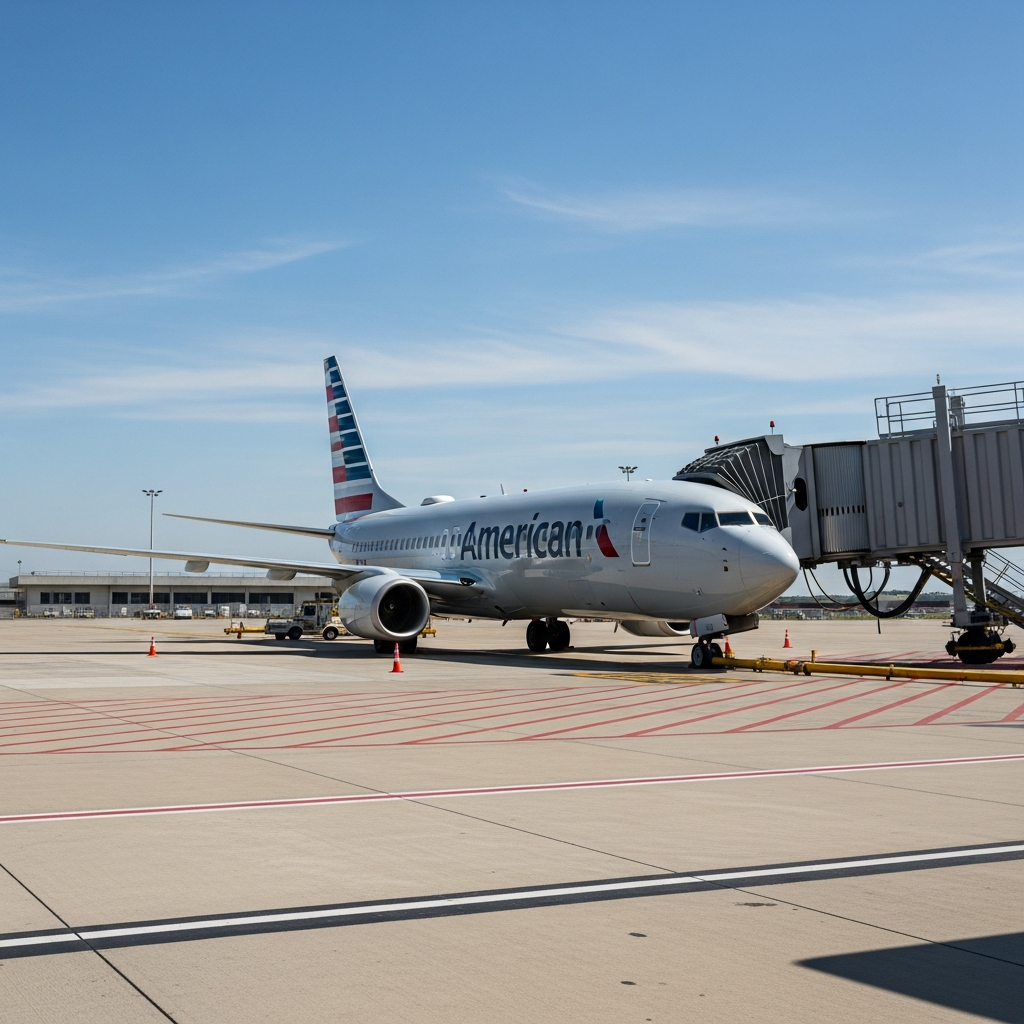
American Airlines formally rejected a merger overture from United Airlines on April 17 — a deal that would have created the world’s largest airline, with a combined mainline fleet exceeding 2,100 aircraft and control over more than a third of all U.S. domestic air traffic. The rejection landed after markets closed on Friday. By Monday morning, American’s stock had shed more than 4% as the merger premium evaporated from the share price.
How the Proposal Reached the White House
United CEO Scott Kirby first floated the idea internally in late 2025, then brought it directly to President Donald Trump during a February 25 White House meeting — one that had originally been scheduled to discuss the future of Washington Dulles International Airport. Kirby’s pitch centered on global competitiveness. Foreign carriers supply two-thirds of long-haul international seats to and from the U.S., and 60% of those passengers are American citizens. A larger United, Kirby argued, could recapture that business.
Bloomberg broke the story on April 13. Reuters confirmed it through two independent sources the same day. Jon Ostrower at The Air Current noted that industry insiders had known about the discussions for roughly a week before publication.
American’s Rejection — In Its Own Words
Fort Worth-based American’s April 17 statement left little room for interpretation:
“American Airlines is not engaged with or interested in any discussions regarding a merger with United Airlines. While changes in the broader airline marketplace may be necessary, a combination with United would be negative for competition and for consumers, and therefore inconsistent with our understanding of the administration’s philosophy toward the industry and principles of antitrust law. Our focus will remain on executing on our strategic objectives and positioning American to win for the long term.”
United declined to comment. The White House has not issued a formal response. Transportation Secretary Sean Duffy told CNBC there is “room for mergers in the aviation industry” — while warning that any large consolidation would require asset divestitures to protect pricing competition.
The Scale of What Was Proposed
The numbers are staggering. United currently operates 1,086 mainline aircraft — the largest fleet on earth. American flies 1,017 mainline jets, making it second globally. Together, they would have dwarfed Delta’s roughly 995-aircraft fleet by a considerable margin.
On the narrowbody side alone, the merged carrier would have absorbed United’s 600-plus Boeing 737 fleet and Airbus A319, A320, and A321 family aircraft alongside American’s more than 400 Boeing 737s, more than 200 A321ceos, and 80-plus A321neos — the largest A321-family operation in the world. Regional operations would have topped 800 aircraft across both carriers’ express networks. Annual revenue would have exceeded $110 billion, compared with Delta’s $63 billion and Southwest’s $28 billion. Combined long-term debt would have exceeded $45 billion.
Bipartisan Backlash — Rare but Real
Congressional opposition formed quickly — and from both sides of the aisle. On April 20, Senator Elizabeth Warren (D-MA) and Senator Mike Lee (R-UT), chairman of the Subcommittee on Antitrust, Competition Policy, and Consumer Rights, sent a joint letter demanding responses from both CEOs by May 3.
“A United-American merger could lead to increased prices for consumers, at a time when airlines are already squeezing flyers through higher fares and fees. It would enable the massive combined carrier to exercise monopsony power over airline workers, potentially suppressing wages and benefits industry-wide.”
House Democrats’ Monopoly-Busters Caucus was sharper still, calling the proposal “illegal” and warning it would consolidate more than a third of the U.S. airline market. TD Cowen analyst Tom Fitzgerald identified 289 routes where combining the two carriers would leave just one or two competitors — a structural divestiture problem that would have consumed years of regulatory review.
Legal experts were equally blunt. Cornell law professor George Hay told CNBC: “This would be the biggest of all time. I can’t even see the slightest chance that a court would allow it.” Seaport Research Partners analyst Daniel McKenzie was more pointed, calling the deal “dead on arrival, though politely reviewed until the public backlash became too deafening.”
What to Watch Next
The Warren-Lee letter deadline of May 3 is the next pressure point. Both carriers must respond, and their answers will shape the congressional record if the idea resurfaces. Smaller consolidation, meanwhile, is already moving. Alaska Air Group and Hawaiian Airlines transition to a shared passenger service system April 22, and the Allegiant-Sun Country merger is expected to close as early as mid-May. JetBlue remains a live acquisition target, with advisors reportedly retained.
Kirby’s gambit may be dead. The consolidation era in U.S. aviation is not.

Stay in the loop
Get the latest aircraft insider updates delivered to your inbox.