Cessna 172 Oil Consumption — What Numbers Are Normal
Oil consumption in the Cessna 172 has gotten complicated with all the conflicting advice flying around. Ask ten pilots what’s normal and you’ll get eleven answers. One mechanic swears anything under a quart per five hours is fine. A CFI on some forum claims their old Skyhawk never touched the oil between changes. Another guy on a Facebook group warns you’re burning too much if it drops even slightly. None of that actually helps you standing on the ramp at 6 a.m., dipstick in hand, wondering if you’re looking at a normal aging engine or the opening act of a $15,000 teardown.
As someone who’s flown enough left-seat hours in 172s to have the walk-around burned into muscle memory, I learned everything there is to know about tracking oil consumption the hard way — watching numbers, logging data, and occasionally calling my A&P over things that turned out to be nothing. Today, I will share it all with you.
What the Lycoming Manual Actually Says
But what is acceptable oil consumption? In essence, it’s whatever falls below Lycoming’s published ceiling of 0.5 quarts per hour. But it’s much more than that — because most pilots either don’t know that number exists or treat it like a target instead of a threshold. It’s not a goal. It’s the line where action becomes mandatory.
The 172 runs one of two engines depending on when it rolled out of Wichita. Earlier models got the O-320 — 150 horsepower, reliable, simple. Later Skyhawks, including the G1000-equipped ones still doing pattern work at flight schools today, run the O-360 at 180 horsepower. Both share the same consumption parameters from the factory. Same ceiling. Same acceptable ranges.
Here’s what trips people up: Lycoming distinguishes between oil consumption and oil loss. Consumption is the oil that actually burns during combustion — normal, expected, happens in every piston engine ever built. Loss is oil escaping through seals, gaskets, or external weeps. When you pull the dipstick, you’re measuring both combined. The 0.5 qt/hr ceiling covers the total. Don’t try to separate them at the dipstick. You can’t.
Normal Range by Engine Age and Hours
Engine time matters. A lot.
Fresh engines — zero to 500 hours since new or overhaul — often consume more oil than you’d expect. Rings haven’t fully seated against the cylinder walls yet. You might see 0.3 to 0.5 quarts per 50 flight hours during break-in. Feels wrong. It isn’t. I watched a freshly overhauled O-360 burn nearly a full quart on a 10-hour cross-country from Pueblo to Santa Fe and back, convinced something was catastrophically wrong. My A&P laughed. “That’s what new rings do,” he said. That was the last time I panicked over a break-in engine.
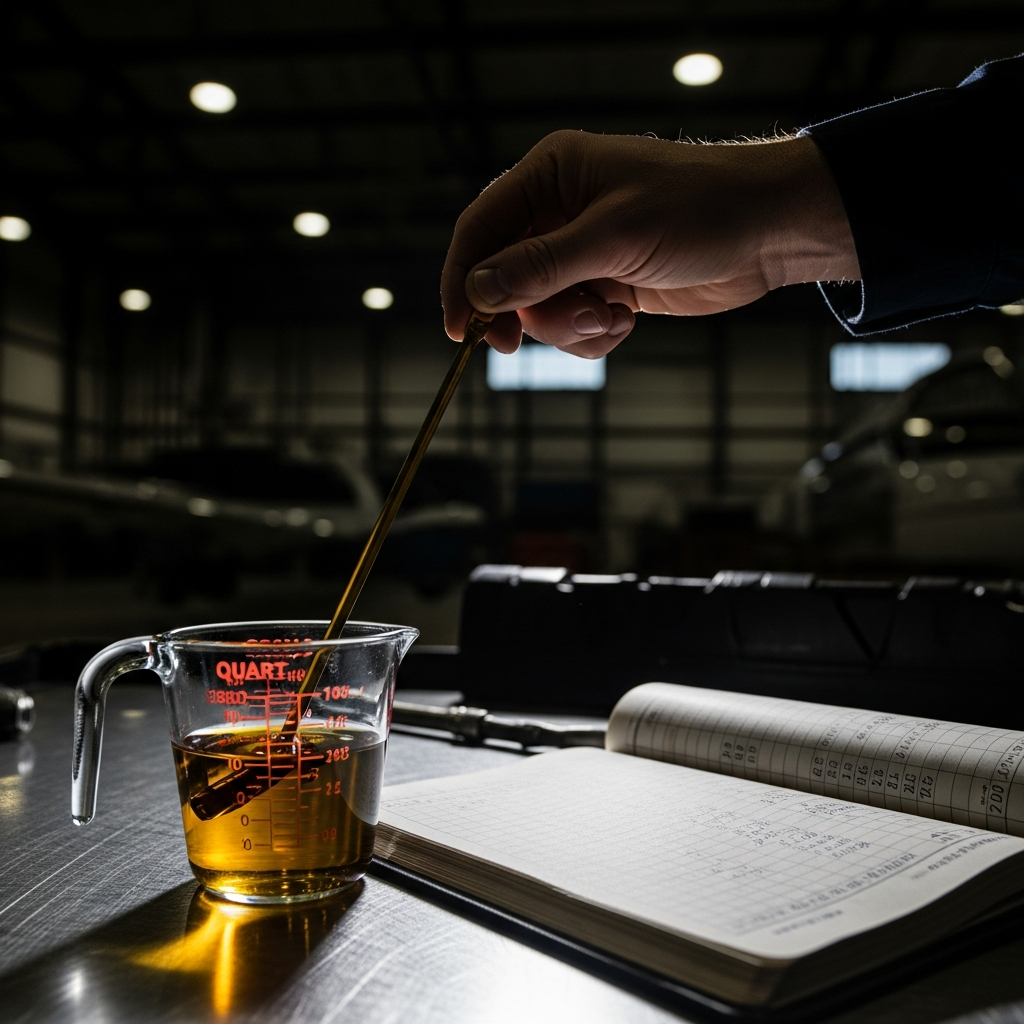
Mid-life engines — 500 to 1,500 hours total time — usually settle into what I’d call the sweet spot: 0.1 to 0.25 quarts per 50 hours. Write that number in your logbook the first time you see it. Seriously, just jot it in the margin. Baseline: 0.15 qt/50 hrs, established March 2023. That single data point becomes your measuring stick for everything that comes after. If consumption suddenly doubles, you have proof something changed — not just a feeling.
High-time engines approaching TBO — 1,500 hours and climbing toward the 2,000-hour mark — typically land between 0.25 and 0.4 quarts per 50 hours. Rings wear. Valve guides develop a little slop. That’s age. A 1,800-hour O-320 burning 0.3 quarts per 50 hours is normal. The same rate on a 600-hour engine? That warrants a closer look. Context is everything.
Signs Your Oil Consumption Is Actually a Problem
Probably should have opened with this section, honestly — because the speed of change matters just as much as the absolute number.
A sudden spike in consumption is your first red flag. Steady at 0.2 quarts per 50 hours for eight months, then suddenly topping off every 30 hours? Something shifted. Could be a valve guide starting to go. Could be a ring. Could be a gasket weeping internally. Don’t diagnose it yourself — get your A&P involved and tell them when the change happened.
Blue smoke on startup in cold weather is mostly harmless — condensation, cold combustion, oil sitting in places overnight. Blue smoke in cruise, or blue smoke after the engine’s fully warm, is different. That’s oil reaching the combustion chamber. Valve guide wear and piston ring blow-by are the usual suspects. This one earns a phone call, not a mental note.
Oil on the belly or cowling is external loss, not internal consumption. Often simpler to fix — a weeping gasket, a drain plug that wasn’t torqued to spec (usually 20 to 25 ft-lbs on the O-320), a damaged push rod seal. Still needs attention. But don’t confuse a surface leak with a ring problem.
Oil pressure fluctuating while consumption is climbing? That combination suggests internal wear affecting both oil delivery and ring sealing simultaneously. Schedule a borescope inspection. Don’t wait for the next annual.
How Oil Grade and Climate Change What You See
This trips up more pilots than almost anything else — and it messes with your baseline numbers in ways that look alarming until you understand what’s happening.
W100 straight-weight oil is thicker. It seals better against worn rings. In summer heat at a place like Phoenix Deer Valley — where ramp temps hit 115°F and engine temps follow — W100 typically shows lower consumption because viscosity helps the rings do their job. W80 is thinner, flows easier on cold January starts in Minnesota, but seals less efficiently. The same engine running W80 in February looks thirstier than it does on W100 in August. Same engine. Different number. Not a problem.
Multi-grades like 15W-50 or 20W-50 split the difference — thin when cold, thicker once the engine’s up to operating temperature. Your consumption reading on a multigrade won’t match a straight-weight even in the identical aircraft. I’m apparently sensitive to this — I run AeroShell Sport Plus 4 and it works consistently for me while Phillips X/C 20W-50 always showed slightly higher consumption in the same airplane. Don’t make my mistake of treating those numbers as directly comparable without accounting for the grade switch.
Lycoming specifies approved grades and temperature ranges for each engine variant. Use the right oil for your season. Switch grades and your baseline shifts slightly — that’s normal oil behavior, not an engine problem.
When to Call Your A&P and What to Tell Them
Here’s the practical threshold: under 0.3 quarts per 50 hours on a mid-life or older engine — monitor it and move on. Hit 0.5 quarts per 50 hours consistently, see a sudden jump, or spot blue smoke in cruise — call.
While you won’t need a full engine teardown to figure out what’s going on, you will need a handful of real data points to give your mechanic something useful. Don’t call and say “my engine burns a lot of oil.” That’s not actionable. Say: “I’ve logged 47 hours since the last oil change and added 2.0 quarts total. Same interval last time I added 1.1 quarts. Engine is at 1,247 hours total time, O-320-E2D.” That’s a conversation a mechanic can actually work with.
Most elevated consumption in a 172 has a fixable cause — worn valve guides, a stuck ring, an aging gasket. Catching it early, before a single stuck ring becomes a complete ring failure or a cylinder scoring event, saves real money. We’re talking the difference between a $400 valve guide job and a $6,000 cylinder overhaul. That’s what makes tracking consumption so endearing to us pilots who’d rather spend money on fuel than on unplanned maintenance.
So, without further ado, let’s make this simple: pull the dipstick, log what you add, note the hours. Do it every flight. Three months of consistent data is worth more than any forum thread — and it’s the first thing a good A&P will ask for anyway.
Stay in the loop
Get the latest aircraft insider updates delivered to your inbox.