What a Cessna 172 Engine Overhaul Actually Costs
Cessna 172 engine overhauls have gotten complicated with all the conflicting numbers flying around. Ask three mechanics and you’ll get four answers. So let me just lead with the one that matters: you’re looking at somewhere between $18,000 and $35,000 when labor, parts, and all the line items you didn’t see coming end up on the final invoice.
That’s a massive spread. On purpose. Most aviation sites hand you a number and call it a day — they skip the breakdown because the real answer depends entirely on which route you take. Factory reman. Field overhaul. Exchange engine. Each one lives in its own cost universe, and picking the wrong one will echo through your budget for years.
A factory-remanufactured Lycoming Thunderbolt — the O-320 being the most common powerplant in a 172 — runs roughly $22,000 to $28,000 for the engine alone, before anyone touches a wrench. A quality field overhaul from a shop worth trusting comes in lower upfront, usually $12,000 to $18,000 for the engine work itself, but the odds of hidden cylinder damage or surprise accessory failures go up. An exchange unit? Somewhere in the $16,000 to $24,000 range. Fastest path back in the air. Thinnest warranty coverage.
Here’s why the numbers scatter so wildly: every engine tells a different story. A 2,000-hour O-320 that spent its whole life at a flight school — oil changed religiously every 50 hours, properly leaned on every cross-country, never shock-cooled — that engine might need little more than new rings and a fresh hone. That same model pulled from a 1980s Skyhawk that flew 35 hours a year, sat on the ramp through three Minnesota winters, and got parked entirely for 36 months? Corrosion alone could demand a full teardown.
As someone who watched a friend get burned badly on a “freshly overhauled” engine purchase, I learned everything there is to know about what to ask and who to trust before signing anything. Today, I will share it all with you. The short version of his story: logbooks said fresh overhaul, six months later cylinder three was reading 52/80 and dropping, the signing shop had dissolved, and he was out another $3,500 and a month on the ground. Don’t make his mistake.
Factory Reman vs Field Overhaul vs Exchange Engine
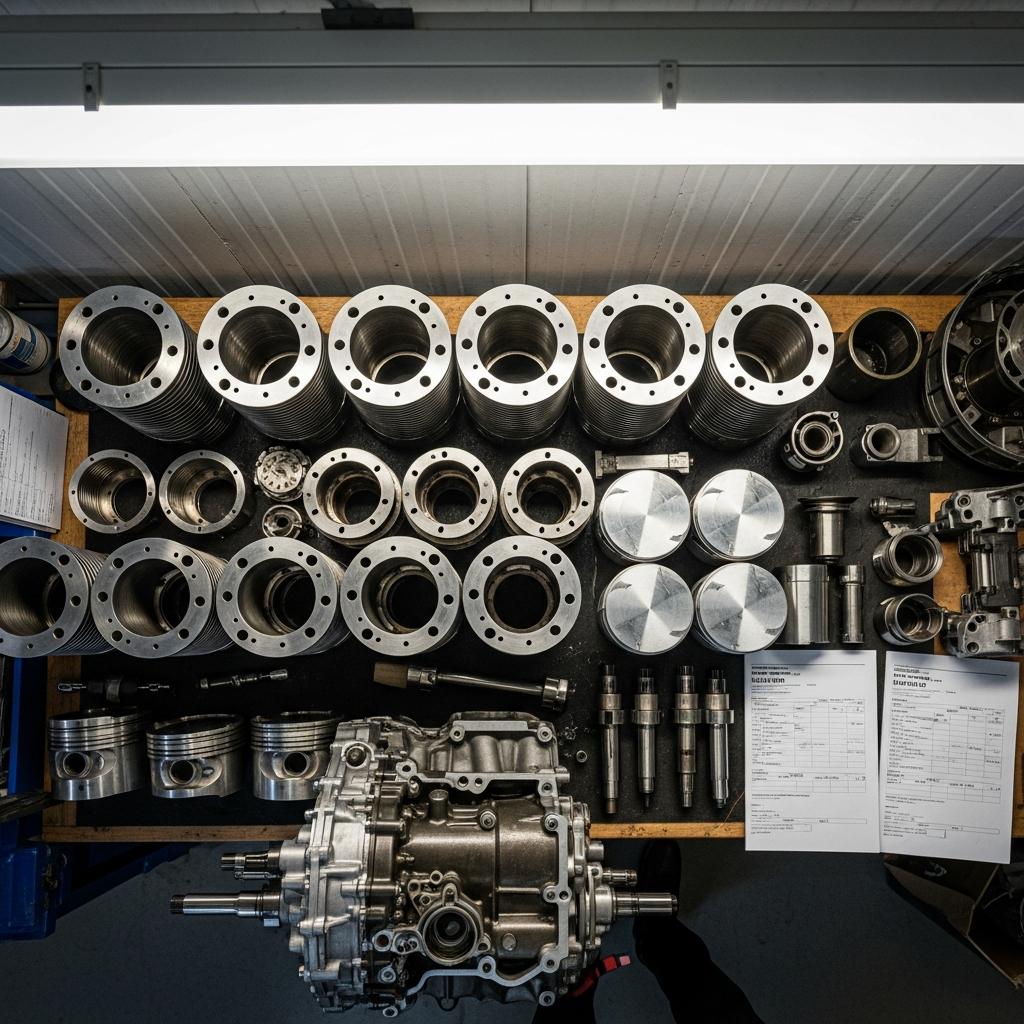
But what is a factory reman, exactly? In essence, it’s Lycoming taking your core engine, stripping it completely, inspecting every part against new tolerances, replacing anything worn with new components, and handing you back a zero-time engine in an old shell. But it’s much more than that — your TBO resets, your warranty clock starts fresh, and you get five years or 500 hours of coverage, whichever arrives first.
The catch is always the number at the bottom. A Thunderbolt reman through an authorized Lycoming dealer runs $22,000 to $28,000 before shipping — figure another $400 to $800 depending on distance. Then your mechanic still has to pull the old engine and hang the new one. Most reputable shops bill $20 to $30 per flat-rate labor hour. Removal and installation typically eats 25 to 35 hours, longer if the engine mount needs replacing or someone finds corrosion in a bad spot. That’s another $3,000 to $4,500 before you’ve touched accessories.
Total for a factory reman, realistically: $25,000 to $33,000. And that’s before the accessory pile starts growing.
A field overhaul works differently. Your shop pulls the engine, tears it down on the bench, runs magnetic particle inspection on the crankcase looking for cracks, replaces piston rings, relinishes cylinders where needed, and puts everything back together. Quality is everything here — a shop with a real test cell and a reputation built over 20 years charges $12,000 to $18,000 for the engine work. Someone running cut-rate overhauls out of a shared hangar will absolutely charge you less and absolutely cost you more later.
The field overhaul gamble: your engine doesn’t go back to zero time. Logbooks show “Overhauled,” but accumulated hours remain. That matters for resale value and occasionally for insurance renewals. Worse, if the shop finds cracked cylinders mid-teardown — and sometimes they do — the bill jumps fast. Each cylinder replacement adds $800 to $1,200. Crankshaft regrind? Another $2,000 to $4,000. You don’t know what you’re getting into until you’re already in it.
Field overhaul with labor, removal and installation: $17,000 to $25,000. Higher if metallurgy surprises you.
An exchange engine is the middle path. You ship your core, the shop sends back a freshly overhauled engine from existing stock. Turnaround is often days instead of months — that’s what makes exchange engines endearing to us owners who can’t afford weeks of downtime. Cost runs $16,000 to $24,000 depending on the vendor and the spec. Warranty is usually 12 months on parts and labor.
The trade-off: you’re accepting someone else’s overhaul on an engine with an unknown history. That’s a real thing to sit with. But if your mechanic estimates eight weeks to overhaul your core and you need to fly in four, exchange engines solve problems that nothing else does.
Hidden Costs That Blow Up Your Budget
Probably should have opened with this section, honestly. This is where owners consistently get blindsided — not by the engine work itself, but by everything that needs to happen alongside it.
- Magneto overhaul — $400 to $600 per mag, and you have two. They fire your spark plugs. If they’re original or have significant time on them, overhauling them during engine work isn’t optional. It’s just smart.
- Carburetor overhaul — $300 to $500. Fuel varnish attacks metering pins and jet seats. Skip this and you’re gambling on rough running or lean-condition surprises at the worst possible moment.
- Starter overhaul or replacement — $400 to $800. Overhauled cores cost less than new units. Either way, a 15-year-old starter doesn’t owe you anything.
- Alternator overhaul or replacement — $500 to $1,000. Same logic applies. I’m apparently hard on electrical components — Plane Power alternators work for me while rebuilt Prestolites never seem to last past two years. Your experience may vary, but don’t skip this one.
- Propeller overhaul — $1,200 to $2,000. If you’re already into the engine, the prop is right there. One FAA airworthiness inspector I spoke with recommended overhauling props on the same cycle as engines. Many shops bundle it as a package. Worth asking.
- Engine mount inspection and replacement — $800 to $2,000 if the mounts are shot. They often are. Rubber deteriorates, cracks spread, and you can’t see it until someone looks.
- Baffling replacement — $400 to $800. Old baffles get brittle and crack. They exist to keep cooling air exactly where it needs to be. While you’re in there, just replace them.
- All new hoses, clamps, and fasteners — $600 to $1,200. Old rubber fails. New hoses protect a freshly overhauled engine from becoming a very expensive fire risk.
- Test cell run and data logging — $500 to $1,000. Reputable shops run the overhauled engine at full power for 30 to 60 minutes before release. This catches break-in problems before you’re at 8,500 feet over a mountain range.
Add those up. Best case: $4,500 in accessory costs. Realistic case: $6,000 to $8,000.
Your $18,000 field overhaul just became $24,000 to $26,000. Your $22,000 factory reman is now $27,000 to $30,000 once everything gets factored in. So, without further ado, let’s talk about when you actually need to do any of this.
When to Overhaul and When to Run It Past TBO
TBO for an O-320 is 2,000 hours. A lot of owners treat that number like a legal hard stop. It isn’t. An engine can fly legally past TBO as long as it remains airworthy. That’s the actual standard.
The Hobbs meter is not your primary decision tool. Compression is. Metal in the oil is. Cylinder differential trends are.
Start running compression checks every 100 hours once you pass 1,800. A healthy O-320 holds 70 psi per cylinder — treat 60 as your floor. Four cylinders sitting at 65 to 68? You probably have another 200 hours. One cylinder at 55 while the others hold at 70? That cylinder is deteriorating and will fail. Pull it now rather than later.
Oil analysis is the closest thing to a crystal ball this side of a borescope. Blackstone Labs charges around $30 per sample. They’ll report back the PPM of iron, chromium, aluminum, and lead in your oil. Trending matters more than any single number — a sudden iron spike means something is wearing faster than it was last quarter. That’s your warning.
One thing nobody talks about enough: low-utilization engines often reach overhaul time before high-time ones. An O-320 that flew 40 hours a year for 25 years has absorbed more thermal stress and corrosion exposure than one that flew 80 hours a year over the same period. Temperature cycling is brutal on engines that sit cold for weeks at a time. That was 1996 thinking when it wasn’t discussed openly. Now we know better. Plan accordingly.
How to Find a Shop and What to Ask Them
Start with your local AOPA chapter or a Cessna 172 type club — the community is enormous, find one. Ask specifically for shops that specialize in Lycoming engines. A generalist A&P mechanic is not the same thing as a shop that has been tearing down O-320s for 30 years. There is a meaningful difference in what they’ll catch during a teardown.
When you call a shop, ask these questions directly:
- What exactly is included in your quoted price?
- What happens if you find cylinder damage during teardown?
- Do you offer a warranty, and what does it actually cover?
- Will you run a test cell check before releasing the engine?
- Do you provide an itemized invoice or a flat fee?
- What’s your realistic turnaround time right now?
Get at least two quotes. The lowest number is almost never the right answer. The shop that sends you a three-page itemized breakdown and walks you through their reasoning? That’s your shop. The one that says “trust me, we do these all the time” and hands you a single number on a Post-it? Walk away.
When you add it all together — engine work, accessories, labor, test cell, shipping, and a contingency buffer for what the teardown reveals — a complete, properly executed Cessna 172 engine overhaul runs somewhere between $23,000 and $32,000 in the real world. Some will cost more when cracks or corrosion show up mid-job. Some will come in under that if the core turns out cleaner than expected.
Budget the high end. Start the timeline earlier than you think you need to. Get references from actual aircraft owners, not just the shop’s website. Your engine is the heartbeat of the airplane. Treat it that way.
Stay in the loop
Get the latest aircraft insider updates delivered to your inbox.