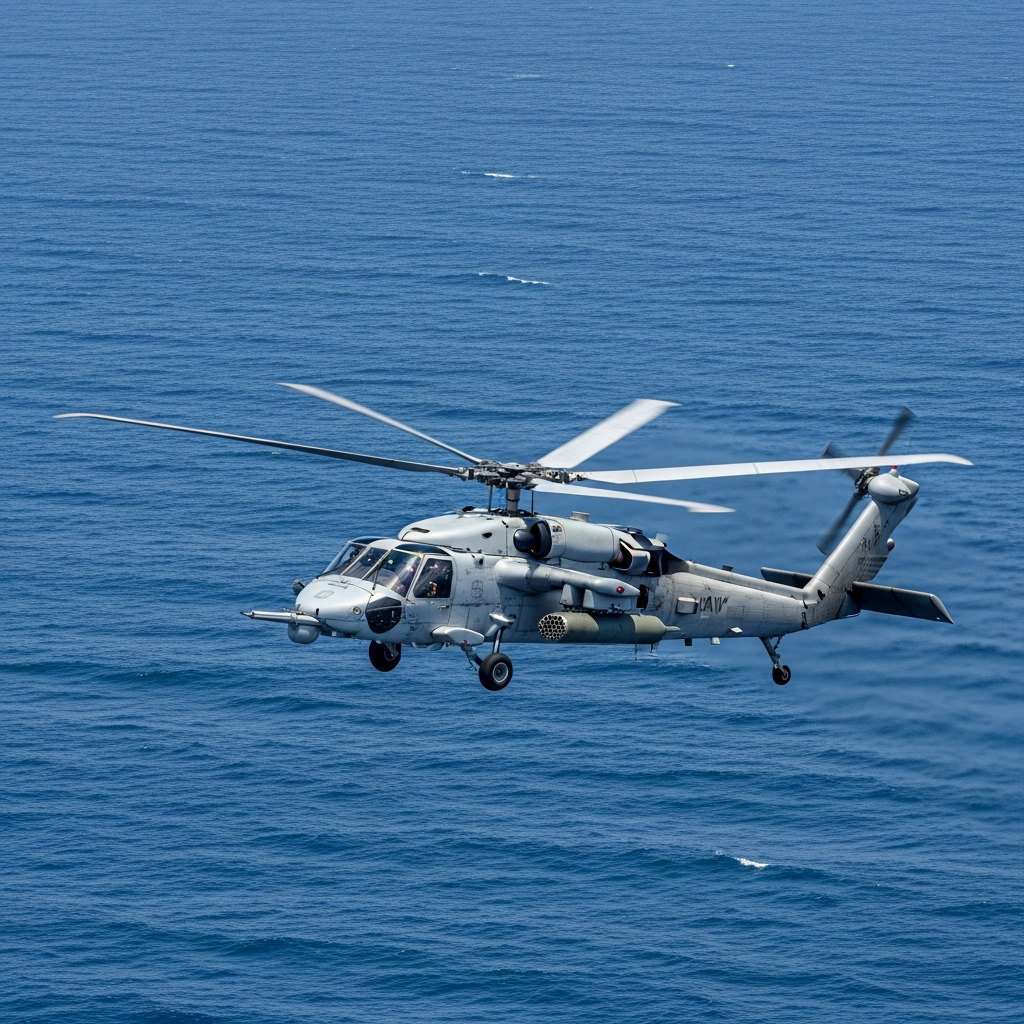
U.S. Navy MH-60S Sea Hawk and U.S. Army AH-64 Apache helicopters sank six Iranian small attack boats in the Strait of Hormuz on the morning of May 4, 2026. The IRGC craft had moved against commercial shipping the U.S. pledged to protect under what the Trump administration called “Project Freedom.” (President Trump separately estimated seven boats were sunk — one more than CENTCOM’s official figure.)
U.S. Central Command confirmed the engagement at a press conference that afternoon. CENTCOM Commander Admiral Brad Cooper — who had personally flown over the strait in an Apache the day before — described a multi-wave Iranian assault: cruise missiles, one-way attack drones, and six fast-attack boats. All were defeated.
“We have an enormous amount of capability and firepower concentrated in and around the strait, including AH-64 Apache and MH-60 Seahawk helicopters used just this morning to eliminate six Iranian small boats threatening commercial shipping.”
— Adm. Brad Cooper, CENTCOM Commander, May 4, 2026
“We had drone launches against commercial ships, all of which were defended against, consistent with our commitment, and then the small boats were all going against commercial ships, and all were sunk by Apaches and Seahawk helicopters.”
— Adm. Brad Cooper
Cooper declined to specify what munitions the helicopters used, saying only they “were very effective.” No tail numbers, squadron designations, or basing locations were disclosed — Cooper did not say where the Apaches or Seahawks were based during the May 4 mission. The MH-60S is a capability already on the record for destroyer-based operations in the region: weeks earlier, on March 27, a Seahawk armed with Hellfire missiles was photographed launching from the Arleigh Burke-class destroyer USS Pinckney in the Middle East.
Aircraft Built for This Fight
The pairing makes tactical sense. The Army’s Apache — almost certainly the AH-64E variant deployed in the CENTCOM area of responsibility — carries the M230 30mm chain gun, capable of 650 rounds per minute, alongside up to 16 AGM-114 Hellfire missiles and Longbow millimeter-wave radar for fire-and-forget engagement of surface targets. It is worth noting that when General Dan Caine announced Apache deployments to the region on March 19, their assigned role was handling one-way attack drones — not fast-attack watercraft, a role that had been associated with A-10s. Against a small boat running at 50 knots in narrow waters, the combination of helmet-mounted targeting, FLIR, and a hard-hitting direct-fire weapon is exactly what the engagement profile demands.
The MH-60S Sierra is the Navy’s surface warfare and combat support variant — built to operate from destroyer and carrier decks in precisely this kind of maritime environment. Folding rotor blades, corrosion-resistant materials, and an advanced radar and infrared sensor suite make it well-suited to identifying and engaging fast movers in confined, high-traffic waterways. Depending on mission configuration, it can carry Hellfires and crew-served machine guns, serving as both a persistent patrol asset and a lethal responder.
The Broader Engagement
The boat engagement was one piece of a larger Iranian assault. Cooper confirmed the IRGC had launched cruise missiles and drones at ships over the preceding 12 hours, targeting commercial vessels and U.S. Navy warships — though Cooper specified the missiles were aimed at “both U.S. Navy ships, but mostly after commercial shipping.” All threats were defeated. Earlier that same day, the South Korean container ship HMM Namu suffered an explosion and fire while anchored off the UAE — 24 crew members were aboard, no casualties were reported — an incident that underscored the exact threat environment Project Freedom was designed to address.
The defensive umbrella Cooper described extends well beyond helicopters. CENTCOM has concentrated ballistic missile defense-capable destroyers, two carrier strike groups, an amphibious readiness group, and over 100 land- and sea-based aircraft in and around the strait — A-10s, F-15s, F-16s, F-18s, F-35s, and EA-18G Growlers — backed by 15,000 service members.
Iran denied the boat losses. A senior Iranian military official called Cooper’s account “a lie.” On May 5, Tehran separately accused U.S. forces of killing five civilian passengers in a helicopter strike — a claim CENTCOM had not publicly addressed at time of publication.
What Comes Next
President Trump announced on May 5–6 that Project Freedom would be paused, citing “great progress” toward a nuclear agreement with Iran. Whether that pause holds — and whether a ceasefire reportedly dating to April 8 can survive the events of May 4, its status having been uncertain enough that Cooper declined to confirm it remained in effect — will determine whether the helicopter engagement was a one-time deterrent action or the opening of a sustained rotary-wing campaign in one of the world’s most strategically critical waterways.
Stay in the loop
Get the latest aircraft insider updates delivered to your inbox.