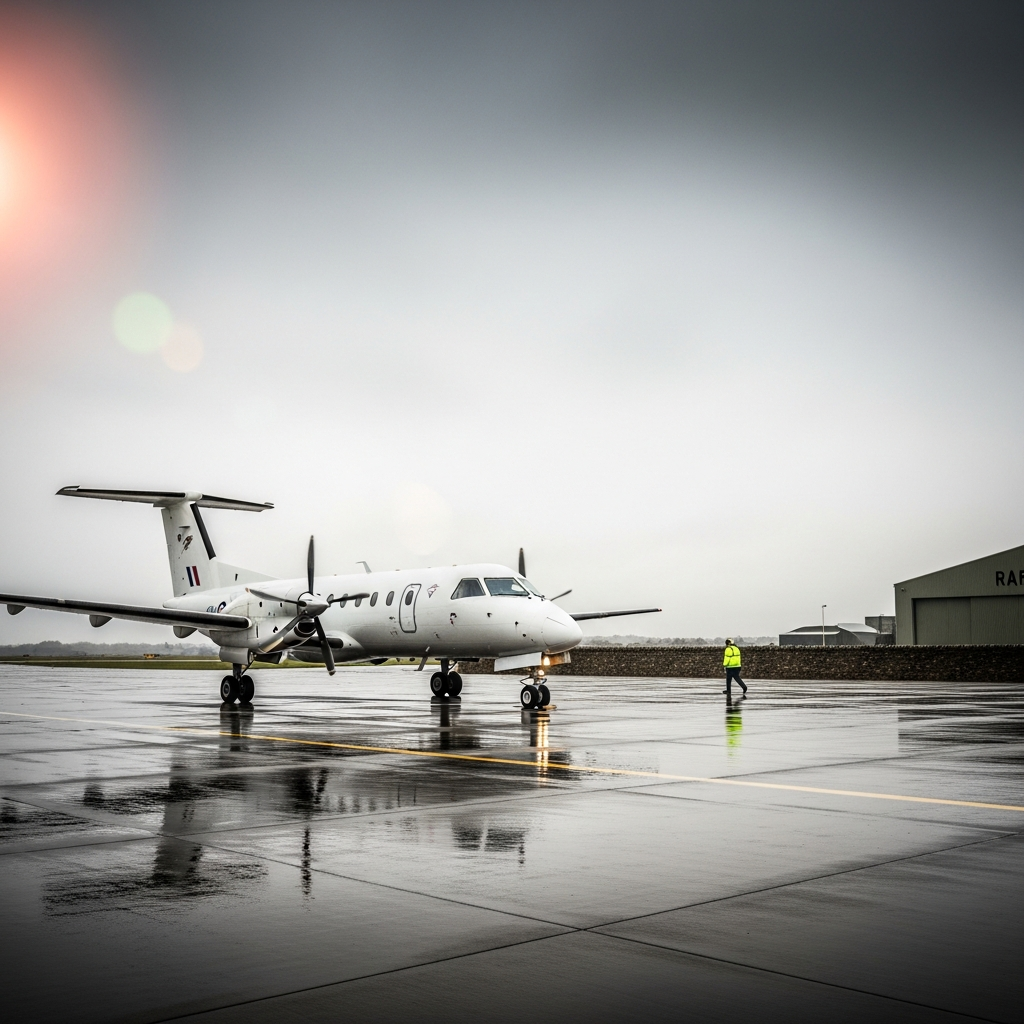
Loganair has made history as the first commercial airline in the UK to fly an all-electric aircraft on scheduled service. The Scottish carrier completed a 10-day proof-of-concept programme across Royal Mail routes—a significant milestone for regional electric aviation across Europe.
On 19 March 2026, Loganair operated BETA Technologies’ ALIA CX300 (registered N214BT) from Glasgow Airport to Dundee Airport. The 68-nautical-mile flight took 38 minutes, followed by a second leg to Inverness covering 85 nautical miles in 54 minutes. Over the next ten days, the all-electric aircraft completed 23 flights across the UK, with 18 Scottish legs connecting Glasgow, Dundee, Aberdeen, Inverness, Wick, and Kirkwall. In total, the aircraft covered 1,006 nautical miles in 11.2 flight hours—mirroring Royal Mail’s existing postal routes and averaging 56 miles per sector at 99 knots. The aircraft achieved energy efficiency of 1.37 kilowatt-hours per nautical mile.
The Aircraft—Built for Regional Routes
The ALIA CX300 takes a deliberate approach, avoiding vertical-takeoff complexity in favor of conventional runways. Powered by BETA’s H500A electric motor—delivering 572 horsepower and 1,000 pound-feet of torque—the aircraft can carry up to five passengers or 200 cubic feet of cargo. Its range reaches 336 nautical miles. The 225-kilowatt-hour battery system consists of five high-voltage packs and enables fast charging in 20 to 40 minutes using BETA’s mobile mini-cube charging units. These integrate with existing airport infrastructure and require only minor upgrades.
The economics make a compelling case. Loganair CEO Luke Farajallah stated that the CX300 could reduce operating costs by 80 percent compared to conventional regional aircraft. Real-world data backed this up: a 45-minute flight consumed just $7 worth of energy, compared to $160 for a helicopter over the same route—a 96 percent cost advantage. Operating costs of only $18 per flight hour fundamentally change the economics of maintaining air service to remote communities.
The near-silent electric propulsion system opens new operational possibilities. Flights can operate during early morning and late-night windows into noise-sensitive urban airports—a critical advantage for time-sensitive cargo like medical specimens and mail.
Why Scotland, Why Now
Scotland’s geography made it the perfect testing ground. More than 90 inhabited islands and Highland communities separated by hundreds of miles of terrain depend on air connectivity as critical infrastructure—terrain that road and rail simply cannot bridge. The region’s dense network of short-haul routes, typically under 100 miles, aligns precisely with today’s electric aircraft capabilities. As BETA’s Simon Newitt noted, “Scotland’s geography makes it one of the most compelling environments for electric aviation anywhere in the world.”
The programme brought together Loganair, Royal Mail, the UK Civil Aviation Authority, AGS Airports, and HIAL (Highlands and Islands Airports Limited). These flights validated aircraft performance, ground handling, charging operations, and integration into existing airport and airspace systems.
Commercial Commitment and Expansion
Success led to a formal Memorandum of Understanding in early April, followed by a term sheet announcement at the Farnborough International Airshow in July 2026. Loganair committed to purchasing five ALIA CX300 aircraft with options for five more, targeting service entry in 2029. This positions Loganair as Europe’s first commercial airline operating an electric fleet.
BETA’s timing aligns with regulatory momentum building in the UK. The UK CAA published its eVTOL Delivery Model framework on 25 September 2025, with ambitions for initial commercial passenger eVTOL flights by end-2028. FAA certification of the CX300 is targeted for the second half of 2027.
The Loganair-Royal Mail demonstration validates BETA’s broader operator ecosystem, which now includes UPS, United Therapeutics, Bristow Group, and the US Air Force under the Agility Prime initiative. In July 2026, BETA completed organ transport flights under the FAA’s eIPP programme between Virginia Tech/Montgomery Executive Airport in Blacksburg, Virginia; Charlottesville-Albemarle Airport in Charlottesville, Virginia; Frederick Municipal Airport in Frederick, Maryland; and Martin State Airport in Baltimore County, Maryland. These flights proved the regulatory and operational framework now supporting commercial cargo expansion.
Watch for FAA certification decisions and the first commercial revenue service entry, likely on thin routes connecting Scottish islands where electric economics provide decisive competitive advantage over conventional turboprops.
Stay in the loop
Get the latest aircraft insider updates delivered to your inbox.