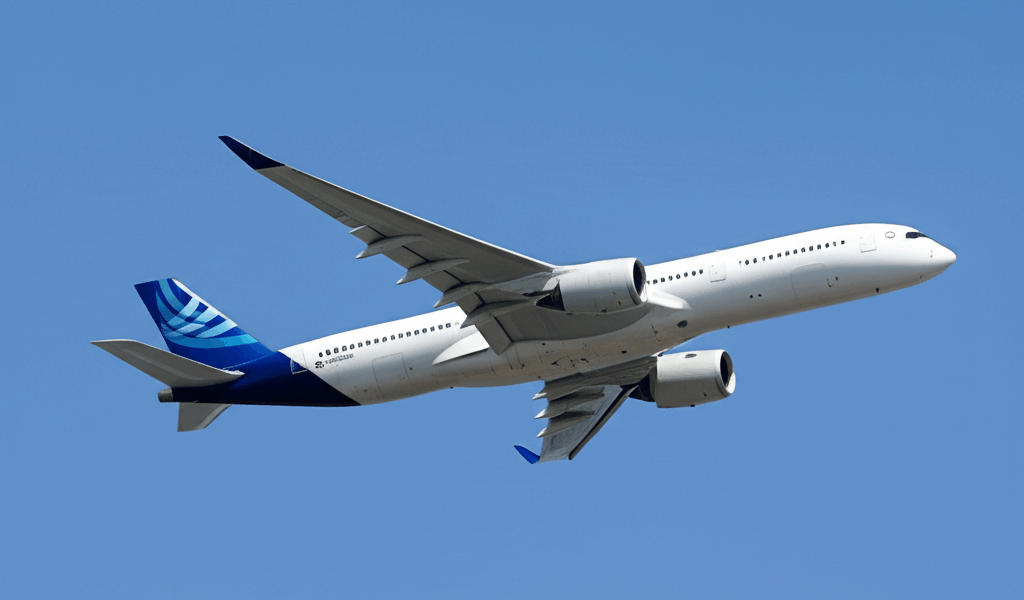
The Airbus A350-1000 doesn’t grab headlines the way its predecessor the A380 did. There’s no “superjumbo” marketing, no double-deck novelty, no celebrity rollouts. It’s just quietly becoming the widebody that serious airlines choose when they’re serious about long-haul economics.
That’s not an accident. And if you’ve flown on one recently, you understand why.
The Spec Sheet That Changes Routes
The A350-1000 carries 350-410 passengers depending on configuration, stretches 73.8 meters long, and burns roughly 25% less fuel than the aircraft it’s replacing. Airbus claims operational costs 25% lower than previous-generation competitors. Airlines flying the aircraft say those numbers hold up in practice—sometimes better.
But the number that matters most is 9,000 nautical miles. That’s the A350-1000’s standard range. The Ultra Long Range variant (A350-1000ULR) stretches that to 9,700 nautical miles with an additional fuel tank.
In practical terms: Doha to Auckland nonstop. Singapore to New York. Sydney to London without a fuel stop. Routes that were theoretical a decade ago are now scheduled service.
Who’s Flying What
Qatar Airways operates 24 A350-1000s, using them on the Doha-Auckland route that regularly exceeds 17 hours. Cathay Pacific, British Airways, and Virgin Atlantic have built their long-haul strategies around the type. Singapore Airlines leads the overall A350 family with 65 aircraft.
The order book tells the story. As of late 2025, the A350 family has 1,529 firm orders from 66 customers. Turkish Airlines leads with 110 orders. China Airlines just ordered 15 A350-1000s. EVA Air has 24 on order. Riyadh Air committed to 25 at the Paris Air Show, with options for 25 more.
And then there’s STARLUX, the Taiwanese carrier that just took delivery of its first A350-1000 in January 2026, becoming the 11th global operator of the type. It joins their existing fleet of 10 A350-900s for premium services to Europe and North America.
The American Absence (About to End)
Here’s a surprising gap: no U.S. carrier currently operates the A350-1000. Delta flies the smaller A350-900 and ordered the -1000, but hasn’t put it into service yet.
That changes in 2026. Delta plans to debut the A350-1000 on commercial service this year, finally bringing the type to American skies. The question isn’t whether it’ll perform—it will—but why it took this long.
The answer involves Boeing loyalty, fleet commonality decisions, and the 787’s strong position with U.S. carriers. But as Boeing’s delivery issues have dragged on and airlines have reassessed their widebody strategies, the A350-1000 has become harder to ignore.
Why It Beats the 777 (On Paper and In Practice)
The Boeing 777-300ER has been the long-haul workhorse for two decades. It’s a fantastic aircraft. But it’s also a generation behind the A350-1000 in efficiency.
That 25% fuel burn advantage isn’t marketing fluff. It’s composite fuselage construction, Rolls-Royce Trent XWB engines, and aerodynamic refinements that add up on 15-hour sectors. When jet fuel costs $3 per gallon and you’re burning tens of thousands of gallons per flight, small percentages become big money.
Passenger experience matters too. The A350’s cabin altitude equivalent sits around 6,000 feet versus 8,000 feet on older designs. Lower cabin altitude means less fatigue, fewer headaches, better hydration. On ultra-long routes, passengers actually feel the difference.
The 777X was supposed to answer this. It still might. But Boeing’s delays have handed Airbus a multi-year window where the A350-1000 is simply the best large widebody you can buy.
The Reliability That Operations Love
Within two years of entering service, the A350 achieved 99.5% operational reliability. That number sounds abstract until you consider what it means: flights that leave on time, passengers that don’t get stranded, maintenance schedules that don’t derail network plans.
Airlines obsess over dispatch reliability because it cascades through everything. A delayed aircraft delays crews, disrupts connections, burns money in passenger accommodation and rebooking. The A350’s ability to stay on schedule isn’t glamorous, but it’s why operations directors love the type.
What the Order Books Tell Us
Air France-KLM just ordered 50 A350s (mix of -900 and -1000) with deliveries starting in 2026. This is a group that has operated everything Airbus makes. They’re betting their long-haul renewal on the A350 family.
In November 2025, Airbus and Qantas revealed the A350-1000ULR, the ultra-long-range variant that Qantas will use for Project Sunrise—nonstop Sydney-to-London service. It’s the longest commercial route ever attempted on a scheduled basis. They’re not flying it on a 787 or a 777. They chose the A350-1000.
That endorsement speaks louder than any marketing presentation.
Production Reality Check
Airbus can’t build these things fast enough. They’re ramping toward 9 A350s per month by the end of 2025, aiming for 12 monthly by 2028. Pre-pandemic they were building 10. The order book is deep enough that customers placing orders now are looking at deliveries in the late 2020s.
This is simultaneously great news for Airbus shareholders and frustrating news for airlines trying to renew fleets. If you want A350-1000s, you’re getting in line behind Riyadh Air, STARLUX, China Airlines, and everyone else who figured this out already.
The Quiet Takeover
The A350-1000 will never have the A380’s emotional resonance. Nobody takes selfies in front of it at airports. Plane spotters don’t travel specifically to catch one.
But twenty years from now, when aviation historians look at which aircraft defined long-haul travel in the 2020s and 2030s, the A350-1000 will be the obvious answer. Not because it was revolutionary or flashy, but because it was exactly what the market needed at exactly the right time.
Sometimes the most successful products are the ones that simply do everything better, without drama, without fanfare, without problems.
The A350-1000 does everything better.




Leave a Reply