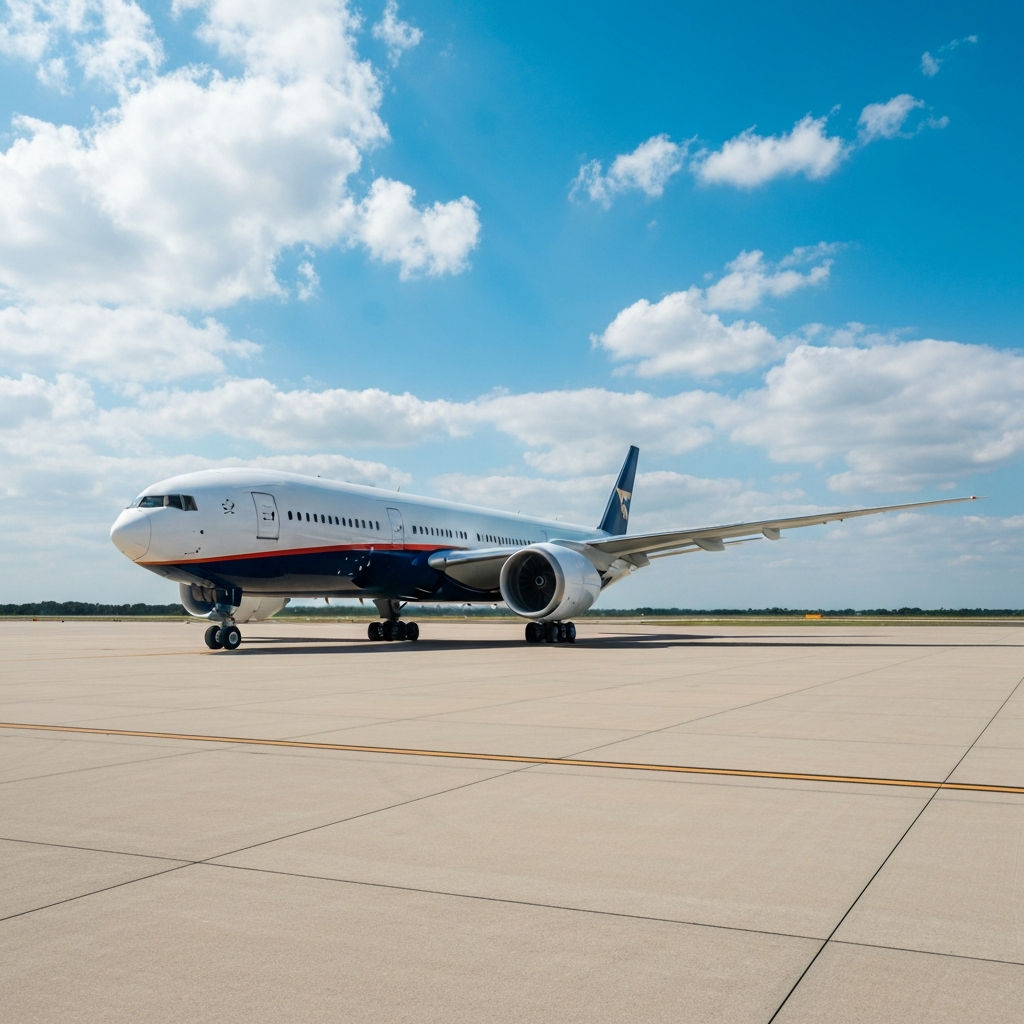
Boeing’s 777-9 just cleared a major FAA milestone. The achievement unlocks the largest remaining block of flight testing and puts the aircraft on track for early 2027 certification and early 2027 first deliveries—a timeline that has slipped repeatedly since the program’s 2013 launch.
The FAA issued Type Inspection Authorization (TIA) Phase 4B approval in early June 2026. Stephanie Pope, president and CEO of Boeing Commercial Airplanes, announced the authorization on June 6 while attending the IATA Annual General Meeting in Rio de Janeiro. She called Phase 4B “one of the biggest pieces remaining” for Boeing to execute before certification.
“This authorization unlocks the largest remaining portion of our flight test with the FAA that we can now go execute,” Pope told aviation media on June 6. “4B is a significantly larger piece, focusing on systems like avionics, stability and control testing, and human factors assessments.”
What Phase 4B Demands
Phase 4B is one of the most rigorous certification stages in aviation. Earlier test phases isolated individual systems, but Phase 4B is different—FAA personnel directly participate in and validate the 777-9’s safety systems, emergency checklists, and non-normal operations across the fully integrated aircraft. The phase covers avionics evaluations, stability and control testing, and comprehensive human-factors assessments. It’s the kind of real-world validation that precedes ETOPS (extended-range twin-engine operational performance standards) approval.
The 777-9 stretches 76.7 meters (251 feet 9 inches)—the longest twin-engine commercial aircraft ever built. Its all-composite wings feature hydraulically folding wingtips that retract to 64.8 meters, allowing the aircraft to fit within ICAO aerodrome code E despite its size. Two General Electric GE9X-105B1A turbofans power the jet, each producing approximately 105,000 pounds of thrust. The aircraft will carry up to 426 passengers in a three-class configuration with a range exceeding 7,285 nautical miles.
The Road to Phase 4B
Boeing achieved TIA Phase 4A clearance on March 17, 2026—the first gate to final certification testing. Phase 4B now removes the next regulatory barrier. Boeing’s test fleet—currently five aircraft including Lufthansa’s first production-standard airframe, which first flew in May 2026—continues intensive flight validation.
The program has experienced serious delays. Engine compressor anomalies pushed the first flight from June 2019 to January 25, 2020. A cracked thrust link discovered on a test aircraft in August 2024 grounded the fleet for five months. In October 2025, Boeing recorded a US$4.9 billion pre-tax charge and pushed first delivery from 2026 into 2027.
Boeing CEO Kelly Ortberg told investors on May 27 that the company expects to complete most of the flight-test program by year-end 2026, with ETOPS testing extending into 2027. FAA Administrator Huerta suggested in late May that 777X certification would follow completion of the 737 MAX-7 and MAX-10 work, likely placing certification into early 2027.
Launch Customer Confidence
Lufthansa, the 777-9’s launch customer with 20 aircraft on order, has signaled readiness. CEO Carsten Spohr stated in March 2026 that discussions with Boeing indicate the first aircraft should arrive in the first quarter of 2027—a timeline consistent with Boeing’s public commitments.
Cathay Pacific, another major 777-9 operator, acknowledged June 7 that its own delivery schedule now targets end-of-2027, pending certification completion. The extended timeline has pushed the 777X program toward 13–14 years from formal launch to commercial service entry—significantly longer than the Boeing 787 (7.5 years) or Airbus A380 (under 7 years).
Phase 5 and ETOPS validation remain on the critical path. Boeing’s flight-test cadence and the FAA’s certification timeline will shape the program’s final gates.
Stay in the loop
Get the latest aircraft insider updates delivered to your inbox.