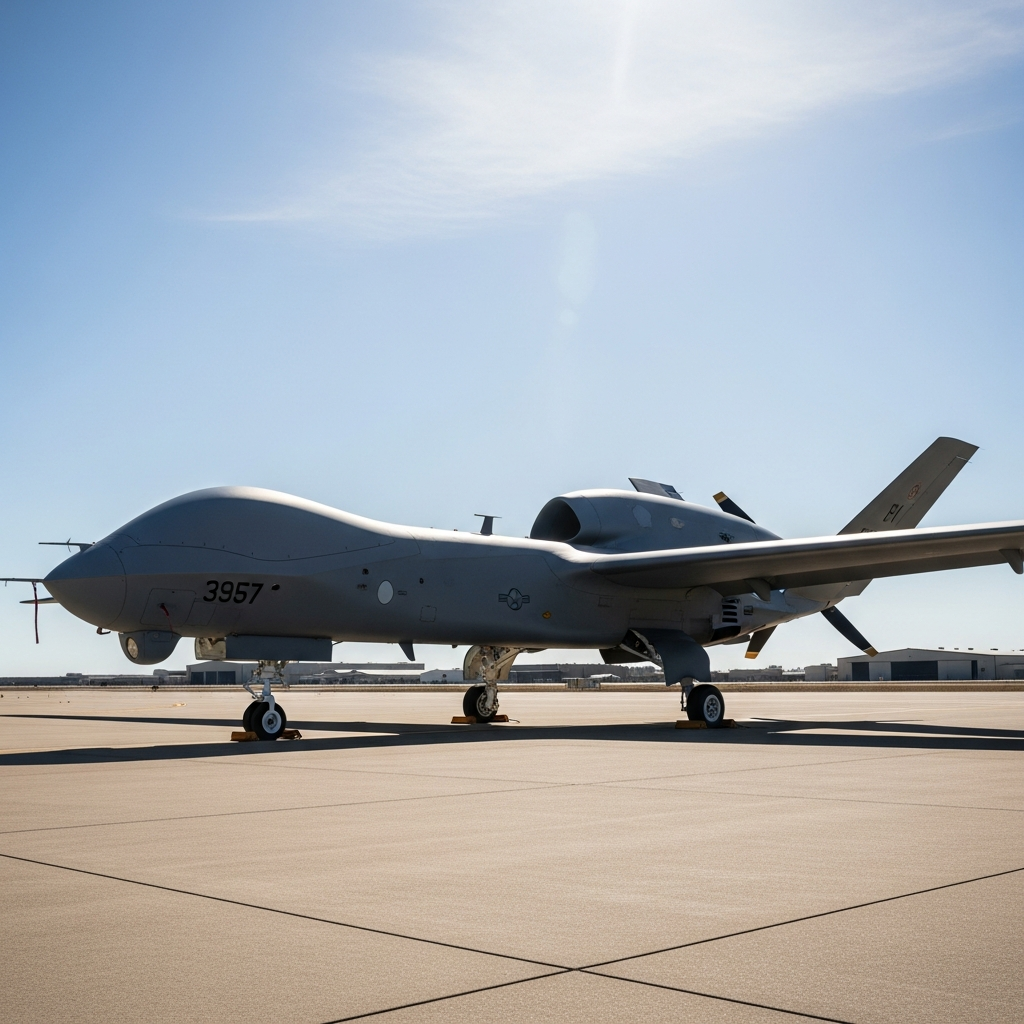
Boeing’s MQ-28 Ghost Bat touched down at Farnborough this week—and it’s a big deal. The unmanned aircraft marked the first time a collaborative combat aircraft (CCA) has ever been integrated into a multinational joint operational exercise, a watershed moment for autonomous warfare.
Just six weeks earlier, the Ghost Bat was flying alongside F-35A, F-35B, F-15EX, HC-130, E-3, and E-2D platforms during Exercise Valiant Shield 2026 in the Pacific. Now at Farnborough, Boeing’s showing it off to the world. The message is clear: this aircraft is ready. It can extend sortie range, add sensor coverage, and multiply firepower without risking a single pilot’s life.
“MQ-28 Ghost Bat is the most proven, mature CCA in allied nations and this latest demonstration highlights our readiness to bring this Australian-developed capability to global air forces,” said Amy List, Vice President and Managing Director of Boeing Defence Australia, at Farnborough on July 20-24.
From Valiant Shield to International Showcase
During Exercise Valiant Shield 2026, a production-representative test aircraft conducted multiple sorties from Rota, Commonwealth of the Northern Mariana Islands between June 22 and July 1—and that’s where things got interesting.
The Ghost Bat participated in a Forward Arming and Refueling Point (FARP) operation. That might sound technical, but what it means is this: the aircraft operated alongside Air Force HC-130J Combat King II and HH-60W Jolly Green II combat search and rescue platforms in a proof-of-concept demonstration. No one had ever done this in a multinational environment before. It proved the Ghost Bat could operate in a distributed warfare concept where centralized logistics are no longer an option.
Pacific Air Forces officials called it a breakthrough. “By integrating our multinational allies and seamlessly executing complex maneuvers across every domain, we have proven our collective readiness to rapidly respond to any crisis,” they said.
Technical Maturity and International Partners
The Ghost Bat measures 11.7 meters long with a 7.3-meter wingspan. It weighs about 3,175 kilograms and flies at speeds up to Mach 0.9 with a range exceeding 2,000 nautical miles. A single commercial turbofan engine powers it. For sensors and avionics, Boeing tapped BAE Systems Australia and Saab AB. The airframe uses composite construction for low observability—achieved through shaping rather than radar-absorbent coatings.
On July 21, Boeing announced three new international partners: Leonardo, Eaton, and Hensoldt. Leonardo has worked with the Ghost Bat team for eight years on electronic systems and now officially joins as a partner. Eaton manufactures the payload launch system in both ITAR and non-ITAR variants. Hensoldt will handle market entry in Germany.
The Block 2 variant is in final assembly now, with first delivery expected by year-end 2026. It features improved open-architecture software, upgraded mission nose packages, and beyond-line-of-sight command and control. Block 3 is larger—a 25 percent airframe expansion with internal weapons bays that can carry AIM-120 AMRAAMs or GBU-39 Small Diameter Bombs, plus extended range.
What Comes Next
The Royal Australian Air Force wants operational service by 2028. Meanwhile, the U.S. Air Force is funding competitors too—General Atomics (FQ-42) and Anduril (FQ-44)—which keeps everyone honest. But the Ghost Bat has a head start: 150-plus test sorties and 20,000 hours of digital validation over five years. That track record counts.
Watch for international procurement announcements within 18 months. Allied nations will be watching closely as they weigh the Ghost Bat’s proven record against newer competitors entering the market.
Stay in the loop
Get the latest aircraft insider updates delivered to your inbox.