What Carb Ice Actually Feels Like When It Hits
Carburetor ice has gotten complicated with all the misinformation flying around — pilots either obsess over it in winter and forget it entirely by July, or they’ve never really felt it and don’t know what they’re looking for. I was descending into Oshkosh on a clear October afternoon, 58 degrees on the nose, when my 172 started running rough. Not sputtering. Rough. There’s a difference, and it matters.
The RPM needle was drifting down maybe 75 counts despite a steady throttle. My first thought wasn’t carburetor ice. My second thought wasn’t either. That’s honestly the whole problem.
Cessna 172 carburetor ice signs don’t feel like what you expect. You picture the engine quitting cold — dramatic, obvious, unmistakable. What you actually get is a gradual roughness. A slow RPM decay. An engine that won’t respond cleanly when you push the throttle. Sometimes it shows up during cruise. Sometimes it sneaks in during descent when your power is pulled back and your guard is completely down. Beautiful VFR days are the worst for this. You’re relaxed. You’re not thinking about ice.
Early stages feel like a bad mag check — uneven combustion, slight vibration, maybe a 50 to 100 RPM drop creeping lower over several minutes. More advanced carb ice feels like partial power loss. The engine’s still running, but it’s not listening. Pull the throttle back and things get worse. That’s the moment most pilots panic and yank the carb heat in — which is actually correct — even though the engine’s immediate response will feel like you’ve made everything worse. You haven’t. Don’t make my mistake of hesitating.
Weather Conditions That Put You at Risk
Here’s what gets pilots killed: assuming carb ice only happens in winter or inside a cloud. That’s wrong.
But what is carburetor ice, exactly? In essence, it’s ice crystals forming inside your carburetor throat when humid air passes through the venturi and temperature drops below freezing. But it’s much more than that — it’s a systemic restriction that chokes fuel flow and kills power without warning, in conditions most pilots would never flag as dangerous.
The FAA charts put peak carb ice probability between 0 and 20 degrees Celsius with high relative humidity. That afternoon into Oshkosh? Fourteen degrees Celsius at field elevation. No clouds. No rain. Humidity sitting around 70 percent. The venturi temperature drop pushed the carburetor throat well below freezing. It happens in those conditions — regularly.
Cessna 172 carbureted engines are particularly vulnerable. The fixed-main-jet design and the aggressive venturi cooling create ideal conditions when you’re running low power. Descents, slow cruise, extended holding — those are your highest-risk phases. Humidity above 50 percent combined with temperatures between freezing and about 50 degrees Fahrenheit is the sweet spot for ice formation. Not winter. Not storms. A nice October descent into a fly-in.
That’s what makes carb ice so endearing to us 172 pilots — it hides in plain sight. Respect the conditions, apply carb heat as habit, and stop waiting for weather that “looks” like ice weather.
How and When to Apply Carb Heat Correctly
So, without further ado, let’s dive in — because the mechanics here are simple and the timing is everything.
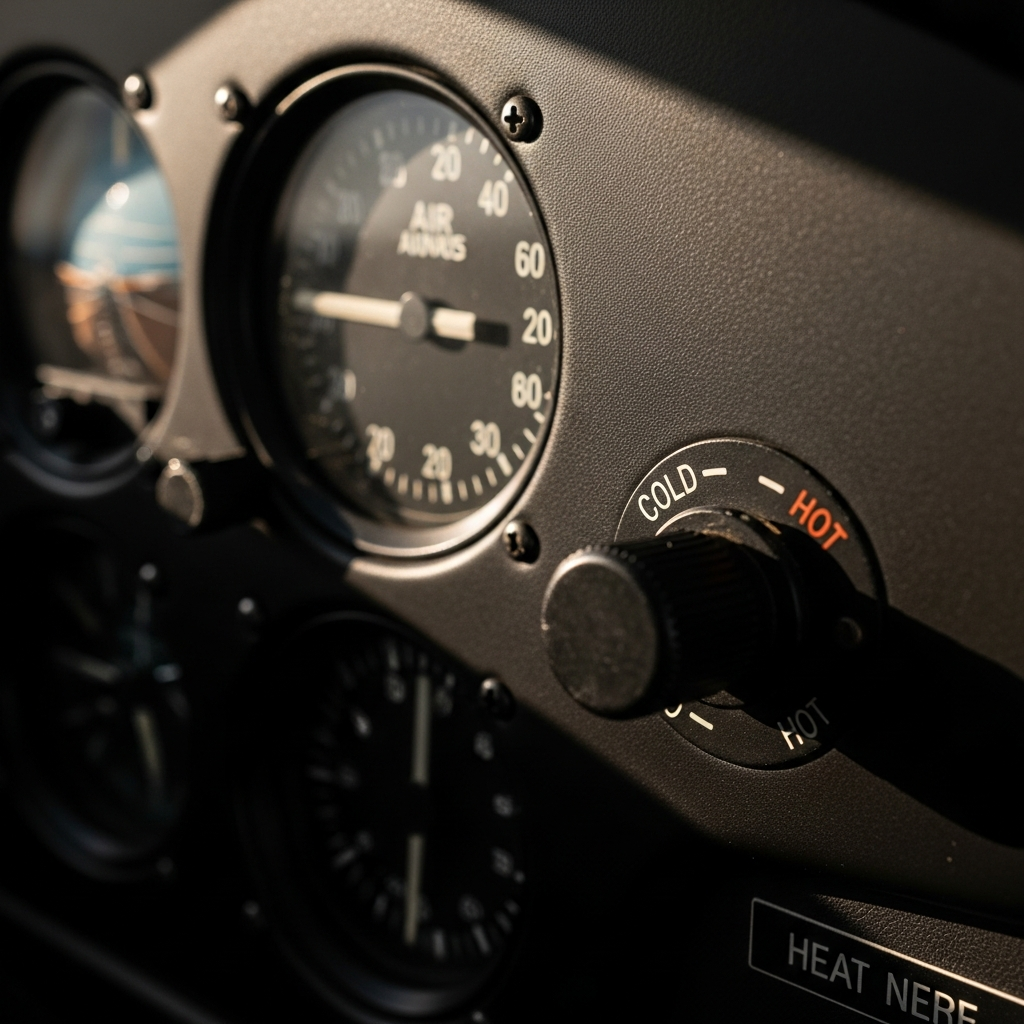
The red knob on your 172’s panel pulls out fully, rerouting intake air through a shroud around the exhaust manifold instead of pulling in cold outside air. That’s the whole system. Simple. What you do with it and when — that’s where pilots go wrong.
If you suspect carb ice, apply full carb heat immediately. Not halfway. Not gradually while you think it over. Full out. The engine will usually get rougher. RPM might drop another 50 to 75 counts. First time this happens, it feels catastrophic. It isn’t — it’s confirmation. Warm air is melting ice crystals and water is temporarily mixing with your fuel charge. Combustion gets messy for maybe 30 to 60 seconds. Then the engine clears, smooths out, and RPM climbs back to where it belongs.
Hold carb heat on for that full cycle. Don’t push it back in during the rough patch. You’re literally melting ice out of your engine intake. Let it finish.
Once things stabilize, the decision depends on where you are. Transitioning to higher power or climbing into warmer air? Carb heat can come back off. Still descending or running low power in marginal humidity? Leave it on. The 172 POH gets vague here because conditions vary, but the safest default is carb heat on during any descent or extended low-power operation when the outside air temperature sits below about 15 degrees Celsius and humidity is anything above moderate.
Probably should have opened with this section, honestly.
What to Do If the Engine Stumbles or Quits
Engine roughness is manageable. An engine that stumbles or loses meaningful power — that’s a different situation requiring immediate action in a specific order.
First: carb heat full on. All the way out. This is counterintuitive when the engine is already struggling, but a heavily ice-restricted carburetor creates significant power loss, not just roughness. Carb heat is your only direct tool here. Use it completely.
Second: pitch for best glide — 65 knots in a standard 172 — and identify a landing area below you. If you’re already descending, you’re halfway there. Maintain aircraft control first. Troubleshoot second. Every time.
Third: watch the clock. If the engine clears within 60 seconds of full carb heat, you had ice. If it doesn’t clear, you’re dealing with something else — fuel starvation, a fouled plug, magneto trouble — and you need to aviate while you work through your options.
The stumbling engine scares pilots into second-guessing carb heat. Don’t. Ice buildup restricts fuel flow and air charge simultaneously. Heat is your solution. Trust it and give it time to work — at least if the symptoms match the conditions that build ice in the first place.
Preflight and Habit Checks That Prevent Carb Ice Problems
Prevention is simpler than recovery. Way simpler.
During your runup — every runup, not just cold-weather runups — pull the carb heat knob fully out for about five seconds. You should see a clean RPM drop of 50 to 150 counts, then smooth recovery when you push it back in. If you get no drop at all, your carb heat system isn’t functioning and you need to figure out why before you leave the ramp. I’ve seen this overlooked on annual inspections — the shroud seal deteriorates and you lose heat delivery entirely without knowing it.
The habit matters more than the preflight check, though. Build carb heat into your descent checklist the same way you build in fuel selector and mixture. Descent begins, carb heat goes on. It stays on through the descent unless you’re in warm air or back at climb power. Climb-out — carb heat cold. Established cruise — carb heat cold. Descent begins again — carb heat on. Simple enough to execute under pressure.
I’m apparently pretty humidity-sensitive in terms of when I pull it, and early carb heat application works for me while waiting for symptoms never does. Don’t make my mistake — by the time you notice the roughness, ice has been building for several minutes already. Early application costs you nothing. Late application costs you the cycle of rough engine, passenger alarm, and a longer recovery before things smooth out.
The 172 carbureted engine is a reliable workhorse — genuinely tough, forgiving of a lot. But it follows the atmosphere’s rules whether you’re paying attention or not. Know what carb ice feels like. Know when to pull the heat. Build it into your scan until it’s automatic. That combination keeps your engine running on the days the conditions line up against you — and those days look nothing like what you picture when you imagine an ice problem.
Stay in the loop
Get the latest aircraft insider updates delivered to your inbox.